Magsaysay Award winner Sandeep Pandey booked for criticizing Savarkar

Agencies
January 22, 2020

Aligarh, Jan 22: An FIR has been lodged against social activist and Magsaysay Award winner Sandeep Pandey for his remarks on Savarkar.

Speaking to media, CO Civil Lines, Anil Samania said, "A complaint is lodged by Rajiv Kumar Ashish, national vice-president of All India Hindu Mahasabha against Magsaysay Award winner Sandeep Pandey in connection with indecent remarks on Veer Savarkar. An FIR is lodged based on this complaint under sections 153 and 505 of the Indian Penal Code (IPC)."

"An investigation is underway. Pandey came to the Aligarh Muslim University (AMU) where he made a speech in which he made the alleged indecent remarks," he added.

Comments

Keshu
 - 
Thursday, 23 Jan 2020

Veer Savarkar? LOL

come on CD...he is british boot licker

Add new comment

  • Coastaldigest.com reserves the right to delete or block any comments.
  • Coastaldigset.com is not responsible for its readers’ comments.
  • Comments that are abusive, incendiary or irrelevant are strictly prohibited.
  • Please use a genuine email ID and provide your name to avoid reject.
Agencies
August 3,2020

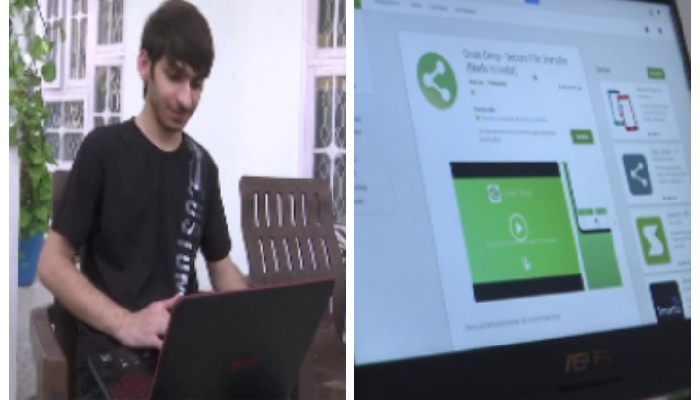
Rajouri, Aug 3: Ashfaq Mehmood Choudhary, a 17-year-old boy from Chattyear of Jammu and Kashmir's Rajouri district, has developed a file-sharing app 'Dodo Drop' which would enable users to share audios, videos, images, and texts between two devices without Internet access.

While speaking to media persons, Ashfaq Mehmood said that the 'Dodo Drop' application is an alternative to the Chinese 'SHAREit' app. "The Indian government has banned several Chinese apps due to data breaching, and among those apps was SHAREit which was used for sharing files.

Users faced a lot of problems due to the ban, and so I decided to make this file-sharing app. With 'Dodo Drop', users can share audios, videos, images, and even texts," he said.

Ashfaq said that it took him four weeks to develop the application, and it was launched on August 1 this year. The 'Dodo Drop' application has a transfer rate of up to 480 mbps, which is faster than the SHAREit app and is "quite easy" to use.

"Users can transfer data comprising photos, videos, audios, apps, texts, etc. between two devices with no Internet access. The transfers are fully encrypted and secure," he added.

"Our Prime Minister has always asserted the need for decreasing the dependency on foreign products and apps and to focus on the development of India-based apps. I tried to be part of the initiative of 'Aatmanirbhar Bharat' by developing an India-based file-sharing app. I want to develop global-standard apps for India," he added.

"We support and cooperate with him. He generates his own income by working on some projects and utilises it. We will continue to support him," said Parvez Ahmed Choudhary, Ashfaq's father.

In July, the Ministry of Electronics and Information Technology (MEITY) banned 47 apps, which were variants and cloned copies of the 59 apps banned earlier in June. These banned clones included SHAREit Lite, Tiktok Lite, Helo Lite, BIGO LIVE Lite, and VFY Lite.

The 59 apps had been banned by the Centre in June in view of the information available that they were engaged in activities which were "prejudicial to sovereignty and integrity and defence" of the country.

Almost all the apps banned had some preferential Chinese interest and the majority had parent Chinese companies.

The ban came amid border tensions with China in the Eastern Ladakh region.

Comments

Add new comment

  • Coastaldigest.com reserves the right to delete or block any comments.
  • Coastaldigset.com is not responsible for its readers’ comments.
  • Comments that are abusive, incendiary or irrelevant are strictly prohibited.
  • Please use a genuine email ID and provide your name to avoid reject.
News Network
March 3,2020

New Delhi, Mar 3: A day after two new cases of novel coronavirus that included one from Delhi were reported, the Health Ministry on Tuesday said six cases with "high-viral load" were detected during sample testing in Agra and these people have been kept in isolation. The six people had come in contact with a 45-year-old patient from Delhi, whose case came to light on Monday, and they include his family members.

According to government sources, the man, who is a resident of Mayur Vihar, had visited them in Agra.

The six have been kept in isolation at Safdarjung Hospital in Delhi and their samples are being sent to NIV, Pune for confirmation.

Contact tracing of the people who came in contact with the six is simultaneously being done through the Integrated Disease Surveillance Program (IDSP) network, the ministry said in a statement.

Sources said the patient from Mayur Vihar was shifted to a quarantine ward at Safdarjung Hospital on Sunday night.

His other family members have been asked to stay alert and look out for symptoms. One accountant, who came in contact with the man and some of his family members, was also quarantined, they said.

India on Monday reported two new cases of the novel coronavirus, one from Delhi and another one from Hyderabad. The government has stepped up its efforts to detect and check the infection which has killed 2,912 people in China.

On Monday, Rajasthan Health Minister Raghu Sharma had said that an Italian tourist tested positive for coronavirus in Jaipur.

The first sample collected from him on February 29 tested negative but his condition deteriorated, so a second sample was collected which tested positive on Monday, the minister said, adding, "Since there is a variation in the reports, the samples have been sent to the NIV, Pune for testing".

India had earlier reported three cases from Kerala, including two medical students from Wuhan in China, the epicentre of the deadly novel coronavirus. They had self-reported on their return to the country and tested positive for the infection. They were discharged from hospitals last month following recovery.

The infected person from Delhi had travelled to Italy, while the other patient who tested positive for the COVID-19 infection is from Telangana and had recently travelled to Dubai.

Both the patients had self-reported after they developed symptoms.

"They tested positive. They are stable and being closely monitored," ministry said on Monday.

The government has asked people to avoid non-essential travel to Iran, Italy, South Korea and Singapore and said India was in discussions with authorities in Iran and Italy, two countries badly affected by the infection, to evacuate Indians there.

The novel coronavirus or COVID-19, which originated in China, has spread to over 60 countries.

Comments

Add new comment

  • Coastaldigest.com reserves the right to delete or block any comments.
  • Coastaldigset.com is not responsible for its readers’ comments.
  • Comments that are abusive, incendiary or irrelevant are strictly prohibited.
  • Please use a genuine email ID and provide your name to avoid reject.
Agencies
June 15,2020

New Delhi, Jun 15: Average temperature of India experienced a rise of 0.7 degree Celsius, along with decline in rainfall, significant increase in frequency of very severe cyclonic storms and droughts in over a decade due to human activities, the Ministry of Earth Sciences in its research report said.

The contentions were made in a report issued by the ministry on the impact of climate change. It will be published by Union Minister Harsh Vardhan on June 19.

According to the report, "Since the middle of the twentieth century, India witnessed rise in temperature; decrease in monsoon; rise in extreme temperature and rainfall, droughts, and sea levels; and increase intensity of severe cyclones.

The report, prepared by researchers of the Centre for Climate Change Research, a cell under The Ministry's Indian Institute of Tropical Meteorology, Pune, further stated that there is compelling scientific evidence that human activities have influenced these changes in regional climate.

India's average temperature has risen by around 0.7 degrees Celsius during 1901-2018, it said, adding that the rise is largely on account of GHG-induced warming and partially offset by forcing due to anthropogenic aerosols.

It states that the average temperature over India is projected to rise by 4.4 degrees Celsius, while the intensity of heat waves is likely to increase by 3-4 times by the end of the century.

In the 30-year period between 1986 and 2015, temperatures of the warmest day and the coldest night of the year have risen by about 0.63 degrees Celsius and 0.4 degree Celsius.

According to the report, by the end of the century, the temperatures of the warmest day and the coldest night are projected to rise by approximately 4.7 degrees Celsius and 5.5 degrees Celsius, respectively.

Alarmingly, sea surface temperature of the tropical Indian Ocean has also risen by one degrees Celsius on average during 1951-2015.

"The frequency of very severe cyclonic storms during the post-monsoon season has increased significantly (+1 event per decade) during the last two decades (2000-2018)," it added.

This came in the backdrop of Cyclone 'Amphan' and 'Nisarga' which made landfalls on May 20 and June 3 and killed several people, flattened villages, and destroyed farms.

"This is the first-ever climate change assessment report for India. This report will be very useful for policy makers, researchers, social scientists, economists, and students," said M. Rajeevan, secretary, the Ministry of Earth Sciences.

Besides this, the report also highlighted various other unnerving data on climate change in the country. Both the frequency and extent of droughts have increased significantly during 1951-2016.

The overall decrease of seasonal "summer monsoon rainfall" during the last 6-7 decades has led to an increased propensity for droughts over India.

"In particular, areas over central India, southwest coast, southern peninsula and north-eastern India have experienced more than 2 droughts per decade, on average, during this period. The area affected by drought has also increased by 1.3 per cent per decade over the same period."

The Hindu Kush Himalayas (HKH) also experienced a temperature rise of about 1.3 degree Celsius during 1951-2014.

Several areas of the Himalayas have experienced a declining trend in snowfall and also retreat of glaciers in recent decades. By the end of the twenty-first century, its annual mean surface temperature is projected to increase by about 5.2 degree Celsius.

The summer monsoon precipitation from June to September over India has also declined by around 6 per cent from 1951 to 2015, with notable decreases over the Indo-Gangetic Plains and the Western Ghats, the report further states.


Comments

Add new comment

  • Coastaldigest.com reserves the right to delete or block any comments.
  • Coastaldigset.com is not responsible for its readers’ comments.
  • Comments that are abusive, incendiary or irrelevant are strictly prohibited.
  • Please use a genuine email ID and provide your name to avoid reject.