



Maharashtra: 180-kg cop undergoes surgery

[email protected] (Express News Service)
March 3, 2017

Mumbai, Mar 3: With his weight receiving national limelight courtesy a tweet by columnist Shobhaa De, inspector Daulataram Jogawat underwent a surgery Thursday to reduce his weight. Jogawat, of the Madhya Pradesh Police, weighs 180 kg. He arrived in the city on February 26 for medical check-ups and agreed to a bariatric surgery at South Mumbai’s Saifee Hospital. Dr Muffazal Lakdawala, bariatric surgeon and chairman of the Institute of Minimal Access Surgical Sciences & Research Centre at Saifee Hospital, performed the surgery along with his team. “He will probably be discharged on Friday,” Lakdawala told.
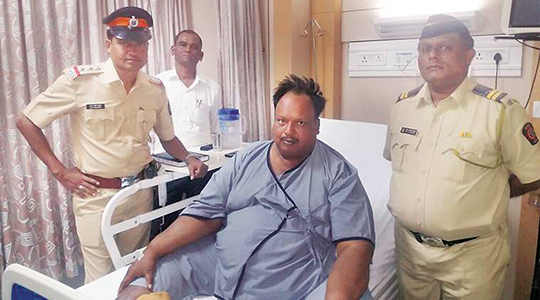
cop

Doctors have said the surgery will not cut all of Jogawat’s flab. The inspector is expected to lose at least 80 kg over the next 18 months without having to maintain any special diet.

De had tweeted Jogawat’s picture to mock the Mumbai Police’s “heavy bandobast” during the recent municipal elections, suggesting that the force needed to be healthier. While the Mumbai Police promptly pointed out that the man was not one of theirs, others noticed that the photo had been in circulation for the past three years, used to make a point about overweight policemen. The trail soon led to 57-year-old Jogawat, who is posted in Police Lines, Neemuch, in MP.

Originally from Rajasthan, Jogawat was born in Ratlam and joined the MP Police as a constable in 1979. Till the early 1990s, he said, he had been a fit man. But he started putting on weight after a gall bladder operation. The inspector also attributes his 180-kg weight to an insulin imbalance he suffers from.

Comments

Add new comment

  • Coastaldigest.com reserves the right to delete or block any comments.
  • Coastaldigset.com is not responsible for its readers’ comments.
  • Comments that are abusive, incendiary or irrelevant are strictly prohibited.
  • Please use a genuine email ID and provide your name to avoid reject.
News Network
February 26,2020

New York, Feb 26:  A new wearable sensor that works in conjunction with artificial intelligence (AI) technology could help doctors remotely detect critical changes in heart failure patients days before a health crisis occurs, says a study.

The researchers said the system could eventually help avert up to one in three heart failure readmissions in the weeks following initial discharge from the hospital and help patients sustain a better quality of life.

"This study shows that we can accurately predict the likelihood of hospitalisation for heart failure deterioration well before doctors and patients know that something is wrong," says the study's lead author Josef Stehlik from University of Utah in the US.

"Being able to readily detect changes in the heart sufficiently early will allow physicians to initiate prompt interventions that could prevent rehospitalisation and stave off worsening heart failure," Stehlik added.

According to the researchers, even if patients survive, they have poor functional capacity, poor exercise tolerance and low quality of life after hospitalisations.

"This patch, this new diagnostic tool, could potentially help us prevent hospitalizations and decline in patient status," Stehlik said.

For the findings, published in the journal Circulation: Heart Failure, the researchers followed 100 heart failure patients, average age 68, who were diagnosed and treated at four veterans administration (VA) hospitals in Utah, Texas, California, and Florida.

After discharge, participants wore an adhesive sensor patch on their chests 24 hours a day for up to three months.

The sensor monitored continuous electrocardiogram (ECG) and motion of each subject.

This information was transmitted from the sensor via Bluetooth to a smartphone and then passed on to an analytics platform, developed by PhysIQ, on a secure server, which derived heart rate, heart rhythm, respiratory rate, walking, sleep, body posture and other normal activities.

Using artificial intelligence, the analytics established a normal baseline for each patient. When the data deviated from normal, the platform generated an indication that the patient's heart failure was getting worse.

Overall, the system accurately predicted the impending need for hospitalization more than 80 per cent of the time.

On average, this prediction occurred 10.4 days before a readmission took place (median 6.5 days), the study said.

Comments

Add new comment

  • Coastaldigest.com reserves the right to delete or block any comments.
  • Coastaldigset.com is not responsible for its readers’ comments.
  • Comments that are abusive, incendiary or irrelevant are strictly prohibited.
  • Please use a genuine email ID and provide your name to avoid reject.
Agencies
March 16,2020

New Delhi, Mar 16: A recent survey across 140 districts of the country shows that about 54 per cent of Indians are finding travelling to be unsafe as the deadly coronavirus (COVID-19) pandemic sweeps globally.

The big worry that people have is community transmission, something that researchers from around the world have approximated at 10 per cent of total infections and more common in places like Wuhan in China, South Korea, Iran and Italy.

The months of March to June have historically been high travel season for most Indians, largely due to the summer vacations in schools. "But it seems that Indians do not want to take a chance with this rather scary virus and are either cancelling or postponing their travel plans," concluded the survey by LocalCircles.

The survey gathered more than 22,000 responses from participants in tier one, two and three cities. It said 48 per cent Indians plan to cancel their international business travel for the next four months.

Besides, nearly 38 per cent of respondents said they had to pay cancellation fee to the website, travel agent, airline or railways.

"These are testing times for the entire travel and tourism industry -- airlines, hotels, travel agents as well as small tour and taxi operators. The best solution at this point is to adjust cost structures, stay flexible and work with a collective approach to minimise the period of impact to both citizens and business," said LocalCircles.

Comments

Add new comment

  • Coastaldigest.com reserves the right to delete or block any comments.
  • Coastaldigset.com is not responsible for its readers’ comments.
  • Comments that are abusive, incendiary or irrelevant are strictly prohibited.
  • Please use a genuine email ID and provide your name to avoid reject.
News Network
February 4,2020

Boston, Feb 4: Practising yoga may increase levels of a messenger molecule involved in regulating brain activity, and completing one yoga class per week may maintain elevated levels of this chemical, according to a study which may lead to better ways of mitigating depressive symptoms.

The study, published in the Journal of Alternative and Complementary Medicine, assessed a group of 30 clinically depressed patients who were randomly divided into two groups.

According to the researchers, including those from Boston University in the US, both groups engaged in coherent breathing, and Iyengar yoga -- a form of hatha yoga, developed by B. K. S. Iyengar, emphasising on detail, precision, and alignment in the performance of yoga postures.

The only difference between the groups, the scientists said, was the number of 90 minute yoga sessions, and home sessions in which each group participated.

Over three months, they said, the high-dose group (HDG) was assigned three sessions per week, while the low-intensity group (LIG) engaged in two sessions per week.

The participants underwent magnetic resonance imaging (MRI) scans of their brain before the first and after the last yoga session, and also completed a clinical depression scale to monitor their symptoms, the study noted.

Results of the study revealed that both groups had improvement in depressive symptoms after three months.

Their MRI analysis showed that levels of the brain messenger molecule GABA were elevated after three months of yoga, as compared to the levels before starting yoga.

According to the study, this increase was found for approximately four days after the last yoga session, but the rise was no longer observed after about eight days.

"The study suggests that the associated increase in GABA levels after a yoga session are 'time-limited' similar to that of pharmacologic treatments such that completing one session of yoga per week may maintain elevated levels of GABA," explained study co-author Chris Streeter from Boston University.

Providing evidence-based data may help in getting more individuals to try yoga as a strategy for improving their health and well-being, the scientists said.

"A unique strength of this study is that pairing the yoga intervention with brain imaging provides important neurobiological insight as to the 'how' yoga may help to alleviate depression and anxiety," said study co-author Marisa Silveri from Harvard University.

In this study, we found that an important neurochemical, GABA, which is related to mood, anxiety, and sleep, is significantly increased in association with a yoga intervention," Silveri said.

Comments

Add new comment

  • Coastaldigest.com reserves the right to delete or block any comments.
  • Coastaldigset.com is not responsible for its readers’ comments.
  • Comments that are abusive, incendiary or irrelevant are strictly prohibited.
  • Please use a genuine email ID and provide your name to avoid reject.