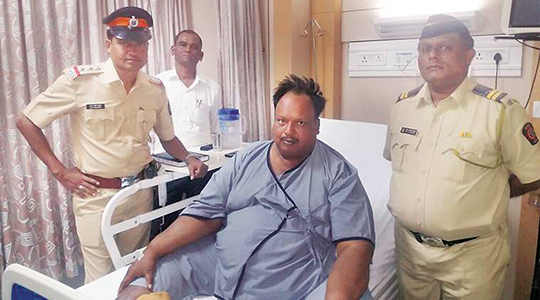
Maharashtra: 180-kg cop undergoes surgery

[email protected] (Express News Service)
March 3, 2017

Mumbai, Mar 3: With his weight receiving national limelight courtesy a tweet by columnist Shobhaa De, inspector Daulataram Jogawat underwent a surgery Thursday to reduce his weight. Jogawat, of the Madhya Pradesh Police, weighs 180 kg. He arrived in the city on February 26 for medical check-ups and agreed to a bariatric surgery at South Mumbai’s Saifee Hospital. Dr Muffazal Lakdawala, bariatric surgeon and chairman of the Institute of Minimal Access Surgical Sciences & Research Centre at Saifee Hospital, performed the surgery along with his team. “He will probably be discharged on Friday,” Lakdawala told.

cop

Doctors have said the surgery will not cut all of Jogawat’s flab. The inspector is expected to lose at least 80 kg over the next 18 months without having to maintain any special diet.

De had tweeted Jogawat’s picture to mock the Mumbai Police’s “heavy bandobast” during the recent municipal elections, suggesting that the force needed to be healthier. While the Mumbai Police promptly pointed out that the man was not one of theirs, others noticed that the photo had been in circulation for the past three years, used to make a point about overweight policemen. The trail soon led to 57-year-old Jogawat, who is posted in Police Lines, Neemuch, in MP.

Originally from Rajasthan, Jogawat was born in Ratlam and joined the MP Police as a constable in 1979. Till the early 1990s, he said, he had been a fit man. But he started putting on weight after a gall bladder operation. The inspector also attributes his 180-kg weight to an insulin imbalance he suffers from.

Comments

Add new comment

  • Coastaldigest.com reserves the right to delete or block any comments.
  • Coastaldigset.com is not responsible for its readers’ comments.
  • Comments that are abusive, incendiary or irrelevant are strictly prohibited.
  • Please use a genuine email ID and provide your name to avoid reject.
Agencies
July 8,2020

Scientists have designed a “catch and kill” air filter which they say can trap the novel coronavirus and neutralise it instantly, an invention that may reduce the spread of COVID-19 in closed spaces such as schools, hospitals and health care facilities, as well as public transit environments like airplanes.

According to the study, published in the journal Materials Today Physics, the device killed 99.8 per cent of the novel coronavirus, SARS-CoV-2, in a single pass through its filter. It said the device, made from commercially available nickel foam heated to 200 degrees Celsius, also killed 99.9 per cent of the spores of the deadly bacterium Bacillus anthracis which causes the anthrax disease.

“This filter could be useful in airports and in airplanes, in office buildings, schools, and cruise ships to stop the spread of COVID-19,” said Zhifeng Ren, a co-author of the study from the University of Houston (UH) in the US.

“Its ability to help control the spread of the virus could be very useful for society,” Ren added.

The researchers said they are also developing a desk-top model for the device which is capable of purifying the air in an office worker’s immediate surroundings. According to the scientists, since the virus can remain in the air for about three hours, a filter that could remove it quickly was a viable plan, and with businesses reopening across the world, they believe controlling the spread in air conditioned spaces was urgent.

The study noted that the novel coronavirus cannot survive temperatures above 70 degrees Celsius, so by making the filter temperature far hotter — about 200 degree Celsius, the researchers said they were able to kill the virus almost instantly.

Ren said the nickel foam met several key requirements. “It is porous, allowing the flow of air, and electrically conductive, which allowed it to be heated. It is also flexible,” the researchers noted in a statement.But they added that nickel foam also had low resistivity, making it difficult to raise the temperature high enough to quickly kill the virus.

The researchers said they solved this problem by folding the foam, connecting multiple compartments with electrical wires to increase the resistance high enough to raise the temperature as high as 250 degrees Celsius. By making the filter electrically heated, rather than heating it from an external source, they said the the amount of heat that escaped from the filter is minimised, allowing air conditioning to function with very low strain.

When the scientists built and tested a prototype for the relationship between voltage/current and temperature, they said it satisfies the requirements for conventional heating, ventilation, and air conditioning (HVAC) systems, and could kill the coronavirus.

“This novel biodefense indoor air protection technology offers the first-in-line prevention against environmentally mediated transmission of airborne SARS-CoV-2, and will be on the forefront of technologies available to combat the current pandemic and any future airborne biothreats in indoor environments,” said Faisal Cheema, another co-author of the study from UH.

The researchers have called for a phased roll-out of the device, “beginning with high-priority venues, where essential workers are at elevated risk of exposure.” They believe the novel device will both improve safety for frontline workers in essential industries and allow nonessential workers to return to public work spaces.

Comments

Add new comment

  • Coastaldigest.com reserves the right to delete or block any comments.
  • Coastaldigset.com is not responsible for its readers’ comments.
  • Comments that are abusive, incendiary or irrelevant are strictly prohibited.
  • Please use a genuine email ID and provide your name to avoid reject.
Agencies
March 15,2020

Should you let your babies "cry it out" or rush to their side? Researchers have found that leaving an infant to 'cry it out' from birth up to 18 months does not adversely affect their behaviour development or attachment.

The study, published in the Journal of Child Psychology and Psychiatry, found that an infant's development and attachment to their parents is not affected by being left to "cry it out" and can actually decrease the amount of crying and duration.

"Only two previous studies nearly 50 or 20 years ago had investigated whether letting babies 'cry it out' affects babies' development. Our study documents contemporary parenting in the UK and the different approaches to crying used," said the study's researcher Ayten Bilgin from the University of Warwick in the UK.

For the study, the researchers followed 178 infants and their mums over 18 months and repeatedly assessed whether parents intervened immediately when a baby cried or let the baby let it cry out a few times or often.

They found that it made little difference to the baby’s development by 18 months.

The use of parent’s leaving their baby to ‘cry it out’ was assessed via maternal report at term, 3, 6 and 18 months and cry duration at term, 3 and 18 months.

Duration and frequency of fussing and crying was assessed at the same ages with the Crying Pattern Questionnaire.

According to the researchers, how sensitive the mother is in interaction with their baby was video-recorded and rated at 3 and 18 months of age.

Attachment was assessed at 18 months using a gold standard experimental procedure, the strange situation test, which assesses how securely an infant is attached to the major caregiver during separation and reunion episodes.

Behavioural development was assessed by direct observation in play with the mother and during assessment by a psychologist and a parent-report questionnaire at 18 months.

Researchers found that whether contemporary parents respond immediately or leave their infant to cry it out a few times to often makes no difference on the short - or longer term relationship with the mother or the infants behaviour.

This study shows that 2/3 of mum's parent intuitively and learn from their infant, meaning they intervene when they were just born immediately, but as they get older the mother waits a bit to see whether the baby can calm themselves, so babies learn self-regulation.

Comments

Add new comment

  • Coastaldigest.com reserves the right to delete or block any comments.
  • Coastaldigset.com is not responsible for its readers’ comments.
  • Comments that are abusive, incendiary or irrelevant are strictly prohibited.
  • Please use a genuine email ID and provide your name to avoid reject.
Agencies
June 28,2020

As the COVID-19 wave sweeps strongly across the country, including in Tamil Nadu, mental health experts say the pandemic has triggered panic attacks among those who tested positive for the virus, causing bouts of depression and even driving some to the brink of suicide.

According to experts, nervousness, fear of contamination, panic attacks, constant reassurance seeking behaviour, sleep disturbance, excessive worry, feelings of helplessness and probability of an economic slowdown are the major factors leading to depression and anxiety among the people.

Potential job losses, financial burden, uncertainty about the future and fears of running out of food and necessities add to the worries.

Online platforms too have seen a growing number of people seeking help for mental health issues, ranging from anxiety and loneliness to concerns over productivity and job loss since the outbreak of COVID-19.

Director of Institute of Mental Health here, Dr R Purna Chandrika said towards April end about 3,632 calls were received and psychiatric counselling was provided to 2,603 callers.

"We have dedicated services at our centres in the districts and the calls meant for government medical college hospitals are routed to the respective institutions," she said.

Due to heavy virus caseloads, making this city the major contributor to the state's tally, the Greater Chennai Corporation too started a free helpline to help residents cope up with stress during the pandemic.

"From the psychological perspective, we don't find a single human being who is not feeling some degree of stress or anxiety due to coronavirus. The intensity and impact varies from person to person," said Lt Col N T Rajan, director of Chennai-based Mastermind Foundation.

The organisation is involved in free counselling throughout India ever since the first case of the deadly virus was reported in the country.

The foundation's recommendation on not to deploy the vulnerable in the police force, especially those above 50 years and women personnel with children below five years for COVID-19 related duty, was accepted and implemented by the Punjab government.

Psychiatrists feel that further worsening situations could lead to severe mental health issues, even triggering suicidal tendencies.

"Further worsening depression may lead to severe mental health issues and suicidal tendencies," said Dr S Senthil Kumar, a psychiatrist.

However, not all of them require medicines, he added.

"The situation is serious. There should be counselling at three stages--on coping with the virus, how to face it if tested positive and how to face life once treated and discharged from the hospital," Rajan said.

Awareness was of paramount importance, he said and warned the pandemic could cause panic attacks while in hospital or drive them to the brink of suicide.

Tamil Nadu, one of the worst affected states with a virus count in excess of 74,000 as of Friday, has witnessed a few instances of suicides allegedly related to COVID-19.

Hari Singh, owner of popular 'Iruttu Kadai' halwa shop in Tirunelveli, allegedly died by committing suicide on Thursday after being tested positive for COVID-19. He was 80.

Earlier in May, two COVID-19 patients in their 50s allegedly committed suicide in separate instances, at the government hospitals they were admitted to for treatment.

In the city corporation limits, a three-member team comprising a psychiatrist, counsellor and a social worker work for the respective zones.

"We direct certain sections of people like those with withdrawal symptoms and people requiring pills, to visit the doctor at their corporation zonal at a specific time, for medicines," a health worker of the civic body said.

Health platform, Lybrate reported an increase of 180 per cent in online patient consultations related to mental health on its platform between March 1 and June 20 across the country.

The largest increase came from Mumbai and Delhi, followed by Pune, Ahmedabad, Chennai and Bengaluru.

The biggest jump was witnessed in the age group of 25 and 45 years.

Comments

Add new comment

  • Coastaldigest.com reserves the right to delete or block any comments.
  • Coastaldigset.com is not responsible for its readers’ comments.
  • Comments that are abusive, incendiary or irrelevant are strictly prohibited.
  • Please use a genuine email ID and provide your name to avoid reject.