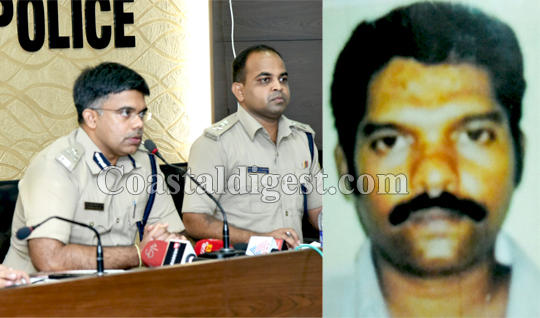
Mangaluru: Drug offender Goods' Rahim arrested under Goonda Act

[email protected] (CD Network | Chakravarthi)
October 4, 2016

Mangaluru, Oct 5: In a rare move, the Mangaluru city police have invoked a drug peddler under the Karnataka Prevention of Dangerous Activities of Bootleggers, Drug Offenders, Gamblers, Goondas, Immoral Traffic Offenders, Slum Grabbers and Video or Audio Pirates Act, 1985.

comm1

City Police Commissioner M. Chandra Sekhar told presspersons here on Tuesday that he passed the order against T.P. Abdul Rahim alias T.P. Rahim alias Goods' Rahim alias Kindi' Rahim (41), a resident of Ansari Road, Bunder, Mangaluru, based on the reports by inspector Shantharam, Assistant Commissioner of Police Uday M. Nayak and Deputy Commissioner of Police (Law and Order) M. Shantharaju.

The accused, facing eight cases under the NDPS Act, has been sent to Belagavi Central Prison, the commissioner said.

Alarmed over the increasing reports of drug abuse by youngsters, the city police have launched a two-pronged drive—to deter drug usage and to cut supply of drugs.

“Detaining a drug peddler under the Goonda Act is aimed at curtailing drug supply,” Mr. Sekhar said and claimed that such an action was taken for the first time in Mangaluru. “The police have a list of persons who indulge in drug supply and action will be taken against all of them. Priority is being given to nab those who supply drugs near educational institutions,” he said.

Rahim, despite being arrested several times for peddling, continued to indulge in the crime after coming out on bail. Similar steps would follow for others too, the commissioner said. The police had conducted over 40 raids this year, seized 94.219 kg of ganja and canabbis and 70 g of cocaine, he said. The police have so far sent about 135 drug addicts to rehabilitation centres and would keep a close watch on them at least for six months after their release.

“The police do not want to socially boycott them as drug abuse is a curable symptom. Parents too have a greater role in identifying the changed behaviour of their wards and arranging counselling before things go out of hand,” he said.

Deputy Commissioners of Police M. Shantharaju (Law and Order) and Sanjeev M. Patil (Crime and Traffic) were present.

Comments

A.Mangalore
 - 
Wednesday, 5 Oct 2016

Good move. He should be behind the bar forever.

Add new comment

  • Coastaldigest.com reserves the right to delete or block any comments.
  • Coastaldigset.com is not responsible for its readers’ comments.
  • Comments that are abusive, incendiary or irrelevant are strictly prohibited.
  • Please use a genuine email ID and provide your name to avoid reject.
News Network
April 29,2020

Washington, Apr 29: A US government panel on Tuesday called for India to be put on a religious freedom blacklist over a "drastic" downturn under Prime Minister Narendra Modi, triggering a sharp rebuttal from New Delhi.

The US Commission on International Religious Freedom recommends but does not set policy, and there is virtually no chance the State Department will follow its lead on India, an increasingly close US ally.

In an annual report, the bipartisan panel narrowly agreed that India should join the ranks of "countries of particular concern" that would be subject to sanctions if they do not improve their records.

"In 2019, religious freedom conditions in India experienced a drastic turn downward, with religious minorities under increasing assault," the report said.

It called on the United States to impose punitive measures, including visa bans, on Indian officials believed responsible and grant funding to civil society groups that monitor hate speech.

The commission said that Modi's Hindu nationalist government, which won a convincing election victory last year, "allowed violence against minorities and their houses of worship to continue with impunity, and also engaged in and tolerated hate speech and incitement to violence."

It pointed to comments by Home Minister Amit Shah, who notoriously referred to mostly Muslim migrants as "termites," and to a citizenship law that has triggered nationwide protests.

It also highlighted the revocation of the autonomy of Kashmir, which was India's only Muslim-majority state, and allegations that Delhi police turned a blind eye to mobs who attacked Muslim neighborhoods in February this year.

Coronavirus state-wise India update: Total number of confirmed cases, deaths on April 29

The Indian government, long irritated by the commission's comments, quickly rejected the report.

"Its biased and tendentious comments against India are not new. But on this occasion, its misrepresentation has reached new levels," foreign ministry spokesman Anurag Srivastava said.

"We regard it as an organization of particular concern and will treat it accordingly," he said in a statement.

The State Department designates nine "countries of particular concern" on religious freedom -- China, Eritrea, Iran, Myanmar, North Korea, Pakistan, Saudi Arabia, Tajikistan and Turkmenistan.

The commission asked that all nine countries remain on the list. In addition to India, it sought the inclusion of four more -- Nigeria, Russia, Syria and Vietnam.

Pakistan, India's historic rival, was added by the State Department in 2018 after years of appeals by the commission.

In its latest report, the commission said that Pakistan "continued to trend negatively," voicing alarm at forced conversions of Hindus and other minorities, abuse of blasphemy prosecutions and a ban on the Ahmadi sect calling itself Muslim.

India's citizenship law fast-tracks naturalization for minorities from neighbouring countries -- but not if they are Muslim.

Modi's government says it is not targeting Muslims but rather providing refuge to persecuted people and should be commended.

But critics consider it a watershed move by Modi to define the world's largest democracy as a Hindu nation and chip away at independent India's founding principle of secularism.

Tony Perkins, the commission's chair, called the law a "tipping point" and voiced concern about a registry in the northeastern state of Assam, under which 1.9 million people failed to produce documentation to prove that they were Indian citizens before 1971 when mostly Muslim migrants flowed in during Bangladesh's bloody war of independence.

"The intentions of the national leaders are to bring this about throughout the entire country," Perkins told an online news conference.

"You could potentially have 100 million people, mostly Muslims, left stateless because of their religion. That would be, obviously, an international issue," said Perkins, a Christian activist known for his opposition to gay rights who is close to President Donald Trump's administration.

Three of the nine commissioners dissented -- including another prominent Christian conservative, Gary Bauer, who voiced alarm about India's direction but said the ally could not be likened to non-democracies such as China.

"I am deeply concerned that this public denunciation risks exactly the opposite outcome than the one we all desire," Bauer said.

Trump, who called for a ban on Muslim immigration to the US when he ran for president, hailed Modi on a February visit to New Delhi.


Comments

Add new comment

  • Coastaldigest.com reserves the right to delete or block any comments.
  • Coastaldigset.com is not responsible for its readers’ comments.
  • Comments that are abusive, incendiary or irrelevant are strictly prohibited.
  • Please use a genuine email ID and provide your name to avoid reject.
News Network
February 14,2020

Bhuj, Feb 14: In a horrifying incident, as many as 68 undergraduate girls were paraded through their college into the restroom and forced to individually remove their undergarments to prove that they were not menstruating. 

This shameful exercise was conducted at Shri Sahjanand Girls’ Institute (SSGI) in Gujarat’s Bhuj under the supervision of principal and other teachers. 

It all began after the hostel rector complained to the principal that some of the inmates had been violating the Hindu religious norms specifically for menstruating females.

According to the sect’s norms, menstruating females are barred from entering the temple and kitchen. They are even forbidden from touching other students. However, the hostel administration reportedly complained to principal Rita Raninga that some girls who were having their periods not just mingled with other hostel inmates, but also entered the kitchen and ventured near the temple on the premises. 

“It was sheer mental torture and we don’t have words to describe it,” a student who underwent the traumatic experience said, adding that there were total 68 girls who were forced to pass through the test.

“The hostel administration levelled this allegation and insulted us on Wednesday. On Thursday, when we were attending lectures, rector Anjaliben called the principal and complained about this. We were forced to leave our classrooms and queue up outside in the passage. The principal abused and insulted us, asking which of us were having our periods. Two of us who were menstruating stepped aside,” said another victim.

“Despite this, we were all taken to the washroom. There, female teachers asked us to individually remove our undergarments so they could check if we were menstruating,” she added.

Another teenage undergraduate said, “We come from farflung villages. The college campus houses a school that runs classes from Class 1to 12. They provide hostel facilities to the school students. The college does not have its own hostel. We live with the school-kids in their hostel.”

She added, “The principal, hostel rector and the trustees harass us regularly over the issue of menstruation. We are punished for having periods. This happens even if we follow their religious rules. They made us remove our undergarments because they thought some of us were lying about not having periods, and mingling with the others against rules. But the humiliation meted out to us on Thursday was the last straw. When we protested against this, trustee Pravin Pindoria told us that we could take legal action if we wanted but we would have to first leave the hostel. He also forced the students to sign a letter saying nothing happened in college. But enough is enough.”

Kutch University authorities have, meanwhile, swung into action and a five-member team including in-charge vice-chancellor, Darshna Dholakia, and two other senior female professors visited the college on Thursday. “We will speak to the students and the college authority and later initiate appropriate action based on the findings,” Dholakia said.

Run by followers of Swaminarayan Mandir, the college was set up in 2012 but moved into a new building on the premises of Shree Swaminarayan Kanya Mandir in 2014. The college which offers BCom, BA and BSc courses has about 1,500 students of which 68, who come from remote villages, stay in the hostel on campus. The college is known for its pro-Hindutva stance.

Comments

Add new comment

  • Coastaldigest.com reserves the right to delete or block any comments.
  • Coastaldigset.com is not responsible for its readers’ comments.
  • Comments that are abusive, incendiary or irrelevant are strictly prohibited.
  • Please use a genuine email ID and provide your name to avoid reject.
Agencies
January 9,2020

New Delhi, Jan 9: A total of 10,349 people involved in the farming sector, including 5,763 farmers or cultivators, committed suicide in 2018, the National Crime Records Bureau (NCRB)'s report on 'Crime in India-2018' reveals.

The annual data was released around three months after the government released the NCRB report on 'Crime in India-2017'.

As per the latest data, of the 10,349 persons, who committed suicide in 2018, 4,586 were agricultural labourers.

The number of suicides in the farming sector in 2018 accounted for 7.7 per cent of the total suicide-victims (1,34,516) in the country, the NCRB data said.

Suicides in the country in 2018 rose to 1,34,516 from 1,29,887 in 2017.

The rate of suicides was up from 9.9 per cent in 2017 to 10.2 per cent in 2018. In 2017, a total of 10,655 farming sector-suicides were reported.

West Bengal, Bihar, Odisha, Uttarakhand, Meghalaya, Goa, Chandigarh, Daman and Diu, Delhi, Lakshadweep and Puducherry reported zero suicides of farmers or cultivators and agricultural labourers during 2018, said the report.

Comments

Add new comment

  • Coastaldigest.com reserves the right to delete or block any comments.
  • Coastaldigset.com is not responsible for its readers’ comments.
  • Comments that are abusive, incendiary or irrelevant are strictly prohibited.
  • Please use a genuine email ID and provide your name to avoid reject.