Mangaluru: Leftists take out rally against communal' Modi govt

[email protected] (CD Network)
May 25, 2016

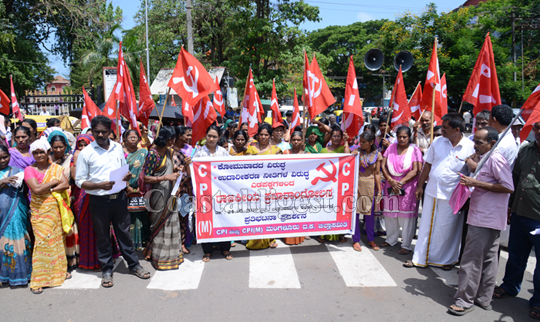
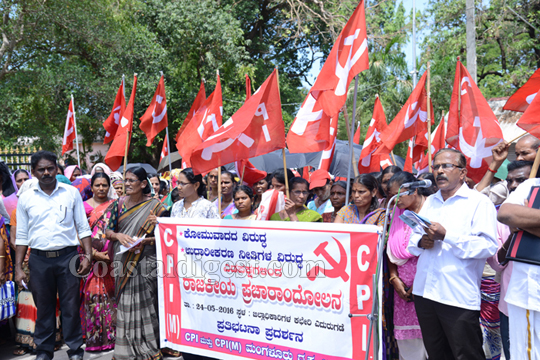
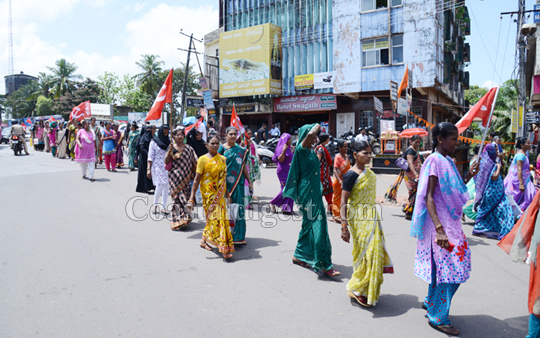
Mangaluru, May 25: Registering their protest against the “communal and anti-people policies” of Narendra Modi led union government, the workers of Left parties staged a rally in Mangaluru.

protest 1

The rally was jointly organised by the Dakshina Kannada district committees of Communist Party of India (Marxist) and Communist Party of India as a precursor to mammoth protest rally planned by the Left parties in Bengaluru on June 6.

Speaking on the occasion, CPI district secretary V Kukyan said the BJP led NDA government which already two years at the centre have belied all promises made to their respective electorate.

He said that the government's policies had left the poor and the deserving sections of society in a rather piquant situation.

“Team Modi is catering to the interests of the capitalists ignoring the interests of both farmers and the labour class, he said adding the state government too has failed in providing even basic minimum amenities to the people that expected it,” he said.

The BJP that promised to bring back black money stashed in tax havens abroad prior to the elections has failed miserably in this regard. Corporate borrowers owe Indian banks nearly Rs 3-lakh crore, he said adding nationalized banks have already declared this as non-performing assets. The union government also failed to stop liquor baron Vijay Mallya from fleeing the country and being brought to justice here, he noted.

CPM district secretary Vasanth Achary said it is the corporates who are reaping the benefits of Indian independence and not poor people.

protest 3

protest 4

protest 6

protest 7

protest 8

Comments

Insaan
 - 
Wednesday, 25 May 2016

Ok. Ok. Cha pardh illade pole.

A. Mangalore
 - 
Wednesday, 25 May 2016

Good move. Though the main opposition party Congress is doing very very less effort to counter communalism of Modi Government.
Atleast Khanayya Kumar voice heard more than entire Congress party.

aharkul
 - 
Wednesday, 25 May 2016

good move CPI (M). Keep it up.....

Add new comment

  • Coastaldigest.com reserves the right to delete or block any comments.
  • Coastaldigset.com is not responsible for its readers’ comments.
  • Comments that are abusive, incendiary or irrelevant are strictly prohibited.
  • Please use a genuine email ID and provide your name to avoid reject.
Agencies
May 8,2020

Washington D.C., May 8: The prime time for brain development in a child's life is the first year, where the infant spends most of the time asleep. It is the time when neural connections form and sensory memories are encoded.

However, when sleep is disrupted, as occurs more often among children with autism, brain development may be affected, too.

New research led by the University of Washington finds that sleep problems in a baby's first 12 months may not only precede an autism diagnosis but also may be associated with altered growth trajectory in a key part of the brain, the hippocampus.

The study, which was published in the American Journal of Psychiatry, researchers report that in a sample of more than 400 taken of 6- to 12-month-old infants, those who were later diagnosed with autism were more likely to have had difficulty falling asleep.

It also states that this sleep difficulty was associated with altered growth trajectories in the hippocampus.

"The hippocampus is critical for learning and memory, and changes in the size of the hippocampus have been associated with poor sleep in adults and older children.

As many as 80 per cent of the children with autism spectrum disorder have sleep problems," said Annette Estes, director of the UW Autism Center and senior author of the study.

"In our clinical experience, parents have a lot of concerns about their children's sleep, and in our work on early autism intervention, we observed that sleep problems were holding children and families back," added Estes, who is also a UW professor of speech and hearing sciences.

"It could be that altered sleep is part-and-parcel of autism for some children. One clue is that behavioural interventions to improve sleep don't work for all children with autism, even when their parents are doing everything just right. This suggests that there may be a biological component to sleep problems for some children with autism," said Estes.

To consider links among sleep, brain development, and autism, researchers at the IBIS Network looked at MRI scans of 432 infants, surveyed parents about sleep patterns, and measured cognitive functioning using a standardized assessment.

At the outset of the study, infants were classified according to their risk for developing autism: Those who were at higher risk of developing autism -- about two-thirds of the study sample -- had an older sibling who had already been diagnosed.

Infant siblings of children with autism have a 20 per cent chance of developing autism spectrum disorder -- a much higher risk than children in the general population.

In the current study, 127 of the 432 infants were identified as "low risk" at the time the MRI scans were taken because they had no family history of autism.

They later evaluated all the participants at 24 months of age to determine whether they had developed autism. Of the roughly 300 children originally considered "high familial risk," 71 were diagnosed with autism spectrum disorder at that age.

Problems with sleep were more common among the infants later diagnosed with an autism spectrum disorder, as were larger hippocampi. No other subcortical brain structures were affected, including the amygdala, which is responsible for certain emotions and aspects of memory, or the thalamus, a signal transmitter from the spinal cord to the cerebral cortex.

The authors note that while parents reported more sleep difficulties among infants who developed autism compared to those who did not, the differences were very subtle and only observed when looking at group averages across hundreds of infants.

Sleep patterns in the first years of life change rapidly as infants transition from sleeping around the clock to a more adult-like sleep/wake cycle. Until further research is completed, Estes said, it is not possible to interpret challenges with sleep as an early sign of increased risk for autism.


Comments

Add new comment

  • Coastaldigest.com reserves the right to delete or block any comments.
  • Coastaldigset.com is not responsible for its readers’ comments.
  • Comments that are abusive, incendiary or irrelevant are strictly prohibited.
  • Please use a genuine email ID and provide your name to avoid reject.
News Network
January 20,2020

Mysuru, Jan 20: As the Karnataka state Congress is still awaiting the appointment of Karnataka Pradesh Congress Committee (KPCC) President, MLA Satish Jarkiholi has said that in order to balance the caste and regional equations, All India Congress Committee (AICC) was planning to create four working presidents posts for KPCC.

Talking to media personnel here on Sunday, Mr Jarkiholi, who is considered to be in the race for the post, said that a clear picture about the constitution of additional posts of the working president in the KPCC would emerge in a week.

He added that it has been delayed due to the Assembly elections in Delhi.

Comments

Add new comment

  • Coastaldigest.com reserves the right to delete or block any comments.
  • Coastaldigset.com is not responsible for its readers’ comments.
  • Comments that are abusive, incendiary or irrelevant are strictly prohibited.
  • Please use a genuine email ID and provide your name to avoid reject.
coastaldigest.com news network
July 11,2020

Bengaluru, Jul 11: Amidst the mounting number of covid-19 cases, Karnataka is witnessing another disturbing trend of increasing number of people ending their life. After the lockdown was relaxed, the state saw a worrying jump in the number of suicides.

According to statistics, as many as 2,211 suicide cases have been registered in just two months. The number of suicides rose by 23% in May to 1,127, and by another 18% in June to 1,084, from an average of 912 suicides in the first three months of the year. 

In April, however, the number nearly halved to 477. But April was also the month during which the lockdown (announced on March 24) was complete, and everyone was at home -- which, experts say, could have prevented people with suicidal tendencies from taking their own lives.

Shockingly, number of teenagers including school children committing suicide also increased in the state in past couple of months.

With the pandemic still accelerating and impacting people in multiple ways, the World Health Organisation has urged people to pay greater attention to mental health and suicide prevention. 

Dr Poonam Khetrapal Singh, Regional Director, World Health Organisation (WHO), South-East Asia Region, said stigma related to Covid-19 infection may lead to feelings of isolation and depression. Another precipitating factor impacting mental health amidst Covid-19 could be domestic violence, which is reported to have increased globally as several countries imposed lockdowns, she said.

“Hitting lives and livelihoods, the pandemic is causing fear, anxiety, depression and stress among people. Social distancing, isolation and coping with perpetually evolving and changing information about the virus has both triggered and aggravated existing and pre-existing mental health conditions, which need urgent attention,” she said.

Dr H Chandrashekar, professor and head of the department of psychiatry at Victoria Hospital, said reasons for suicide are always multi-factored, combined, cumulative, unresolving and interrelated.

“There is grief everywhere now due to deaths related to Covid-19, and it may have an adverse effect on some. But people should be watchful of their family members, especially those who are in depression and have a history of suicide attempts. One should never ignore signs, like when someone says they feel like ending their life. They should not be left alone, and unconditional support needs to be given. Also, objects that could be used to commit suicide must be kept away from them,” Dr Chandrashekar said.

Comments

Add new comment

  • Coastaldigest.com reserves the right to delete or block any comments.
  • Coastaldigset.com is not responsible for its readers’ comments.
  • Comments that are abusive, incendiary or irrelevant are strictly prohibited.
  • Please use a genuine email ID and provide your name to avoid reject.