Mangaluru: Leftists take out rally against communal' Modi govt

[email protected] (CD Network)
May 25, 2016

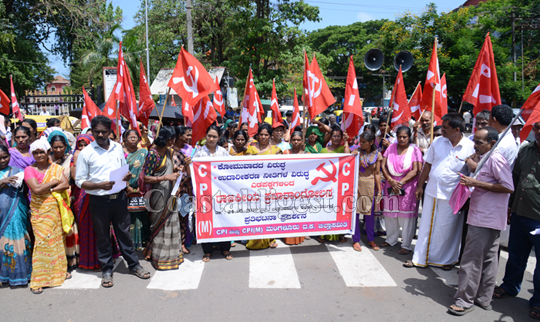
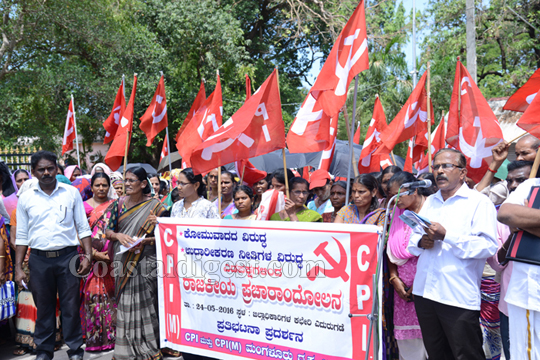
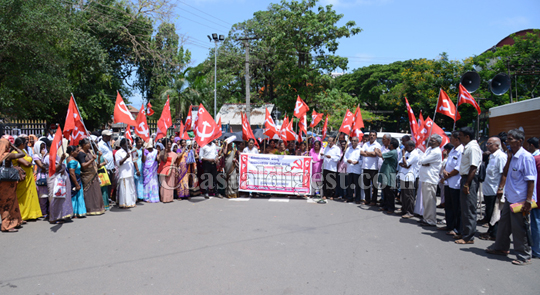
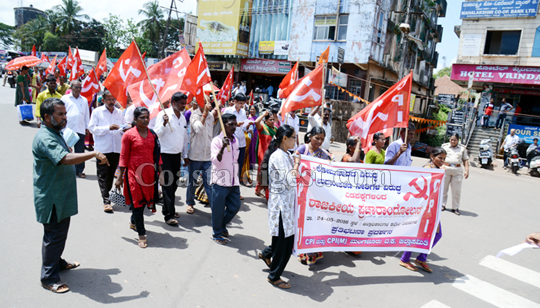
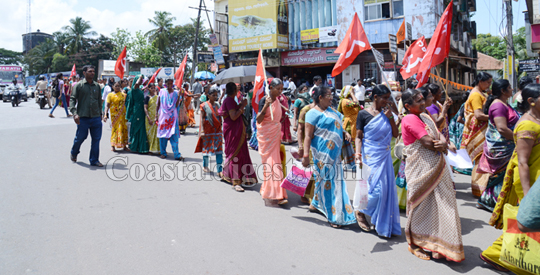
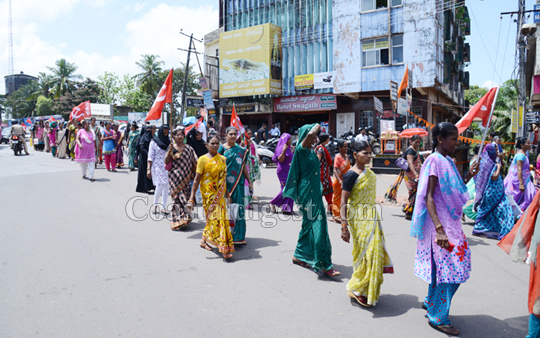
Mangaluru, May 25: Registering their protest against the “communal and anti-people policies” of Narendra Modi led union government, the workers of Left parties staged a rally in Mangaluru.

protest 1

The rally was jointly organised by the Dakshina Kannada district committees of Communist Party of India (Marxist) and Communist Party of India as a precursor to mammoth protest rally planned by the Left parties in Bengaluru on June 6.

Speaking on the occasion, CPI district secretary V Kukyan said the BJP led NDA government which already two years at the centre have belied all promises made to their respective electorate.

He said that the government's policies had left the poor and the deserving sections of society in a rather piquant situation.

“Team Modi is catering to the interests of the capitalists ignoring the interests of both farmers and the labour class, he said adding the state government too has failed in providing even basic minimum amenities to the people that expected it,” he said.

The BJP that promised to bring back black money stashed in tax havens abroad prior to the elections has failed miserably in this regard. Corporate borrowers owe Indian banks nearly Rs 3-lakh crore, he said adding nationalized banks have already declared this as non-performing assets. The union government also failed to stop liquor baron Vijay Mallya from fleeing the country and being brought to justice here, he noted.

CPM district secretary Vasanth Achary said it is the corporates who are reaping the benefits of Indian independence and not poor people.

protest 3

protest 4

protest 6

protest 7

protest 8

Comments

Insaan
 - 
Wednesday, 25 May 2016

Ok. Ok. Cha pardh illade pole.

A. Mangalore
 - 
Wednesday, 25 May 2016

Good move. Though the main opposition party Congress is doing very very less effort to counter communalism of Modi Government.
Atleast Khanayya Kumar voice heard more than entire Congress party.

aharkul
 - 
Wednesday, 25 May 2016

good move CPI (M). Keep it up.....

Add new comment

  • Coastaldigest.com reserves the right to delete or block any comments.
  • Coastaldigset.com is not responsible for its readers’ comments.
  • Comments that are abusive, incendiary or irrelevant are strictly prohibited.
  • Please use a genuine email ID and provide your name to avoid reject.
coastaldigest.com news network
June 13,2020

Shivamogga, Jun 13: Senior BJP leader and Karnataka Minister for Rural Development and Panchayat Raj, K S Eshwarappa on Saturday opined that during the selection of candidates to the legislative council, the party needs to take into consideration those who helped the party in formation of government in the State.

Speaking to media persons on the sideline of a programme here, he said the party high command would give another surprise while issuing tickets during the MLC election.

Mr Eshwrappa said that party high command will take a call on selecting candidates, but priority should be given to the leader who won on Congress and Janata Dal and then jumped to BJP which helped to form govt under the leadership of B S Yediyurappa.

Comments

Add new comment

  • Coastaldigest.com reserves the right to delete or block any comments.
  • Coastaldigset.com is not responsible for its readers’ comments.
  • Comments that are abusive, incendiary or irrelevant are strictly prohibited.
  • Please use a genuine email ID and provide your name to avoid reject.
News Network
February 18,2020

Bengaluru, Feb 18: Deputy chief minister Laxman Savadi was elected to the legislative council on Monday and although it was a done deal that he would win, a vote from across the aisle spiced up the election.

Counting was conducted soon after ballots were cast and Savadi polled 113 of the 120 votes cast, including the vote of disgruntled JD(S) legislator GT Devegowda. Seven votes were declared invalid. Members of the two opposition parties — Congress and JD(S) — abstained from voting.

The election was necessitated following the resignation of Rizwan Arshad of the Congress. Rizwan resigned after he was elected to the legislative assembly from the Shivajinagar constituency in the assembly bypolls held for 15 seats in December last year.

BR Anil Kumar, who was initially promised the support of both Congress and JD(S) was supposed to contest as an independent candidate. However, as both parties refused to support him at the last minute, he withdrew, paving the way for Savadi’s victory.

The BJP has 117 members in the 225-member assembly, but N Mahesh of the BSP and two independents, H Nagesh and Sharath Bachchegowda, besides GT Devegowda also voted, taking the total electorate to 120 (including the speaker). BJP’s SA Ramadas did not turn up because of health reasons.

“I would like to thank all those who were responsible for my victory. Special thanks to leaders of my party and chief minister BS Yediyurappa, who gave me the opportunity to be the BJP candidate,” said Savadi.

Winning this council election was crucial for Savadi to retain his ministry as he was not an elected member of either of the houses. Rules mandate that a non-member must get elected either to the assembly or council within six months after taking over as minister. February 20 was the deadline for Savadi, who had lost 2018 assembly polls from Athani, to get elected.

Officials in the assembly secretariat said seven votes were invalid because voters had wrongly marked their choices on ballot paper. According to norms, a voter has to mark numerical one, two and three against the names of the candidates in order of preference. Marking only numerical one is allowed. However, six ballots had a tick mark, while a voter had registered a cross mark. Since it was a secret ballot, it was not known who the MLAs were whose votes were invalid.

“The ballot papers bear serial numbers and they are randomly distributed. It is virtually impossible to say who a voter cast his or her vote for,” said assembly secretary MK Vishalakashi, the retuning officer for the bypoll.

Comments

Add new comment

  • Coastaldigest.com reserves the right to delete or block any comments.
  • Coastaldigset.com is not responsible for its readers’ comments.
  • Comments that are abusive, incendiary or irrelevant are strictly prohibited.
  • Please use a genuine email ID and provide your name to avoid reject.
Media Release
February 14,2020

Veteran journalist P. Sainath has said that the nation is in a crisis. And this crisis is not limited to just the rural area. It has become a national crisis at various areas such as agriculture, education, economy, job creation etc.

He was delivering the endowment lecture on the topic ‘Indian democracy at the post-liberalization and post-truth era’ at Media Manthan 2020 organized by the PG department of journalism and mass communication at St Aloysius College (Autonomous). 

Mr Sainath said that the many policies adopted in the 90s led to India becoming unusually unequal. Referring to the speech Ambedkar had made at the Constituent Assembly while handing over the draft of the Constitution, Mr Sainath said, “Ambedkar had warned about the weakness of Indian democracy that liberty without equality allows the supremacy of a few over the multitude. Liberty, equality and fraternity must be kept together as we cannot have one without the other.” 

Mr Sainath stated that the agrarian crisis was no longer about the loss of productivity, employment or about farmer suicide; it was a societal, civilizational crisis. Commenting on the lopsided policies such as cow-slaughter ban, he explained how cow slaughter ban had adversely affected many industries due to their interdependency. While Muslims who slaughtered cows were rendered helpless, the cattle traders who were mostly OBCs lost their earnings as the cattle prices crashed. An important industry like Kolhapur sandals industry in Maharashtra went bankrupt as a result of the cow slaughter ban in Maharashtra. He said the policymakers had no idea how the rural industries were interconnected. Demonetisation too devastated the rural economy as 98 percent of rural transactions happen through cash. 

Mr Sainath also spoke about the crisis of inequality which affects the Dalits and the Adivasis far more than anyone else as 90 percent of the rural households take home less than Rs 10,000/- per month. “Women are yet another group whose labour is never counted in the gross domestic product. Women and girls globally do unpaid work which amounts to about 12.5 billion working hours per year. Monetarily speaking, this is worth 10.8 trillion dollars,” Mr Sainath added. 

Speaking about the crisis of jobs Mr Sainath said that major companies were laying off employees just to create more profits for the investors and the adoption of artificial intelligence in the industry would further destroy millions of jobs.

Rector of St Aloysius College Institutions Fr Dionysius Vaz SJ, Principal Dr (Fr) Praveen Martis SJ, HOD of Journalism and Mass Communication department Dr (Fr) Melwyn Pinto SJ were present.

‘Veerappan and Vijay Mallya’s business models are interesting!’

Addressing the gathering during his endowment lecture on Friday, Mr Sainath made an interesting comment on the so called ‘revenue model’. “Whenever I visit IIMs and IITs for lectures on my PARI project, the students there ask me what my revenue model for my project is. I tell them that I do not have a revenue model. In fact, journalism does not begin with a revenue model. Gandhiji, Ambedkar, Bhagat Singh were all great journalists. But they did not have a revenue model,” Mr Sainath said.

On a lighter note, he said that the best revenue model that he liked was that of forest brigand Veerappan and liquor baron Vijay Mallya. “Veerappan ruled the forest for forty years and from the top ministers to the villagers he could dictate terms and liver royally. Similarly, Mallya’s revenue model was to steal the banks and run away abroad and live like a king,” Mr Sainath added.

Journalism is not and can never be a business. It is a calling, he opined. While newspaper can be a business, television can be a business, journalism per se cannot be reduced to a business. “Unfortunately today, journalists are recruited on a contract basis and they have no bargaining power; and there are no unions to fight for their cause. Hence, they are at the mercy of the corporate media houses for their survival and are made to write stories that cannot be called journalism,” Mr Sainath said.

Answering a question as to the pressures he faced as a journalist, he said that external pressures from the government or others could be very well handled. It is the internal pressures from once own media house that journalists find it difficult to manage.


 

Comments

Add new comment

  • Coastaldigest.com reserves the right to delete or block any comments.
  • Coastaldigset.com is not responsible for its readers’ comments.
  • Comments that are abusive, incendiary or irrelevant are strictly prohibited.
  • Please use a genuine email ID and provide your name to avoid reject.