Mangaluru: Tipper kills Engg student; body lies on road for half an hour

[email protected] (CD Network | Chakravarthi)
September 21, 2016

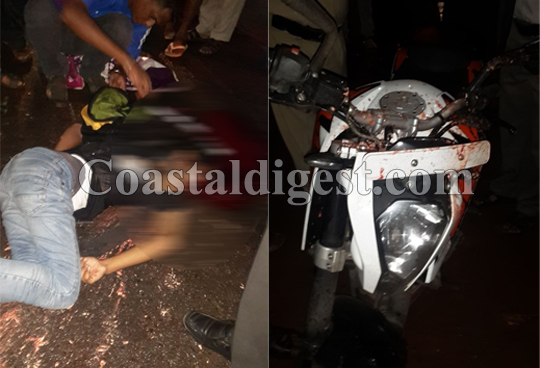
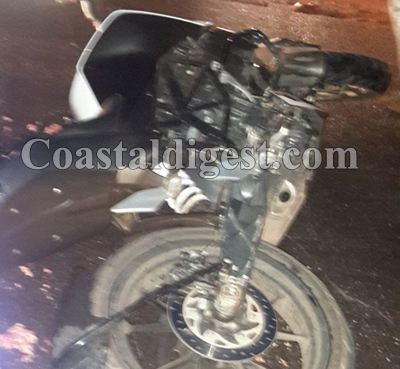
Mangaluru, Sep 21: An engineering student died after his motorbike collided with a tipper-lorry in Naguri on Mangaluru-Bengaluru National Highway on Wednesday.

riyan

The deceased has been identified as Ahmed Raiyan (19), son of Riyaz Chenna, a native of Bhatkal. He was a first year Bachelor of Engineering student of Sahyadri College of Engineering, Adyar Mangaluru.

According to police, Raiyan was on his way to his hostel when the accident occurred. When the boy reached Nagori, a speeding tipper rammed into his motorbike

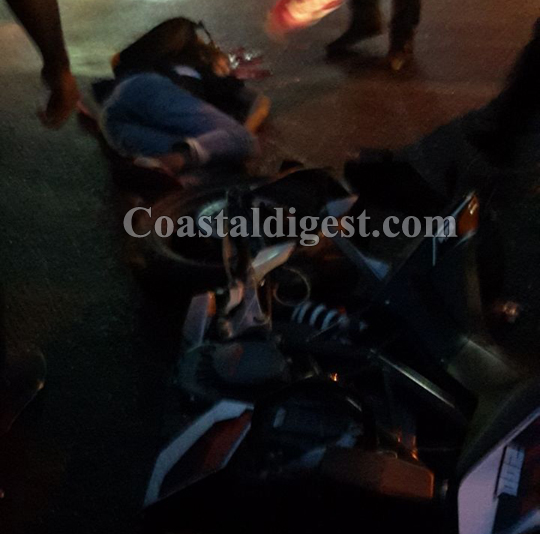
He was thrown onto the road and died on the spot. The driver of the tipper fled from the scene immediately.

For more than half an hour the body of Riyan was lying on the road as passersby and local residents decided to stay away.

For more than half an hour of the death of Ahmed Riyan, no efforts were made by anyone to shift the dead body from the road.

Police reached the spot after half an hour and shifted the body for Government Wenlock Hospital for post-mortem. When the news began to spread members of Bhatkal Hostel, Mangaluru and Bhatkal Muslim Jamaath Mangaluru rushed to the hospital.

The body was later handed over to family members. The final rites will be held in Bhatkal.

naguriacc 1

naguriacc 2

naguriacc 3

Comments

Satyameva jayate
 - 
Thursday, 22 Sep 2016

rip......
His life and more other daily must be lesson for parents of reckless motorists who feel proud of their kids showing circus in streets and putting others lives in danger too...young blood should warm up for their future and their parents dreams....not to kill themselves for cheap show off....may God save us all from such incidents..

Mr Frank
 - 
Thursday, 22 Sep 2016

All parents must take care and advise their boys before gifting them two wheeler.May ALmighty bless parents to bear loss.

Add new comment

  • Coastaldigest.com reserves the right to delete or block any comments.
  • Coastaldigset.com is not responsible for its readers’ comments.
  • Comments that are abusive, incendiary or irrelevant are strictly prohibited.
  • Please use a genuine email ID and provide your name to avoid reject.
IBTimes
June 3,2020

A pregnant elephant in Kerala ate a pineapple, which was filled with country-made bombs or dynamites. It led to a painful death as the elephant was pregnant and died standing in the Velliyar River in Palakkad in Kerala. People are venting out their anger and concerns all over social media about the gruesome incident.

Yesterday, it was reported that the pregnant elephant was killed after locals allegedly fed her a pineapple stuffed with crackers.

However, when International Business Times, India, reached out to Dr Ab Qayoom, who is an Indian Forest Service Officer, for his comments about what actually must have happened, we got to know that no one have fed the pineapple to the elephant.

Snares used for keeping animals away

Dr Qayoom stated that pineapples filled with firecrackers are used as a snare for catching wild boars. He said, "No one would have fed the pineapple to the elephant. The animal must have found it lying somewhere and must have consumed it herself not knowing what lies ahead for her."

He also stated a second possibility. He said, "Some people actually do such insane things as they consider wild animals as a threat to their property and life. Such incidents do happen at places where wild animals create problems for human beings."

Snares are often found around farms, coffee plantations

He added that wild boars often spoil crops and people use snares as a way to protect their farms and crops. This year, it was reported that the government would soon permit farmers with licensed firearms to shoot wild boars that wander into their lands. The problem is that people do not limit their snares to only wild boars and there have been several incidents when tigers, leopards and other animals have fallen prey to these haphazardly placed snares around farms, coffee farms and wildlife corridors.

Elephant kept standing in water before dying

The pregnant wild elephant originally belonged to Silent Valley National Park (SVNP), Palakkad. As the elephant died, she remained calm despite being in excruciating pain. The elephant kept standing and died at Velliyar River, Malappuram, with its trunk in the water.

The elephant was 15-years-old and was probably getting some relief as it stood in the water after her tongue and mouth exploded. Mohan Krishnan, Section Forest Officer, Nilambur, shared the sad incident on his Facebook page where he had acted as the Rapid Response Team official to rescue the elephant, which was in distress.

When a postmortem examination was carried out, it was learnt that the reason for the elephant's death was due to asphyxia where water had got into her lungs and trachea. Dr David Abraham, Assistant Forest Veterinary Officer, Thrissur, carried out the postmortem.

Dr David said, "I have so far done more than 250 postmortems of elephants alone in my more than two decades career. But this was the first time I was so moved as I could hold the foetus of the baby in my hands. Initially, none of us was aware that the elephant was pregnant. After seeing her heart, I spotted the amniotic fluid and realized that she was pregnant."

Claim reviewed :

Fact checking Palakkad elephant death

Claimed By :

Twitter, Facebook and Youtube posts.

Fact Check :

False

https://t.co/uR4p7rDUli

Comments

Peta
 - 
Thursday, 4 Jun 2020

Still killed by human, what this media want to justify the killing will be filing suit on this media soon...u will be in trouble soon.

MOHAMMED MOOLU…
 - 
Wednesday, 3 Jun 2020

A very cruel, henious and inhumen act. This culprit should be with murder and punished sevierly. 

Add new comment

  • Coastaldigest.com reserves the right to delete or block any comments.
  • Coastaldigset.com is not responsible for its readers’ comments.
  • Comments that are abusive, incendiary or irrelevant are strictly prohibited.
  • Please use a genuine email ID and provide your name to avoid reject.
News Network
April 2,2020

The current physical distancing guidelines provided by the World Health Organisation (WHO) and by the US Centers for Disease Control and Prevention (CDC) may not be adequate to curb the coronavirus spread, according to a research which says the gas cloud from a cough or sneeze may help virus particles travel up to 8 metres. The research, published in the Journal of the American Medical Association, noted that the the current guidelines issued by the WHO and CDC are based on outdated models from the 1930s of how gas clouds from a cough, sneeze, or exhalation spread.

Study author, MIT associate professor Lydia Bourouiba, warned that droplets of all sizes can travel 23 to 27 feet, or 7-8 metres, carrying the pathogen.

According to Bourouiba, the current guidelines are based on "arbitrary" assumptions of droplet size, "overly simplified", and "may limit the effectiveness of the proposed interventions" against the deadly pandemic.

 She explained that the old guidelines assume droplets to be one of two categories, small or large, taking short-range semi-ballistic trajectories when a person exhales, coughs, or sneezes.

However based on more recent discoveries, the MIT scientist said, sneezes and coughs are made of a puff cloud that carries ambient air, transporting within it clusters of droplets of a wide range of sizes.

Bourouiba warned that this puff cloud, with ambient air entrapped in it, can offer the droplets moisture and warmth that can prevent it from evaporation in the outer environment.

"The locally moist and warm atmosphere within the turbulent gas cloud allows the contained droplets to evade evaporation for much longer than occurs with isolated droplets," she said.

"Under these conditions, the lifetime of a droplet could be considerably extended by a factor of up to 1000, from a fraction of a second to minutes," the researcher explained in the study.

The MIT scientist, who has researched the dynamics of coughs and sneezes for years, added that these droplets settle along the trajectory of a cough or sneeze contaminating surfaces, with their residues staying suspended in the air for hours.

"Even when maximum containment policies were enforced, the rapid international spread of COVID-19 suggests that using arbitrary droplet size cutoffs may not accurately reflect what actually occurs with respiratory emissions, possibly contributing to the ineffectiveness of some procedures used to limit the spread of respiratory disease," Bourouiba wrote in the study

Comments

Add new comment

  • Coastaldigest.com reserves the right to delete or block any comments.
  • Coastaldigset.com is not responsible for its readers’ comments.
  • Comments that are abusive, incendiary or irrelevant are strictly prohibited.
  • Please use a genuine email ID and provide your name to avoid reject.
News Network
March 27,2020

Belgaum, Mar 26: The police on Thursday thrashed people who had gone to offer prayers at a mosque despite the nationwide lockdown in force.
In a video, the police personnel can be seen thrashing the people with batons while they were leaving after offering prayers at a local mosque here.
In another incident in Rajasthan's Pratapgarh, the police made few youngsters hop along a road and even gave the 'murga,' punishment to a few of them for violating the restrictions.
Similarly in Uttar Pradesh's Budaun, the police made people hop along a road with their bags strapped on their backs as a punishment. The people were possibly going to their native places.
In the video of the Budaun incident, a few men can be seen being made to hop along the road with a stick-wielding policeman keeping a watch.
SSP Budaun told ANI that an investigation is being conducted into the incident and expressed an apology for the police's behaviour.
Prime Minister Narendra Modi had announced a 21-day countrywide lockdown to check the spread of coronavirus, saying that "social distancing" is the only option to deal with the highly contagious disease.

Comments

Add new comment

  • Coastaldigest.com reserves the right to delete or block any comments.
  • Coastaldigset.com is not responsible for its readers’ comments.
  • Comments that are abusive, incendiary or irrelevant are strictly prohibited.
  • Please use a genuine email ID and provide your name to avoid reject.