



Mass evacuation in Syria to proceed after deadly blast

April 16, 2017

Beirut, Apr 16: More than 3,000 Syrians are expected to be evacuated Sunday from four areas as part of a population transfer that was briefly stalled the day before by a deadly blast that killed scores of people, most of them government supporters.eva
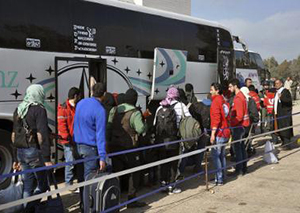
The United Nations is not overseeing the transfer deal, which involves residents of the pro-government villages of Foua and Kfarya and the opposition-held towns of Madaya and Zabadani. All four have been under siege for years, their fate linked through a series of reciprocal agreements that the U.N. says have hindered aid deliveries.

Rami Abdurrahman, who heads the Britain-based Syrian Observatory for Human Rights, and Hezbollah's Al-Manar TV said 3,000 people will be evacuated from Foua and Kfarya, while 200, the vast majority of them fighters, will be evacuated from Zabadani and Madaya.

Abdurrahman said Saturday's blast _which hit an area where thousands of pro-government evacuees had been waiting for hours _ killed 126. He said the dead included 109 people from Foua and Kfarya, among them 68 children and 13 women.

No one has claimed the attack, but both the Islamic State group and the al-Qaida-affiliated Fatah al-Sham Front have targeted civilians in government areas in the past.

After the blast, some 60 buses carrying 2,200 people, including 400 opposition fighters, entered areas held by rebels in the northern province of Aleppo, Abdurrahman said. More than 50 buses and 20 ambulances carrying some 5,000 Foua and Kfarya residents entered the government-held city of Aleppo, Syrian state TV said, with some of them later reaching a shelter in the village of Jibreen to the south.

U.N. relief coordinator Stephen O'Brien said he was "horrified" by the deadly bombing, and that while the U.N. was not involved in the transfer it was ready to "scale up our support to evacuees."

He called on all parties to uphold their obligations under international humanitarian and human rights law, and to "facilitate safe and unimpeded access for the U.N. and its partners to bring life-saving help to those in need."

Residents of Madaya and Zabadani, formerly summer resorts, joined the 2011 uprising against President Bashar Assad. Both came under government siege in the ensuing civil war. Residents of Foua and Kfraya, besieged by the rebels, have lived under a steady hail of rockets and mortars for years, but were supplied with food and medicine through military airdrops.

Critics say the string of evacuations, which could see some 30,000 people moved across battle lines over the next 60 days, amounts to forced displacement along political and sectarian lines.

Comments

Add new comment

  • Coastaldigest.com reserves the right to delete or block any comments.
  • Coastaldigset.com is not responsible for its readers’ comments.
  • Comments that are abusive, incendiary or irrelevant are strictly prohibited.
  • Please use a genuine email ID and provide your name to avoid reject.
News Network
April 17,2020

Washington, Apr 17: The confirmed coronavirus death toll in the United States reached 32,917 on Thursday, according to a tally by Johns Hopkins University.

The toll as of 8:30 pm (0030 GMT Friday) marked an increase of 4,491 deaths in the past 24 hours, by far the highest daily toll in the pandemic so far.

But the figure likely includes "probable" deaths related to COVID-19, which were not previously included. This week, New York City announced it would add 3,778 "probable" coronavirus deaths to its toll.

As of Thursday night, the US Centers for Disease Control and Prevention had recorded 31,071 coronavirus deaths, including 4,141 "probable" virus deaths.

The US has the highest death toll in the world, followed by Italy with 22,170 dead although its population is just a fifth of that of the US.

Spain has recorded 19,130 deaths, followed by France with 17,920.

More than 667,800 coronavirus cases have been recorded in the United States, which has seen a record number of deaths over the past two days.

Meanwhile, President Donald Trump unveiled plans Thursday evening to reopen the US economy, allowing each state's governor "to take a phased deliberate approach to reopening their individual states".

Comments

Add new comment

  • Coastaldigest.com reserves the right to delete or block any comments.
  • Coastaldigset.com is not responsible for its readers’ comments.
  • Comments that are abusive, incendiary or irrelevant are strictly prohibited.
  • Please use a genuine email ID and provide your name to avoid reject.
News Network
June 9,2020

Washington, Jun 9: When epidemiologists talked about "flattening the curve," they probably didn't mean it this way: the US hit its peak coronavirus caseload in April, but since that time the graph has been on a seemingly unending plateau.

That's unlike several other hard-hit countries which have successfully pushed down their numbers of new cases, including Spain and Italy, which now have bell-shaped curves.

Experts say the prolonged nature of the US epidemic is the result of the cumulative impact of regional outbreaks, as the virus that started out primarily on the coasts and in major cities moves inward.

Layered on top of that are the effects of lifting lockdowns in parts of the country that are experiencing rising cases, as well as a lapse in compliance with social distancing guidelines because of economic hardship, and in some cases a belief that the threat is overstated.

"The US is a large country both in geography and population, and the virus is at very different stages in different parts of the country," Tom Frieden, a former director of the Centers for Disease Control and Prevention told AFP.

The US saw more than 35,000 new cases for several days in April. While that figure has declined, it has still been exceeding 20,000 regularly in recent days.

By contrast, Italy was regularly hitting more than 5,000 cases per day in March but is currently experiencing figures in the low hundreds.

"We did not act quickly and robustly enough to stop the virus spreading initially, and data indicate that it travelled from initial hotspots along major transport routes into other urban and rural areas," added Frieden, now CEO of the non-profit Resolve to Save Lives.

To wit: the East Coast states of New York, New Jersey and Massachusetts accounted for about 50 percent of all cases until about a month or so ago -- but now the geographic footprint of the US epidemic has shifted to the Midwest and southeast, including Florida.

Another key problem, said Jennifer Nuzzo, an epidemiologist at Johns Hopkins, is that the United States is still not doing enough testing, contact tracing and isolation.

After coming late to the testing party -- for reasons ranging from technical issues to regulatory hurdles -- the US has now conducted more COVID-19 tests than any other country.

It even has one of the highest per capita rates per country of 62 per 1,000 people, according to the website ourworldindata.org -- better than Germany (52 per 1,000) and South Korea (20 per 1,000).

But according to Nuzzo, these numbers are misleading, because "the amount of testing that a country should do should be scaled to the size of its epidemic.

"The United States has the largest epidemic in the world so obviously we need to do a lot more testing than any other country."

For Johns Hopkins, the more important metric is the positivity rate -- that is, out of all tests conducted, how many came back positive for COVID-19.

As of June 7, the United States had an average daily positivity rate of 14 percent, well above the World Health Organization guideline of 5 percent over two weeks before social distancing guidelines should be relaxed.

By contrast, Germany, which has tested far fewer people in relation to its population, has a positivity rate of 5 percent.

Even if testing were scaled up, carrying out tests in of itself does very little good without the next steps -- finding out who was exposed and then asking them to isolate.

Here also, too many US states are lagging woefully behind.

Texas, which is experiencing a surge in cases after relaxing its lockdown, is a case in point. The state targeted hiring a modest 4,000 tracers by June, but according to local reports is still more than a thousand shy of even that goal.

Opt-in app based efforts have also been slow to get off the ground.

Then there is the fact that some people are growing tired of lockdowns, while others don't have the economic luxury of being able to stay home for prolonged periods.

The government sent some 160 million Americans a single stimulus check of up to $1,200 back in April but it's not clear whether more will be forthcoming.

Still others, particularly in so-called red states under Republican leadership, have chafed under restrictions and mask-wearing guidelines that they see as an affront to their personal freedom.

"The US is kind of on the extreme of the individual liberty side," Sten Vermund, dean of the Yale School of Public Health, told AFP.

Part of this has to do with mixed messaging from Republican leaders, including President Donald Trump, said Nuzzo.

"We have had at the highest political level an assertion that this is a situation that's been overblown, and that maybe certain protective behaviors are not necessary," she said.

More recently, tens of thousands of people across the country have taken to the streets to protest the killing on an unarmed black man by police, risking coronavirus infection to demonstrate against the public health threat of racialized state violence.

Comments

Add new comment

  • Coastaldigest.com reserves the right to delete or block any comments.
  • Coastaldigset.com is not responsible for its readers’ comments.
  • Comments that are abusive, incendiary or irrelevant are strictly prohibited.
  • Please use a genuine email ID and provide your name to avoid reject.
News Network
June 9,2020

Jun 9: The World Health Organization says it still believes the spread of the coronavirus from people without symptoms is “rare,” despite warnings from numerous experts worldwide that such transmission is more frequent and likely explains why the pandemic has been so hard to contain.

Maria Van Kerkhove, WHO''s technical lead on COVID-19 said at a press briefing on Monday that many countries are reporting cases of spread from people who are asymptomatic, or those with no clinical symptoms.

But when questioned in more detail about these cases, Van Kerkhove said many of them turn out to have mild disease, or unusual symptoms.

Although health officials in countries including Britain, the U.S. and elsewhere have warned that COVID-19 is spreading from people without symptoms, WHO has maintained that this type of spread is not a driver of the pandemic and is probably accounts for about 6 per cent of spread, at most.

Numerous studies have suggested that the virus is spreading from people without symptoms, but many of those are either anecdotal reports or based on modeling.

Van Kerkhove said that based on data from countries, when people with no symptoms of COVID-19 are tracked over a long period to see if they spread the disease, there are very few cases of spread.

“We are constantly looking at this data and we''re trying to get more information from countries to truly answer this question,” she said. “It still appears to be rare that asymptomatic individuals actually transmit onward.”

Comments

Add new comment

  • Coastaldigest.com reserves the right to delete or block any comments.
  • Coastaldigset.com is not responsible for its readers’ comments.
  • Comments that are abusive, incendiary or irrelevant are strictly prohibited.
  • Please use a genuine email ID and provide your name to avoid reject.