



Mass evacuation in Syria to proceed after deadly blast

April 16, 2017

Beirut, Apr 16: More than 3,000 Syrians are expected to be evacuated Sunday from four areas as part of a population transfer that was briefly stalled the day before by a deadly blast that killed scores of people, most of them government supporters.eva
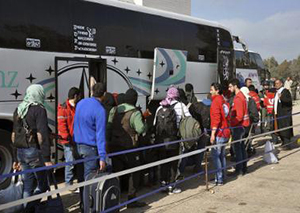
The United Nations is not overseeing the transfer deal, which involves residents of the pro-government villages of Foua and Kfarya and the opposition-held towns of Madaya and Zabadani. All four have been under siege for years, their fate linked through a series of reciprocal agreements that the U.N. says have hindered aid deliveries.

Rami Abdurrahman, who heads the Britain-based Syrian Observatory for Human Rights, and Hezbollah's Al-Manar TV said 3,000 people will be evacuated from Foua and Kfarya, while 200, the vast majority of them fighters, will be evacuated from Zabadani and Madaya.

Abdurrahman said Saturday's blast _which hit an area where thousands of pro-government evacuees had been waiting for hours _ killed 126. He said the dead included 109 people from Foua and Kfarya, among them 68 children and 13 women.

No one has claimed the attack, but both the Islamic State group and the al-Qaida-affiliated Fatah al-Sham Front have targeted civilians in government areas in the past.

After the blast, some 60 buses carrying 2,200 people, including 400 opposition fighters, entered areas held by rebels in the northern province of Aleppo, Abdurrahman said. More than 50 buses and 20 ambulances carrying some 5,000 Foua and Kfarya residents entered the government-held city of Aleppo, Syrian state TV said, with some of them later reaching a shelter in the village of Jibreen to the south.

U.N. relief coordinator Stephen O'Brien said he was "horrified" by the deadly bombing, and that while the U.N. was not involved in the transfer it was ready to "scale up our support to evacuees."

He called on all parties to uphold their obligations under international humanitarian and human rights law, and to "facilitate safe and unimpeded access for the U.N. and its partners to bring life-saving help to those in need."

Residents of Madaya and Zabadani, formerly summer resorts, joined the 2011 uprising against President Bashar Assad. Both came under government siege in the ensuing civil war. Residents of Foua and Kfraya, besieged by the rebels, have lived under a steady hail of rockets and mortars for years, but were supplied with food and medicine through military airdrops.

Critics say the string of evacuations, which could see some 30,000 people moved across battle lines over the next 60 days, amounts to forced displacement along political and sectarian lines.

Comments

Add new comment

  • Coastaldigest.com reserves the right to delete or block any comments.
  • Coastaldigset.com is not responsible for its readers’ comments.
  • Comments that are abusive, incendiary or irrelevant are strictly prohibited.
  • Please use a genuine email ID and provide your name to avoid reject.
News Network
April 26,2020

Islamabad, Apr 26: Pakistan Prime Minister Imran Khan has been trumped by the country's powerful military yet again, this time over his government's inadequate steps and its poor response in curbing the coronavirus outbreak in the country, even as cases soared over 12,500.

In his address to the nation on March 22, Khan explained the reasons for not imposing a countrywide lockdown, asserting that millions would lose their jobs and affect families, who are below the poverty line, struggling to find enough food to eat. However, less than 24 hours later, Pakistan Army spokesperson Major General Babar Iftikhar announced the implementation of lockdown in the country having a population of over 200 million, contradicting the statements made by Imran Khan.

As lockdown was imposed, the military has deployed troops across Pakistan and is orchestrating the COVID-19 response through the National Core Committee, a body set up to coordinate policy between the national and provincial governments.

"The government left a big gap in its handling of the coronavirus. The army has tried to fill that gap, there was no choice," an unnamed retired general was quoted by Financial Times as saying.

The virus crisis in Pakistan has once again made things crystal clear about who is calling the shots -- the military, widely believed to bring Imran Khan to power in 2018.

The armymen have taken over the COVID-19 crisis as an opportunity to prove their competency in contrast to Imran Khan, who was mocked after urging youth to come forward and join Corona Relief Tigers Force, a volunteer body to wage "jihad" against the virus.

According to analysts, the military's seizure of the coronavirus response marks yet another policy failure for Imran Khan in the eyes of the generals, as per the Financial Times report.

The 67-year-old cricketer-turned-politician has repeatedly failed to gain international traction over the Kashmir issue and has struggled to convince the Financial Action Task Force (FATF) in getting his country removed from 'grey list' for terror funding.

In times of emergency, one has to take clear decisions and take them through. You can't dither. The whole world is advising strong lockdown. If the prime minister does not show that he is decisive, somebody else will," said Nafisa Shah, a Member of Parliament from the opposition Pakistan Peoples Party (PPP).

Even after the lockdown was imposed, Imran Khan continued to question the need for its implementation, raising eyebrows over the country's response in tackling the virus, as cases continue to rise. This comes even as such drastic measures are in place in many countries across the world, including neighbouring India.

According to The Dawn, the country has 12,657 confirmed cases of COVID-19, which includes 2,755 recoveries and 265 deaths. Punjab has the highest number of cases -- 5,326 --, followed by 4,232 in Sindh.

However, experts suggest that the actual numbers could be more given the low testing rates and inadequate supply of testing kits.

Doctors and nurses across the country have staged protests over the lack of personal protective equipment, as increasing numbers of health workers contract COVID-19.

"Because of the lack of resources, there is chaos among the doctors and healthcare workers. They know people are dying, they know the severity of the illness and they have to work without PPE," Shoaib Hasan Tarar, a doctor working in Rawalpindi, was quoted as saying.

As the coronavirus crisis continues to ravage Pakistan, the country's overwhelming health infrastructure has put a toll on its already floundering economy. The IMF said that the GDP will shrink 1.5 per cent in 2020. The cash-strapped nation is set to be the first major emerging economy to apply to a G-20 initiative to request debt repayment relief, according to Financial Times.

In early March, Pakistan saw a surge in coronavirus cases, when infected pilgrims and workers crossed the border from Qom, a religious city in Iran, which is a hotspot.

Pakistan's limited resources were exposed when quarantined pilgrims agitated against unhealthy conditions at Taftan camp on Pakistan-Iran border, where five people were living in a tent with no access to toilets.

While the lockdown is in place, authorities have been confronted by hardline clerics who have defied social distancing terms and downplayed the threat of the virus. During Friday prayers every week, worshippers violate the restrictions by gathering at various mosques.

Last week, Islamabad inked an agreement allowing mosques to stay open for Ramzan. It stipulated that people should follow 20 rules, including maintaining a six feet distance from each other.

"There is little consistency in terms of how the lockdown is being approached. Coronavirus has shown the disconnect between the national government, regional governments and the military. Imran Khan has been left behind as the cheerleader for keeping Pakistan's morale high. I think people are starting to ask, 'How long is he going to last?'", said Sajjan Gohel, South Asia expert and guest teacher at the London School of Economics.

Comments

Add new comment

  • Coastaldigest.com reserves the right to delete or block any comments.
  • Coastaldigset.com is not responsible for its readers’ comments.
  • Comments that are abusive, incendiary or irrelevant are strictly prohibited.
  • Please use a genuine email ID and provide your name to avoid reject.
News Network
April 24,2020

Toronto, Apr 25: Canadian Prime Minister Justin Trudeau on Thursday (local time) announced a new CAD 1.1 billion package supporting vaccine research and clinical trials as well as expanded testing capacity.

"We are putting in place an additional CAD 1.1 billion dollars for a national medical and research strategy to address COVID-19," Trudeau said during his daily novel coronavirus pandemic briefing on Thursday.

"This plan has three pillars -- research on vaccines and other treatments, support for clinical trials and expanding national testing and modelling," he added.

Trudeau pointed out that CAD 82 million of the total sum will be directed to the development of a vaccine and treatments against the virus, while CAD 471 million will go towards supporting clinical trials.

A further CAD 249 million is being allocated for expanding testing capacity and modelling, the Prime Minister added.

According to Trudeau, this funding will be allotted to a new "immunity task force" commissioned with conducting serology testing -- blood tests looking for the presence of antibodies indicative of exposure to the virus and subsequent immune response.

He said the taskforce, comprising the country's top medical experts, including Chief Public Health Officer Dr Theresa Tam, will test at least a million Canadians over the next two years.

The funding announced today comes in addition to the CAD 200 million committed for COVID-19-related research on March 11.

Trudeau has repeatedly stressed the daily constraints that much of the population is adhering to will be the new normal until a vaccine is developed.

As of Thursday, Canada has confirmed a total of 40,824 COVID-19 cases since the onset of the outbreak, out of which more than 2,000 have proven to be fatal, according to the latest figures from the country's public health agency.

Comments

Add new comment

  • Coastaldigest.com reserves the right to delete or block any comments.
  • Coastaldigset.com is not responsible for its readers’ comments.
  • Comments that are abusive, incendiary or irrelevant are strictly prohibited.
  • Please use a genuine email ID and provide your name to avoid reject.
Agencies
June 26,2020

Scientists predict the world may have a COVID-19 vaccine within one year or even a few months earlier, said the Director-General of the World Health Organisation even as he underlined the importance of global cooperation to develop, manufacture and distribute vaccines.

However, making the vaccine available and distributing it to all will be a challenge and requires political will, Tedros Adhanom Ghebreyesus said on Thursday during a meeting with the European Parliament's Committee for Environment, Public Health and Food Safety.

One option would be to give the vaccine only to those that are most vulnerable to the virus.

There are currently over 100 COVID-19 vaccine candidates in various stages of development.

Adhanom Ghebreyesus said the pandemic has highlighted the importance of global solidarity and that health should not be seen as a cost but an investment.

He added that all countries in the world must strengthen primary health care and crisis preparedness and stressed the need for EU leadership globally.

While the Director-General said the situation in the EU has improved significantly, he underlined that COVID-19 is very much still circulating globally, with more than four million new cases in the last month.

Many Members of European Parliament said that the global community must cooperate including in developing, manufacturing and distributing vaccines against COVID-19 and asked when a safe vaccine could be available.

Several Members of European Parliament underlined the importance of the WHO but also said it has made mistakes in its response to the pandemic.

The Director-General admitted everyone makes mistakes and informed the members that an independent panel will evaluate the WHO response to the pandemic to learn from any mistakes made.

It will start its work soon, he said.

Comments

Add new comment

  • Coastaldigest.com reserves the right to delete or block any comments.
  • Coastaldigset.com is not responsible for its readers’ comments.
  • Comments that are abusive, incendiary or irrelevant are strictly prohibited.
  • Please use a genuine email ID and provide your name to avoid reject.