



Mass graves of suspected Rohingya migrants found in Malaysia

May 24, 2015

Kuala Lumpur, May 24: Malaysia today said it has found mass graves, feared to contain bodies of Bangladeshi and Rohingya migrants from Myanmar, near detention camps used by human traffickers on the border with Thailand, weeks after its police unearthed several bodies from similar shallow graves.mass grave
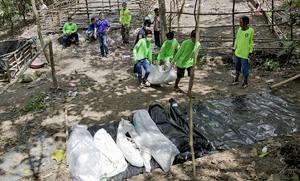
The mass graves were found near 17 abandoned camps in Padang Besar area on the Thai side of the border and they are believed to be a part of human-trafficking activities involving migrants, Home Minister Zahid Hamidi said.

The Minister said the General Operations Force (GOF) had found 14 large tents and three other smaller tents, believed to have been operational for at least five years but were abandoned when the authorities came to the location.

"Today, the inspector-general of police (IGP) and his deputy are at the Malaysia-Thailand border for identification and confirmation. The graves were identified as those for the refugees in the human trafficking trade. Probably, one grave has maybe three, four bodies or maybe only one. So we are counting at the moment," he said.

As governments in Thailand, Malaysia and Indonesia have launched crackdowns amid intensified international spotlight, human traffickers have abandoned camps on land and even boats at sea to avoid arrest.

In many instances, these traffickers have been paid by the miniority Rohingya Muslims from Myanmar to help them flee to Malaysia or Indonesia.

The traffickers reportedly held them to ransom in the jungle camps demanding more money and in many cases leaving them to die quickly burying them in mass graves.

A few weeks ago hundreds of Muslim Rohingyas were found crammed in boats heading to Malaysia and Indonesia.

Human rights groups and activists say the area on the Thai-Malaysia border has been used for years to smuggle migrants and refugees, including Rohingya Muslims, a persecuted minority in Myanmar.

Since May 10 alone, more than 3,600 people - about half of them from Bangladesh and half Rohingyas from Myanmar - have landed ashore in Indonesia, Malaysia and Thailand.

Thousands more are believed to be trapped at sea in boats abandoned by their captains.

Mass graves were discovered in Thailand earlier this month mostly in southern Songkla province bordering Malaysia.

The Rohingya, numbering around 1.3 million in Myanmar, are believed to be one of the most persecuted minorities in the world.

Comments

Add new comment

  • Coastaldigest.com reserves the right to delete or block any comments.
  • Coastaldigset.com is not responsible for its readers’ comments.
  • Comments that are abusive, incendiary or irrelevant are strictly prohibited.
  • Please use a genuine email ID and provide your name to avoid reject.
News Network
June 13,2020

Shanghai, Jun 13: Authorities in Beijing have temporarily shut a major wholesale agricultural market following a rise in locally transmitted novel coronavirus infections in China's capital city over the past two days.

The closure of the Xinfadi wholesale market at 3 a.m. local time on Saturday (1900 GMT on Friday), came after two men working at a meat research centre who had recently visited the market were reported on Friday as having been infected by the novel coronavirus. It was not immediately clear how the men had been infected.

Concern is growing of a second wave of the new virus, even in many countries that seemed to have curbed its spread. It was first reported at a seafood market in Wuhan, the capital of central China's Hubei province, in December.

Beijing authorities had earlier halted beef and mutton trading at the Xinfadi market, alongside closures at other wholesale markets around the city.

Reflecting concerns over the risk of further spread of the virus, major supermarkets in Beijing removed salmon from their shelves overnight after the virus causing COVID-19 was discovered on chopping boards used for imported salmon at the market, the state-owned Beijing Youth Daily reported.

Beijing authorities said more than 10,000 people at the market will take nucleic acid tests to detect coronavirus infections. The city government also said it had dropped plans to reopen schools on Monday for students in grades one through three because of the new cases.

Health authorities visited the home of a Reuters reporter in Beijing's Dongcheng district on Saturday to ask whether she had visited the Xinfadi market, which is 15 km (9 miles) away. They said the visit was part of patrols Dongcheng was conducting.

Listen to the latest songs, only on JioSaavn.com

China reported 11 new COVID-19 cases and seven asymptomatic cases for Friday, the national health authority said on Saturday. And all six locally transmitted cases were confirmed in Beijing.

Comments

Add new comment

  • Coastaldigest.com reserves the right to delete or block any comments.
  • Coastaldigset.com is not responsible for its readers’ comments.
  • Comments that are abusive, incendiary or irrelevant are strictly prohibited.
  • Please use a genuine email ID and provide your name to avoid reject.
News Network
March 4,2020

Tokyo, Mar 4: Takeda Pharmaceutical Co said on Wednesday it was developing a drug to treat COVID-19, the flu-like illness that has struck more than 90,000 people worldwide and killed over 3,000.

The Japanese drugmaker is working on a plasma-derived therapy to treat high-risk individuals infected with the new coronavirus and will share its plans with members of the U.S. Congress on Wednesday, it said in a statement.

Takeda is also studying whether its currently marketed and pipeline products may be effective treatments for infected patients.

"We will do all that we can to address the novel coronavirus threat...(and) are hopeful that we can expand the treatment options," Rajeev Venkayya, president of Takeda's vaccine business, said in the statement.

Takeda said it was in talks with various health and regulatory agencies and healthcare partners in the United States, Asia and Europe to move forward its research into the drug.

Its research requires access to the blood of people who have recovered from the respiratory disease or who have been vaccinated, once a vaccine is developed, Takeda said.

Comments

Add new comment

  • Coastaldigest.com reserves the right to delete or block any comments.
  • Coastaldigset.com is not responsible for its readers’ comments.
  • Comments that are abusive, incendiary or irrelevant are strictly prohibited.
  • Please use a genuine email ID and provide your name to avoid reject.
News Network
July 3,2020

Jul 3: China under President Xi Jinping has stepped up its "aggressive" foreign policy toward India and "resisted" efforts to clarify the Line of Actual Control that prevented a lasting peace from being realised, according to a report released by a US Congress appointed commission.

The armies of India and China have been locked in a bitter standoff at multiple locations in eastern Ladakh for the last seven weeks, and the tension escalated after 20 Indian soldiers were killed in a violent clash in the Galwan Valley on June 15.

“Under General Secretary of the Chinese Communist Party (CCP) Xi Jinping, Beijing has stepped up its aggressive foreign policy toward New Delhi. Since 2013, China has engaged in five major altercations with India along the Line of Actual Control (LAC),” said a brief issued by US-China Economic and Security Review Commission.

"Beijing and New Delhi have signed a series of agreements and committed to confidence-building measures to stabilise their border, but China has resisted efforts to clarify the LAC, preventing a lasting peace from being realised,” said the report and was prepared at the request of the Commission to support its deliberations.

Authored by Will Green, a Policy Analyst on the Security and Foreign Affairs Team at the Commission, the report says that the Chinese government is particularly fearful of India’s growing relationship with the United States and its allies and partners.

“The latest border clash is part of a broader pattern in which Beijing seeks to warn New Delhi against aligning with Washington,” it said.

After Xi assumed power in 2012, there was a significant increase in clashes, despite the fact that he met Prime Minister Narendra Modi several times and Beijing and New Delhi have agreed to a series of confidence-building mechanisms designed to mitigate tensions.

Prior to 2013, the last major border clash was in 1987. The 1950s and 1960s were a particularly tense period, culminating in 1962 with a war that left thousands of soldiers dead on both sides, according to the records of China's People's Liberation Army, the report said.

“The 2020 skirmish is in line with Beijing’s increasingly assertive foreign policy. The clash came as Beijing was aggressively pressing its other expansive sovereignty claims in the Indo-Pacific region, such as over Taiwan and in the South and East China seas,” it said.

China is engaged in hotly contested territorial disputes in both the South China Sea and the East China Sea. Beijing has built up and militarised many of the islands and reefs it controls in the region. Both areas are stated to be rich in minerals, oil and other natural resources and are vital to global trade.

China claims almost all of the South China Sea. Vietnam, the Philippines, Malaysia, Brunei and Taiwan have counter claims over the area.

Several weeks before the clash in the Galwan Valley, Chinese Defence Minister Wei Fenghe called on Beijing to “use fighting to promote stability” as the country’s external security environment worsened, a potential indication of China’s intent to proactively initiate military tensions with its neighbours to project an image of strength, the report said.

Comments

Add new comment

  • Coastaldigest.com reserves the right to delete or block any comments.
  • Coastaldigset.com is not responsible for its readers’ comments.
  • Comments that are abusive, incendiary or irrelevant are strictly prohibited.
  • Please use a genuine email ID and provide your name to avoid reject.