


Massive US bomb death toll rises to 94: Afghan official

April 15, 2017

Kabul, Apr 15: The number of militants killed in an attack by the largest non-nuclear weapon ever used in combat by the US military has risen to 94, an Afghan official said today. Ataullah Khogyani, spokesman for the provincial governor in Nangarhar, said the number of Islamic State group dead was up from the 36 reported a day earlier.
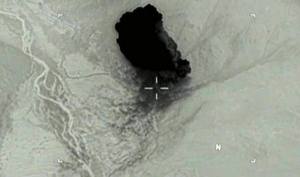
mobA Ministry of Defence official had said yesterday the number of dead could rise as officials assessed the bomb site in Achin district. "Fortunately there is no report of civilians being killed in the attack," Khogyani said.

The US attack on a tunnel complex in remote eastern Nangarhar province near the Pakistan border killed at least four IS group leaders, Khogyani said. He said a clearance operation to assess the site of the attack was continuing.

The strike using the Massive Ordnance Air Blast bomb, or MOAB, was carried out Thursday against an Islamic State group tunnel complex carved into the mountains that Afghan forces had tried to assault repeatedly in recent weeks in fierce fighting in Nangarhar province.

The office of President Ashraf Ghani said Friday there was "close coordination" between the U.S. military and the Afghan government on the operation, and they were careful to prevent any civilian casualties.

The US estimates 600-800 IS fighters are in Afghanistan, mostly in Nangarhar. The US has concentrated on fighting them while also supporting Afghan forces against the Taliban. The US has more than 8,000 US troops in Afghanistan, training local forces and conducting counterterrorism operations.

Also on Saturday, Khogyani said a district leader and three others were wounded when their vehicle was targeted by a bomb. One of the wounded was Ghalib Mujahid, Bati Kot district chief, he said. "The district chief and others are out of danger and are not in life-threatening condition," he said.

Last November, Mujahid was attacked by a sticky bomb attached to the vehicle and he was wounded and his driver was killed.

Comments

Add new comment

  • Coastaldigest.com reserves the right to delete or block any comments.
  • Coastaldigset.com is not responsible for its readers’ comments.
  • Comments that are abusive, incendiary or irrelevant are strictly prohibited.
  • Please use a genuine email ID and provide your name to avoid reject.
News Network
February 12,2020

Saint Martin's Island, Feb 12: At least 15 women and children drowned and more than 50 others were missing after a boat overloaded with Rohingya refugees sank off southern Bangladesh as it tried to reach Malaysia Tuesday, officials said.

Some 138 people -- mainly women and children -- were packed on a trawler barely 13 metres (40 feet) long, trying to cross the Bay of Bengal, a coast guard spokesman told news agency.

"It sank because of overloading. The boat was meant to carry maximum 50 people. The boat was also loaded with some cargo," another coast guard spokesman, Hamidul Islam, added.

Nearly one million Rohingya live in squalid camps near Bangladesh's border with Myanmar, many fleeing the neighbouring country after a 2017 brutal military crackdown.

With few opportunities for jobs and education in the camps, thousands have tried to reach other countries like Malaysia and Thailand by attempting the hazardous 2,000-kilometre journey.

In the latest incident, 71 people have been rescued including 46 women. Among the dead, 11 were women and the rest children.

Anwara Begum said two of her sons, aged six and seven, drowned in the tragedy.

"We were four of us in the boat... Another child (son, aged 10) is very sick," the 40-year-old told news agency.

Fishermen tipped off the coast guard after they saw survivors swimming and crying for help in the sea.

The boat's keel hit undersea coral in shallow water off Saint Martin's Island, Bangladesh's southernmost territory, before it sank, survivors said.

"We swam in the sea before boats came and rescued us," said survivor Mohammad Hossain, 20.

Coast guard commander Sohel Rana said three survivors, including a Bangladeshi, were detained over human trafficking allegations.

An estimated 25,000 Rohingya left Bangladesh and Myanmar on boats in 2015 trying to get to Thailand, Malaysia and Indonesia. Hundreds drowned when overloaded boats sank.

Begum said her family paid a Bangladeshi trafficker $450 per head to be taken to Malaysia.

"We're first taken to a hill where we stayed for five days. Then they used three small trawlers to take us to a large trawler, which sank," she said.

Shakirul Islam, a migration expert whose group works with Rohingya to raise awareness against trafficking, said desperation in the camps was making refugees want to leave.

"It was a tragedy waiting to happen," he said.

"They just want to get out, and fall victim to traffickers who are very active in the camps."

Islam said in the past two months dozens of Rohingya reported approaches from traffickers to his OKUP migration rights group.

"Human smuggling and trafficking in the Bay of Bengal is particularly difficult to address as it requires concerted effort from multiple states," the Bangladesh head of UN agency the International Organization for Migration, Giorgi Gigauri, told news agency.

"The gaps in coordination are easily exploited by criminal networks."

Since last year, Bangladeshi authorities have picked up over 500 Rohingya from rickety fishing trawlers or coastal villages as they waited to board boats.

Trafficking often increases during the November-March period when the sea is safest for the small trawlers used by traffickers.

Bangladesh and Myanmar signed a repatriation deal to send back some Rohingya to their homeland, but none have agreed to return because of safety fears.

The charity Save the Children called on Myanmar to "take all necessary steps to ensure the Rohingya community can return to their homes in a safe and dignified manner".

"The tragic drowning of women and children... should be a wake-up call for us all," the group's Athena Rayburn said in a statement.

Comments

Add new comment

  • Coastaldigest.com reserves the right to delete or block any comments.
  • Coastaldigset.com is not responsible for its readers’ comments.
  • Comments that are abusive, incendiary or irrelevant are strictly prohibited.
  • Please use a genuine email ID and provide your name to avoid reject.
Agencies
May 31,2020

Washington, May 31: US President Donald Trump said Saturday he will delay the G7 summit scheduled to take place in June and invite other countries -- including India and Russia -- to join the meeting.

"I don't feel that as a G7 it properly represents what's going on in the world. It's a very outdated group of countries," Trump told reporters on Air Force One.

He said he would like to invite Russia, South Korea, Australia and India to join an expanded summit in the fall.

It could happen in September, either before or after the UN General Assembly, Trump said, adding that "maybe I'll do it after the election."

Americans head to the polls in early November to choose a new president, with Trump keen for a return to normalcy after the coronavirus pandemic and a healthy economy as voters cast their ballots.

Describing the event as a "G-10 or G-11", Trump said he had "roughly" broached the topic with leaders of the four other countries.

Leaders from the Group of Seven, which the United States heads this year, had been scheduled to meet by videoconference in late June after COVID-19 scuttled plans to gather in-person at Camp David, the US presidential retreat outside Washington.

Trump created suspense last week, however, when he announced that he might hold the huge gathering in-person after all, "primarily at the White House" but also potentially parts of it at Camp David.

German Chancellor Angela Merkel became the first leader to decline the in-person invitation outright.

"Considering the overall pandemic situation, she cannot agree to her personal participation, to a journey to Washington," her spokesman said Saturday.

Her response followed ambivalent to positive reactions to the invitation from Britain, Canada and France.

The 65-year-old chancellor is the oldest G7 leader after Trump, who is 73. Japan's Shinzo Abe, also 65, is several months younger than Merkel. Their age puts them at higher risk from the coronavirus.

The G7 major advanced countries -- Britain, Canada, France, Germany, Italy, Japan and the United States -- hold annual meetings to discuss international economic coordination.

Russia was thrown out of what was the G8 in 2014 after it seized Ukraine's Black Sea peninsula of Crimea, an annexation never recognized by the international community.

The work of the G7 is now more important than ever as countries struggle to repair coronavirus-inflicted damage.

The White House had previously said the huge diplomatic gathering would be a "show of strength" when world economies are gradually reemerging from shutdowns.

The United States is the worst-hit country for COVID-19 infections, recording more than 1.7 million cases and over 103,680 deaths.

Comments

Add new comment

  • Coastaldigest.com reserves the right to delete or block any comments.
  • Coastaldigset.com is not responsible for its readers’ comments.
  • Comments that are abusive, incendiary or irrelevant are strictly prohibited.
  • Please use a genuine email ID and provide your name to avoid reject.
Agencies
April 20,2020

Hong Kong, Apr 20: Oil prices collapsed to more than two-decade lows Monday as traders grow concerned that storage facilities are reaching their limits, while equities were mixed, with some support coming from signs that the coronavirus may have peaked in Europe and the United States.

US crude benchmark West Texas Intermediate briefly plunged almost 20 percent to below 15 -- its lowest since 1999 -- as stockpiles continue to build owing to a crash in demand caused by the COVID-19 pandemic.

Analysts said this month's agreement between top producers to slash output by 10 million barrels a day was having little impact on the oil crisis because of lockdowns and travel restrictions that are keeping billions of people at home.

WTI was hit particularly hard as its main US storage facilities in Cushing, Oklahoma, were filling up.

ANZ said "crude oil prices remained under pressure, as projections of weaker demand weigh on sentiment".

"Despite the OPEC+ alliance agreeing to an unprecedented cut in output, the physical market is awash with oil," it said, referring to the Organization of the Petroleum Exporting Countries and non-OPEC partners.

And AxiCorp's Stephen Innes added: "It's a dump at all cost as no one... wants delivery of oil, with Cushing storage facilities filling by the minute.

"It hasn't taken long for the market to recognise that the OPEC+ deal will not, in its present form, be enough to balance oil markets." Stock traders were in slightly more buoyant mood as governments start to consider how and when to ease lockdowns that have crippled the global economy.

Italy, Spain, France and Britain reported drops in daily death tolls and slowing infection rates.

"We are scoring points against the epidemic," said Prime Minister Edouard Philippe, while insisting "we are not out of the health crisis yet".

Meanwhile, in the US, Andrew Cuomo, governor of badly hit New York state, said the disease was "on the descent", though he cautioned it was "no time to get cocky".

Mounting evidence suggests that the lockdowns and social distancing are slowing the spread of the virus.

That has intensified planning in many countries to begin loosening curbs on movement and easing the crushing pressure on national economies.

Adding to the sense of hope was a report indicating promising research on a drug to treat coronavirus.

Hong Kong, Shanghai and Seoul were each up 0.1 percent, while Wellington added 0.4 percent.

However, Tokyo went into the break 0.9 percent lower, while Sydney and Manila dropped one percent apiece. There were also losses in Taipei, Singapore and Jakarta.

"The longer investors have to contemplate future economic issues while they wait for more countries to be on the downward slope of the pandemic curve, the more scope there is of risk assets pricing in a difficult future," Chris Iggo, of AXA Investment Managers UK, said.

Investors are keeping an eye on Washington, where Congress and the White House are working towards a 450 billion economic relief plan for small business to add to the trillions already pledged to support the economy.

Big-name companies including IBM, Netflix and Coca-Cola are due to deliver their earnings reports.

Comments

Add new comment

  • Coastaldigest.com reserves the right to delete or block any comments.
  • Coastaldigset.com is not responsible for its readers’ comments.
  • Comments that are abusive, incendiary or irrelevant are strictly prohibited.
  • Please use a genuine email ID and provide your name to avoid reject.