



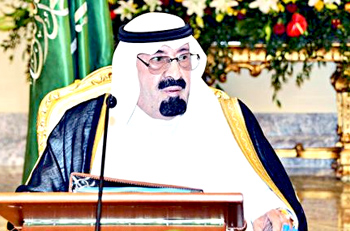
Media mustn’t influence public opinion negatively: Saudi King

May 7, 2014

Saudi_KingJeddah, May 7: Custodian of the Two Holy Mosques King Abdullah reiterated the role of the media in promoting peace and stability across the world during the three-day Asia Media Summit 2014, which was inaugurated here on Tuesday.

“We hope this summit will strengthen media cooperation between Asian countries,” said the king in his keynote speech, which was read out by Culture and Information Minister Abdul Aziz Khoja.

King Abdullah reminded media personalities of their responsibility in disseminating accurate information and appealed to them to propagate sound ideas that encourage reconciliation and harmony.

“The message of Islam, which originated from this country, insists that good words should be the basis for disseminating noble values to improve human behavior in order to build a better civilization,” said the king.

The king cited a Qur’anic verse to reinforce his message. “Have you not considered how Allah presents an example, (making) a good word like a good tree, whose root is firmly fixed and its branches (high) in the sky? It produces its fruit all the time, by permission of its Lord.”

The king warned against using the media to negatively influence public opinion. “Countries around the world are exposed to extraneous cultural influences that shake the foundations of humanitarian and religious values because of the dissemination of irresponsible media content,” he said. “We request that media experts use their influence constructively.”

The king exhorted the media to respect religious values and fortify the fence of morality.

He also stressed the role of the media in ending the tragedies and clashes afflicting the world.

“It is no secret that man-made tragedy fills media outlets these days,” he said.

“This is where the role of responsible media reporting comes in.”

Riyadh Kamal Najm, president of the General Authority for Audio and Visual Media, said the summit offers a good opportunity for government officials and executives to exchange views on improving media management in Asia and other parts of the world.

He emphasized the growing role of media in educating the public. “Media organizations have played an important role in boosting development in the Third World countries,” he said.

Najm emphasized the need for powerful media organizations that can shape public opinion on various political, economic and social issues.

“We have achieved unprecedented progress through information technology, including computers and cellphones, which has changed the way people get information,” he said.

He called for the need to stop misusing information technology and social media sites. “We need regulations that can help weed out and check mischief-makers and troublemakers,” he said.

In her inaugural address, Rosarita Niken Widiastuti, president of the Asia-Pacific Institute for Broadcasting Development and director of Radio Republic Indonesia, thanked Saudi Arabia for hosting the summit and praised the Kingdom for playing a positive role in promoting media ethics.

The conference provides a platform for broadcasters in the region to share their thoughts on broadcasting and information. In attendance are decision-makers, media professionals, scholars and stakeholders of news and programming companies from Asia, Pacific, Africa, Europe, Middle East and North America.

Comments

Add new comment

  • Coastaldigest.com reserves the right to delete or block any comments.
  • Coastaldigset.com is not responsible for its readers’ comments.
  • Comments that are abusive, incendiary or irrelevant are strictly prohibited.
  • Please use a genuine email ID and provide your name to avoid reject.
News Network
April 26,2020

Abu Dhabi, Apr 26: Indian Ambassador to the UAE Pavan Kapoor says he is appalled after the bodies of three Indians flown back to India were returned to Abu Dhabi on Friday.

The three deceased Indian nationals had died of non-coronavirus causes and were flown to Delhi on Thursday but were promptly returned by authorities there.

“We are appalled at what has happened,” Kapoor told Gulf News. “We do not know if the bodies were returned because of coronavirus-related restrictions, but we are obviously not sending the remains of people [who have passed away from COVID-19],” he added.

“[As we understand], it happened because of new protocols at the airport and we are trying to sort it out,” he said.

Sent back a few hours later

“The remains were not offloaded from the plane, and were sent back a few hours later,” Kapoor explained.

The deceased were Kamlesh Bhatt, who passed away on April 17, and Sanjeev Kumar and Jagsir Singh who both died on April 13.

According to reports in Indian media, Kamlesh Bhat was 23 years old, and hailed from Tehri Garhwal district. He allegedly died of cardiac arrest. Along with the remains Kumar and Singh, Bhatt’s body was initially repatriated on an Etihad Airways flight, then sent back, even though his relatives had been on their way to collect them.

Kapoor explained the procedure through which remains are normally returned to family members back home, saying that the worker’s employer typically makes arrangements with cargo companies to repatriate bodies on cargo aircraft.

The employer applies for a No Objection Certificate from the Indian Embassy, which is granted once the Embassy ensures that all local formalities have been completed. The cargo company then applies for airport clearance, and the airline obtains approvals from the receiving airport.

“If airport protocols have changed, it means cargo companies have to be more careful about the clearance they’re getting,” Kapoor advised.

Additional costs
The ambassador added there may eventually be additional costs to repatriate the bodies but that it is first necessary to sort out the concerns.

The global coronavirus outbreak has spawned difficulties in repatriating mortal remains as a result of the travel restrictions imposed by countries. Remains of people dying from COVID-19 are not being sent back, but the caution surrounding the handling of bodies often affects the repatriation of those who succumb to other causes.

As Gulf News reported, Kerala chief minister Pinarayi Vijayan reached out to Indian Prime Minister Narendra Modi on Friday for intervention in bringing back the bodies of Keralites who have died in the Gulf from non-COVID-19 causes.

“I would like to draw your attention to the grievances received from Non-resident Keralites Associations (NRKs) in the Gulf Cooperation Council (GCC) countries on the delay caused in bringing home the mortal remains of NRKs who had expired due to reasons other than the COVID-19 infection,” read the letter by the CM.

“It is learnt that a ‘clearance certificate’ from the Indian Embassies is required to process the application of bringing home the mortal remains of the dead. The Embassies are [further] insisting on the production of a no-objection certificate from the Ministry of Home Affairs (MHA), New Delhi. To enable to bring back the bodies of the NRIs whose deaths occurred due to reasons other than COVID-19 infection, without necessary procedural hassles, I request your kind intervention,” Vijayan has requested.

Comments

Add new comment

  • Coastaldigest.com reserves the right to delete or block any comments.
  • Coastaldigset.com is not responsible for its readers’ comments.
  • Comments that are abusive, incendiary or irrelevant are strictly prohibited.
  • Please use a genuine email ID and provide your name to avoid reject.
News Network
April 28,2020

Riyadh, Apr 28: The number of confirmed coronavirus cases in Saudi Arabia crossed the critical 20,000-mark on Tuesday with the discovery of 1,266 new cases. Eight new deaths were also recorded during the last 24 hours, bringing the virus-related death toll to 152.

Twenty-three percent of the new cases are of Saudi nationals, while 77 percent are of non-Saudi residents, Saudi Press Agency (SPA) quoted the ministry spokesman Dr. Muhammad Al-Abdel Ali as saying.

Out of the total 20,077 cases till Tuesday, 17,141 cases are active, he added. A total of 118 cases are currently critical, the spokesman said.

Out of the 1,266 new cases, 327 were reported in Makkah, 273 in Madinah, 262 in Jeddah, and 171 in Riyadh. There were 58 cases in Jubail, 35 in Dammam, 32 in Taif, 29 in Tabuk and 18 in Al-Zulfi. Additionally, nine cases were recorded in Khulais; eight in Buraidah; seven in Al-Khobar; five in Hufof; four each in Qatif and Ras Tanura; three in Adhum; two each in Al-Jafr, Al-Majaridah, Yanbu, Bisha and Diriyah; and one each in Abha, Khamis Mushayt, Baqeeq, Dhahran, Dhalum, Sabiya, Hafr Al Batin, Hail, Sakaka, Wadi Al-Dawasir and Sajr, the spokesman said.

The Kingdom saw a spike in cases when the health ministry began its field-testing efforts nearly two weeks ago, targeting suspected infection cluster areas. Since then, there has been a steady increase in daily cases.

Till Monday, around 1 million people were screened in various neighborhoods throughout the Kingdom.

Comments

Add new comment

  • Coastaldigest.com reserves the right to delete or block any comments.
  • Coastaldigset.com is not responsible for its readers’ comments.
  • Comments that are abusive, incendiary or irrelevant are strictly prohibited.
  • Please use a genuine email ID and provide your name to avoid reject.
News Network
July 1,2020

Riyadh, Jul 1: Saudis braced Wednesday for a tripling in value added tax, another unpopular austerity measure after the twin shocks of coronavirus and an oil price slump triggered the kingdom's worst economic decline in decades.

Retailers in the country reported a sharp uptick in sales this week of everything from gold and electronics to cars and building materials, as shoppers sought to stock up before VAT is raised to 15 percent.

The hike could stir public resentment as it weighs on household incomes, pushing up inflation and depressing consumer spending as the kingdom emerges from a three-month coronavirus lockdown.

"Cuts, cuts, cuts everywhere," a Saudi teacher in Riyadh told AFP, bemoaning vanishing subsidies as salaries remain stagnant.

"Air conditioner, television, electronic items," he said, rattling off a list of items he bought last week ahead of the VAT hike.

"I can't afford these things from Wednesday."

With its vast oil wealth funding the Arab world's biggest economy, the kingdom had for decades been able to fund massive spending with no taxes at all.

It only introduced VAT in 2018, as part of a push to reduce its dependence on crude revenues.

Then, seeking to shore up state finances battered by sliding oil prices and the coronavirus crisis, it announced in May that it would triple VAT and halt a cost-of-living monthly allowance to citizens.

The austerity push underscores how Saudi Arabia's once-lavish spending is becoming a thing of the past, with the erosion of the welfare system leaving a mostly young population to cope with reduced incomes and a lifestyle downgrade.

That could pile strain on a decades-old social contract whereby citizens were given generous subsidies and handouts in exchange for loyalty to the absolute monarchy.

The rising cost of living may prompt many to ask why state funds are being lavished on multi-billion-dollar projects and overseas assets, including the proposed purchase of English football club Newcastle United.

Shopping malls in the kingdom have drawn large crowds in recent days as retailers offered "pre-VAT sales" and discounts before the hike kicks in.

A gold shop in Riyadh told AFP it saw a 70 percent jump in sales in recent weeks, while a car dealership saw them tick up by 15 percent.

Once the new rate is in place, businesses are predicting depressed sales of everything from cars to cosmetics and home appliances.

Capital Economics forecast inflation will jump up to six percent year-on-year in July, from 1.1 percent in May, as a result.

"The government ended the country's lockdown (in June) and there are signs that economic activity has started to recover," Capital Economics said in a report.

"Nonetheless, we expect the recovery to be slow-going as fiscal austerity measures bite."

The kingdom also risks losing its edge against other Gulf states, including its principal ally the United Arab Emirates, which introduced VAT at the same time but has so far refrained from raising it beyond five percent.

"Saudi Arabia is taking massive risks with contractionary fiscal policies," said Tarek Fadlallah, chief executive officer of the Middle East unit of Nomura Asset Management.

But the kingdom has few choices as oil revenue declines.

Its finances have taken another blow as authorities massively scaled back this year's hajj pilgrimage, from 2.5 million pilgrims last year to around a thousand already inside the country, and suspended the lesser umrah because of coronavirus.

Together the rites rake in some $12 billion annually.

The International Monetary Fund warned the kingdom's GDP will shrink by 6.8 percent this year -- its worst performance since the 1980s oil glut.

The austerity drive would boost state coffers by 100 billion riyals ($26.6 billion), according to state media.

But the measures are unlikely to plug the kingdom's huge budget deficit.

The Saudi Jadwa Investment group forecasts the shortfall will rise to a record $112 billion this year.

Comments

Add new comment

  • Coastaldigest.com reserves the right to delete or block any comments.
  • Coastaldigset.com is not responsible for its readers’ comments.
  • Comments that are abusive, incendiary or irrelevant are strictly prohibited.
  • Please use a genuine email ID and provide your name to avoid reject.