



Meet Apple"s iPhones, Smartwatch: All you need to know

September 10, 2014

Sep 10: For the first time in years, Apple"s iPhones aren"t the star of the show. Apple unveiled a smartwatch on Tuesday, a wearable device that marks the company"s first major entry in a new product category since the iPad"s debut in 2010.
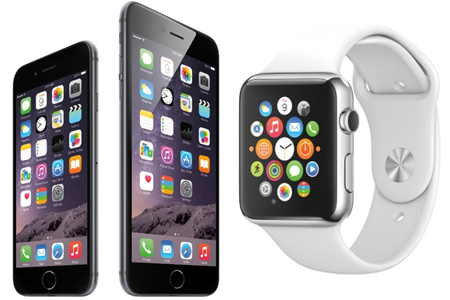
Apples iPhonesThe move is significant because of recent questions about whether Apple still has a knack for innovating following the 2011 death of co-founder Steve Jobs.

The device"s introduction upstaged the company"s two new, larger iPhones, which won"t just have bigger screens; they"ll have a new, horizontal viewing mode to take advantage of the larger display.

The iPhone 6 will have a screen measuring 4.7 inches, while the iPhone 6 Plus will be 5.5 inches. In both cases, app developers will be able to design apps that can be viewed differently when the phone is held horizontally.

Apple also introduced a system for using the phone to make credit card payments at retail stores.

Apple is turning to the past as it lays out its future. The company is holding the event at the Flint Center for the Performing Arts, the same venue where Jobs unveiled the industry-shifting Mac computer 25 years ago. The Cupertino, California, venue is near Apple"s headquarters.

As for the iPhones, which still represent the main source of Apple"s profits, larger models should help the company compete with Android devices.

LARGER iPHONES

Now, Apple is increasing that. The iPhone 6 will have a 4.7-inch screen, while the iPhone 6 Plus will be 5.5 inches. The screen resolution on the Plus version will be sharper than previous iPhones, at 401 pixels per inch rather than 326.

With the larger screen comes a new horizontal view of the home screen. Usually, icons are stacked vertically, even when the phone is turned horizontally. App developers will also have new tools to rearrange their content to take advantage of that larger screen.

The new phones aren"t as big as Samsung"s latest flagship phones — 5.1 inches for the Galaxy S5 and 5.7 inches for the Note 4 — but they will be large enough to neutralize a key advantage Samsung and other Android manufacturers have had.

Notably, Samsung"s Note phone isn"t getting bigger this year. Last year"s Note 3 was 5.7 inches. Instead, Samsung is emphasizing other hardware features, such as a sharper screen. It"s also releasing a model with a curved edge to display weather, time and other information on the side of the phone.

Apple says the new phones will be faster and have better battery life than previous versions. The phones will also have a new sensor, the barometer, to estimate how much you"ve climbed stairs, not just how far you"ve walked or run.

Of course, some people still use their phones to actually make calls. When there"s poor cellular reception, people will be able to make regular calls over Wi-Fi. The handoff between the two networks will be seamless. In the U.S., this feature will initially be available through T-Mobile.

The resolution on the camera is staying at 8 megapixels, while rival Android and Windows phones have been boosting that. The S5, for instance, is at 16 megapixels. However, the megapixel count is only one factor in what makes a good photo. Apple says it is putting in new sensors for better shots.

Apple is also improving a slow-motion video feature by allowing even slower shots. The camera will be able to take 240 frames per second, double what"s in last year"s iPhone 5s. Normally, video is at 60 frames per second.

The new phones will start shipping in the U.S. on Sept. 19, with advance orders to begin this Friday. Starting prices will be comparable to those in the past — $199 with a two-year contract for the iPhone 6 with 16 gigabytes of storage.

However, the step-up models will have double the memory than before — $299 for 64 gigabytes and $399 for 128 gigabytes. The iPhone 6 Plus phones will cost $100 more at each configuration.

MOBILE PAYMENTS

Apple is calling its new payment system Apple Pay. You"ll be able to use your phone"s camera to capture a photo of your card. Apple will verify it behind the scenes and add it to your phone"s Passbook account so you can make payments at a retailer. Apple announced several merchants that will accept this system, including Macy"s, Whole Foods, Walgreens and Disney stores — and of course, Apple stores.

Many companies have tried to push mobile payment services, but none has caught on widely. Cook says that"s because the business models have been centered around companies" self-interest instead of the user experience. The latter, Cook says, is “exactly what Apple does best.”

For security, the card number is stored only on the device. Each time you pay, a one-time card number is created to make the transaction.

APPLE WATCH

Apple"s new wearable device has been dubbed the iWatch. It"s likely to be a computerized watch or bracelet to help people monitor health, manage homes and even buy merchandise.

Consumer electronics companies have yet to demonstrate a compelling need for smartwatches, while bracelets have largely been niche products aimed at tracking fitness activities. Apple"s device is expected to do more and do it well.

Consider the company"s track record: Music players, smartphones and tablet computers existed long before Apple made its own versions. But they weren"t mainstream or popular until the iPod, iPhone and iPad came along. Under Jobs, Apple made those products easy and fun to use.

Apple may use Tuesday"s event merely to announce the wearable product, along with the price. There"s speculation that the device wouldn"t be available until early next year, though Apple was expected to start taking advance orders during the holiday shopping season.

NEW SOFTWARE

Though much of the attention has been on new gadgets, the software powering those gadgets is getting its annual refresh. Apple considers iOS 8 to be its biggest update since the introduction of the app store in 2008.

Existing iPhone and iPad users will be eligible for the free upgrade, too. Apple takes pride in pushing existing customers to the latest software, allowing app developers to incorporate new features without worrying about abandoning existing users. With Android, many recent phones can"t be upgraded right away because of restrictions placed by manufacturers and wireless carriers.

Among other things, iOS 8 will let devices work better in sync. For instance, it"ll be possible to start a message on an iPhone and finish it on an iPad. With an upcoming Mac upgrade called Yosemite, it"ll be possible to continue working on that same message on a Mac computer as well.

The new iOS software will also let people do more things without jumping from app to app. For example, if a text message comes in as you"re composing an email, you"ll be able to pull down the text from the top edge and send a reply, all without leaving the email app.

A new keyboard aims to predict what you"re about to type, going beyond standard spell-checking. You can install keyboards from outside parties, too, something Android already allows.

In fact, Apple is opening up more of its features to outside developers than in the past. The fingerprint sensor on iPhones won"t be restricted to Apple"s own services, for instance.

The new software will be available to existing users on Sept. 17.

HOME AND HEALTH

Apple is rolling out the HomeKit and HealthKit systems. The idea is to turn Apple"s products into a suite of digital servants that do everything from monitoring a person"s eating habits and exercise routines to turning on the coffee maker in the morning.

Again, Apple isn"t first in offering home and health monitoring systems. But consumers haven"t rushed to buy those systems partly because products from various manufacturers don"t always work with one another. With HomeKit and HealthKit, Apple is seeking to create some unity — with Apple"s devices serving as a hub.

Comments

Add new comment

  • Coastaldigest.com reserves the right to delete or block any comments.
  • Coastaldigset.com is not responsible for its readers’ comments.
  • Comments that are abusive, incendiary or irrelevant are strictly prohibited.
  • Please use a genuine email ID and provide your name to avoid reject.
Agencies
February 5,2020

San Francisco, Feb 5: After a German artist, Simon Weckert, demonstrated how he "hacked" Google Maps with 99 smartphones and a wagon to create "virtual traffic jams" on the streets of Berlin, Google responded to the incident saying it "appreciates" creative use of maps.

Admitting that it has not quite cracked travelling by wagon, the tech giant also hinted that it might use cases like this to improve how its maps work.

"We appreciate seeing creative uses of Google Maps like this as it helps us make maps work better over time," 9to5Google quoted a Google spokesperson as saying.

In a YouTube video, Weckert showed that he put 99 smartphones with Google Maps onto a small wagon cart and then wheeled that cart around various streets in Berlin, including outside the Google office, Android Authority reported on Monday.

The smartphones "apparently fooled Google Maps" into thinking that there was a high concentration of users on those streets.

Because the second-hand phones were in a cart, Maps was further tricked into believing that the traffic was slow-moving.

As a result, the navigation app started showing virtual traffic jams by turning green streets to red in the online navigational tool, showcasing how digital technology can have a real impact on the real world.

"Traffic data in Google Maps is refreshed continuously thanks to information from a variety of sources, including aggregated anonymised data from people who have location services turned on and contributions from the Google Maps community," the Google spokesperson said.

"We've launched the ability to distinguish between cars and motorcycles in several countries including India, Indonesia and Egypt, though we haven't quite cracked travelling by wagon," the statement added. After a German artist, Simon Weckert, demonstrated how he "hacked" Google Maps with 99 smartphones and a wagon to create "virtual traffic jams" on the streets of Berlin, Google responded to the incident saying it "appreciates" creative use of maps.

Admitting that it has not quite cracked travelling by wagon, the tech giant also hinted that it might use cases like this to improve how its maps work.

"We appreciate seeing creative uses of Google Maps like this as it helps us make maps work better over time," 9to5Google quoted a Google spokesperson as saying.

In a YouTube video, Weckert showed that he put 99 smartphones with Google Maps onto a small wagon cart and then wheeled that cart around various streets in Berlin, including outside the Google office, Android Authority reported on Monday.

The smartphones "apparently fooled Google Maps" into thinking that there was a high concentration of users on those streets.

Because the second-hand phones were in a cart, Maps was further tricked into believing that the traffic was slow-moving.

As a result, the navigation app started showing virtual traffic jams by turning green streets to red in the online navigational tool, showcasing how digital technology can have a real impact on the real world.

"Traffic data in Google Maps is refreshed continuously thanks to information from a variety of sources, including aggregated anonymised data from people who have location services turned on and contributions from the Google Maps community," the Google spokesperson said.

"We've launched the ability to distinguish between cars and motorcycles in several countries including India, Indonesia and Egypt, though we haven't quite cracked travelling by wagon," the statement added.

Comments

Add new comment

  • Coastaldigest.com reserves the right to delete or block any comments.
  • Coastaldigset.com is not responsible for its readers’ comments.
  • Comments that are abusive, incendiary or irrelevant are strictly prohibited.
  • Please use a genuine email ID and provide your name to avoid reject.
Agencies
February 6,2020

Washington D.C., Feb 6: An international team of astronomers has found an unusual monster galaxy that existed about 12 billion years ago when the universe was only 1.8 billion years old.

The team of astronomers was led by scientists at the University of California, Riverside.

Dubbed XMM-2599, the galaxy formed stars at a high rate and then died. Why it suddenly stopped forming stars is unclear.

"Even before the universe was 2 billion years old, XMM-2599 had already formed a mass of more than 300 billion suns, making it an ultra massive galaxy," said Benjamin Forrest, a postdoctoral researcher in the UC Riverside Department of Physics and Astronomy and the study's lead author.

"More remarkably, we show that XMM-2599 formed most of its stars in a huge frenzy when the universe was less than 1 billion years old and then became inactive by the time the universe was only 1.8 billion years old," Forrest added.

The team used spectroscopic observations from the W. M. Keck Observatory's powerful Multi-Object Spectrograph for Infrared Exploration or MOSFIRE, to make detailed measurements of XMM-2599 and precisely quantify its distance.

The study results appear in the Astrophysical Journal.

"In this epoch, very few galaxies have stopped forming stars, and none are as massive as XMM-2599," said Gillian Wilson, a professor of physics and astronomy at UCR in whose lab Forrest works.

"The mere existence of ultramassive galaxies like XMM-2599 proves quite a challenge to numerical models. Even though such massive galaxies are incredibly rare at this epoch, the models do predict them."

"The predicted galaxies, however, are expected to be actively forming stars. What makes XMM-2599 so interesting, unusual, and surprising is that it is no longer forming stars, perhaps because it stopped getting fuel or its black hole began to turn on. Our results call for changes in how models turn off star formation in early galaxies," the professor stated.

The research team found XMM-2599 formed more than 1,000 solar masses a year in stars at its peak of activity -- an extremely high rate of star formation. In contrast, the Milky Way forms about one new star a year.

"XMM-2599 may be a descendant of a population of highly star-forming dusty galaxies in the very early universe that new infrared telescopes have recently discovered," said Danilo Marchesini, an associate professor of astronomy at Tufts University and a co-author on the study.

"We have caught XMM-2599 in its inactive phase," Wilson said, who led the W. M. Keck Observatory data acquisition
Co-author Michael Cooper, a professor of astronomy at UC Irvine, said this outcome is a strong possibility.

"Perhaps during the following 11.7 billion years of cosmic history, XMM-2599 will become the central member of one of the brightest and most massive clusters of galaxies in the local universe," he said.

"Alternatively, it could continue to exist in isolation. Or we could have a scenario that lies between these two outcomes," he stated.

The study was supported by grants from the National Science Foundation and NASA.

Comments

Add new comment

  • Coastaldigest.com reserves the right to delete or block any comments.
  • Coastaldigset.com is not responsible for its readers’ comments.
  • Comments that are abusive, incendiary or irrelevant are strictly prohibited.
  • Please use a genuine email ID and provide your name to avoid reject.
Agencies
June 16,2020

Paris, Jun 16: Increasing numbers of readers are paying for online news around the world even if the level of trust in the media, in general, remains very low, according to a report published Tuesday.

Around 20 percent of Americans questioned said they subscribed to an online news provider (up to four points over the previous year) and 42 percent of Norwegians (up eight points), along with 13 percent of the Dutch (up to three points), compared with 10 percent in France and Germany.

But between a third and a half of all news subscriptions go to just a few major media organisations, such as the New York Times, according to the annual Digital News Report by the Reuters Institute.

Some readers, however, are also beginning to take out more than one subscription, paying for a local or specialist title in addition to a national news source, the study's authors said.

But a large proportion of internet users say nothing could convince them to pay for online news, around 40 percent in the United States and 50 percent in Britain.

YouGov conducted the online surveys of 40 countries for the Reuters Institute in January, with 2,000 respondents in each.

Further surveys were carried out in six countries in April to analyse the initial effects of COVID-19.

The health crisis brought a revival of interest in television news -- with the audience rising five percent on average -- establishing itself as the main source of information along with online media.

Conversely, newspaper circulation was hard-hit by coronavirus lockdown measures.

The survey found trust in the news had fallen to its lowest level since the first report in 2012, with just 38 percent saying they trusted most news most of the time.

However, confidence in the news media varied considerably by country, ranging from 56 percent in Finland and Portugal to 23 percent in France and 21 percent in South Korea.

In Hong Kong, which has been hit by months of sometimes violent street protests against an extradition law, trust in the news fell 16 points to 30 percent over the year.

Chile, which has had regular demonstrations against inequality, saw trust in the media fall 15 percent while in Britain, where society has been polarised by issues such as Brexit, it was down 12 points.

Comments

Add new comment

  • Coastaldigest.com reserves the right to delete or block any comments.
  • Coastaldigset.com is not responsible for its readers’ comments.
  • Comments that are abusive, incendiary or irrelevant are strictly prohibited.
  • Please use a genuine email ID and provide your name to avoid reject.