



Mehbooba meets Governor; Hints at not being averse to BJP

December 31, 2014

Jammu, Dec 31: PDP leader Mehbooba Mufti today met Jammu and Kashmir Governor N N Vohra and dropped hints that her party is not averse to joining hands with BJP as she said the poll mandate was an "opportunity" for Prime Minister Narendra Modi and invoked Atal Bihari Vajpayee.
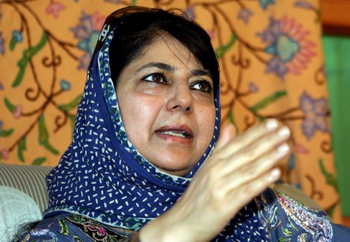
Mehbooba

Without giving details of what exactly she discussed with Vohra, Mehbooba said her meeting with the Governor was "informal" in the wake of a "decisive but divided mandate" thrown up by the recent Assembly polls.

Answering questions over the issue of government formation, she told reporters that "PDP's priority is not to cobble up a majority for the sake of government formation."

Whatever formation is firmed up, it should respect the mandate of the people and have the principle of "reconciliation", she said, adding "till that is not taken along, forming any government will be useless".

Mehbooba, whose party has bagged 28 seats in the 87-member Assembly, said the mandate was a "challenge and opportunity" for national leadership, be it NDA or Congress.

"For NDA government, it is a big responsibility, for Modi, it is a big responsibility. Jammu and Kashmir has been the biggest challenge for any PM right from Nehru till date," Mehbooba said.

Referring to Modi's "dream" of development and addressing the problem of unemployment, the PDP leader said there cannot be "development till there is peace on the ground".

In this regard, she invoked former Prime Minister and said "It is not possible till Vajpayeeji's political process is taken forward."

She noted that for peace in Jammu and Kashmir, Vajpayee had "started a political process. Vajpayeeji had started dialogue with Hurriyat, he had started dialogue with Pakistan when L K advani was the Deputy Prime Minister. We got generous economic package. UPA continued it for some time and then stopped it."

"It is not about BJP, NC or Congress but respect for PDP's agenda for reconciliation. If leadership rises to occasion and takes this mandate head on, then government formation is a matter of 15 minutes," the PDP chief said.

Mehbooba underlined that PDP had got "majority" in Kashmir valley while BJP had got "majority" in Jammu region and the mandate of the people needs to be respected.

She said if the "opportunity" is used, then Jammu and Kashmir can be a "model". In this context, she recalled the statement of Jawaharlal Nehru that the state can be a "showcase" to the world.

While replying to questions, she cited media reports to say that PDP has the support of over 55 MLAs.

Comments

Add new comment

  • Coastaldigest.com reserves the right to delete or block any comments.
  • Coastaldigset.com is not responsible for its readers’ comments.
  • Comments that are abusive, incendiary or irrelevant are strictly prohibited.
  • Please use a genuine email ID and provide your name to avoid reject.
News Network
May 29,2020

Bengaluru, May 29: Former prime minister H D Deve Gowda mourned the demise of Rajya Sabha member and Managing Director of leading Malayalam daily Mathrubhumi M P Veerendra Kumar, hailing him as a great journalist and writer.

"My deepest condolences on the demise of former union Minister and Rajya sabha member Shri M.P. Veerendra Kumar. He was a great journalist and writer. May god give strength to his family & his people to bear the loss," Gowda said in his condolence message.

Veerandra Kumar, who was a member of PTIs Board of Directors, died late Thursday at a private hospital in Kozhikode in Kerala following cardiac arrest.

Comments

Add new comment

  • Coastaldigest.com reserves the right to delete or block any comments.
  • Coastaldigset.com is not responsible for its readers’ comments.
  • Comments that are abusive, incendiary or irrelevant are strictly prohibited.
  • Please use a genuine email ID and provide your name to avoid reject.
News Network
January 13,2020

Jan 13: For the first time in years, the government of India’s Prime Minister Narendra Modi is playing defense. Protests have sprung up across the country against an amendment to India’s laws — which came into effect on Friday — that makes it easier for members of some religions to become citizens of India. The government claims this is simply an attempt to protect religious minorities in the Muslim-majority countries that border India; but protesters see it as the first step toward a formal repudiation of India’s constitutionally guaranteed secularism — and one that must be resisted.

Modi was re-elected prime minister last year with an enhanced majority; his hold over the country’s politics is absolute. The formal opposition is weak, discredited and disorganized. Yet, somehow, the anti-Citizenship Act protests have taken hold. No political party is behind them; they are generally arranged by student unions, neighborhood associations and the like.

Yet this aspect of their character is precisely what will worry Modi and his right-hand man, Home Minister Amit Shah. They know how to mock and delegitimize opposition parties with ruthless efficiency. Yet creating a narrative that paints large, flag-waving crowds as traitors is not quite that easy.

For that is how these protests look: large groups of young people, many carrying witty signs and the national flag. They meet and read the preamble to India’s Constitution, into which the promise of secularism was written in the 1970’s.

They carry photographs of the Constitution’s drafter, the Columbia University-trained economist and lawyer B. R. Ambedkar. These are not the mobs the government wanted. They hoped for angry Muslims rampaging through the streets of India’s cities, whom they could point to and say: “See? We must protect you from them.” But, in spite of sometimes brutal repression, the protests have largely been nonviolent.

One, in Shaheen Bagh in a Muslim-dominated sector of New Delhi, began simply as a set of local women in a square, armed with hot tea and blankets against the chill Delhi winter. It has now become the focal point of a very different sort of resistance than what the government expected. Nothing could cure the delusions of India’s Hindu middle class, trained to see India’s Muslims as dangerous threats, as effectively as a group of otherwise clearly apolitical women sipping sweet tea and sharing their fears and food with anyone who will listen.

Modi was re-elected less than a year ago; what could have changed in India since then? Not much, I suspect, in most places that voted for him and his party — particularly the vast rural hinterland of northern India. But urban India was also possibly never quite as content as electoral results suggested. India’s growth dipped below 5% in recent quarters; demand has crashed, and uncertainty about the future is widespread. Worse, the government’s response to the protests was clearly ill-judged. University campuses were attacked, in one case by the police and later by masked men almost certainly connected to the ruling party.

Protesters were harassed and detained with little cause. The courts seemed uninterested. And, slowly, anger began to grow on social media — not just on Twitter, but also on Instagram, previously the preserve of pretty bowls of salad. Instagram is the one social medium over which Modi’s party does not have a stranglehold; and it is where these protests, with their photogenic signs and flags, have found a natural home. As a result, people across urban India who would never previously have gone to a demonstration or a political rally have been slowly politicized.

India is, in fact, becoming more like a normal democracy. “Normal,” that is, for the 2020’s. Liberal democracies across the world are politically divided, often between more liberal urban centers and coasts, and angrier, “left-behind” hinterlands. Modi’s political secret was that he was that rare populist who could unite both the hopeful cities and the resentful countryside. Yet this once magic formula seems to have become ineffective. Five of India’s six largest cities are not ruled by Modi’s Bharatiya Janata Party in any case — the financial hub of Mumbai changed hands recently. The BJP has set its sights on winning state elections in Delhi in a few weeks. Which way the capital’s voters will go is uncertain. But that itself is revealing — last year, Modi swept all seven parliamentary seats in Delhi.

In the end, the Citizenship Amendment Act is now law, the BJP might manage to win Delhi, and the protests might die down as the days get unmanageably hot and state repression increases. But urban India has put Modi on notice. His days of being India’s unifier are over: From now on, like all the other populists, he will have to keep one eye on the streets of his country’s cities.

Comments

Add new comment

  • Coastaldigest.com reserves the right to delete or block any comments.
  • Coastaldigset.com is not responsible for its readers’ comments.
  • Comments that are abusive, incendiary or irrelevant are strictly prohibited.
  • Please use a genuine email ID and provide your name to avoid reject.
News Network
February 2,2020

New Delhi, Feb 2: The Congress on Sunday released its manifesto for Delhi polls, promising to implement unemployment allowance of Rs 5,000-7,500 per month and cashback schemes for water and power consumers, if voted to power.

Presenting the manifesto, Delhi Congress chief Subhash Chopra said the party will provide free power up to 300 unit per month.

The manifesto also committed to spend 25 per cent budget each year on fighting pollution and improving transport facilities.

An unemployment allowance of Rs 5,000 for graduates and Rs 7,500 for post graduates per month will be provided under the Yuva Swabhiman Yojna, he said.

The Congress will launch flagship cashback schemes for power and water supply to benefit consumers saving these resources. The party, if voted to power, will open 100 Indira Canteens to provide subsidised meals at Rs 15, Chopra said.

The Congress will challenge the Citizenship Amendment Act (CAA) in the Supreme Court and demand the Centre to withdraw the law. The party will also not implement the National Register of Citizens (NRC) and the existing form of the National Population Register (NPR), if voted to power in Delhi.

Comments

Add new comment

  • Coastaldigest.com reserves the right to delete or block any comments.
  • Coastaldigset.com is not responsible for its readers’ comments.
  • Comments that are abusive, incendiary or irrelevant are strictly prohibited.
  • Please use a genuine email ID and provide your name to avoid reject.