


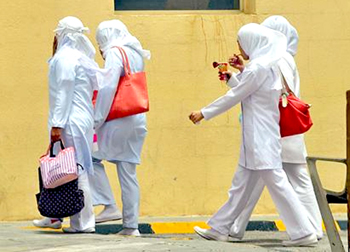
MERS cases drop in KSA; alarm over medics becoming carriers

May 19, 2014

MERS cases dropNew York, May 19: The biggest risk that Middle East Respiratory Syndrome (MERS) will become a global epidemic, ironically, may lie with globe-trotting health care workers.

“This is how MERS might spread around the world,” said infectious disease expert Dr. Amesh Adalja of the University of Pittsburgh Medical Center.

It can take five to 14 days for someone infected with MERS to show symptoms, more than enough time for a contagious person to fly to the other side of the world without being detectable.

Health care workers “are at extremely high risk of contracting MERS compared to the general public,” Adalja said.

The threat has attracted new attention with the confirmation of the first two MERS cases in the United States. Both are health care workers who fell ill shortly after leaving their work in Saudi hospitals and boarding planes bound west.

About one-third of the MERS cases treated in hospitals in Jeddah were health care workers, according to the World Health Organization (WHO).

The Ministry of Health's counted 529 MERS infections since September 2012, of which 168 patients died as of May 17, 2014.

Despite the risk, few of the health care workers now in, or planning to go to, Saudi Arabia are having second thoughts about working there, according to nurses, doctors and recruiters interviewed by Reuters.

Michelle Tatro, 28, leaves next week for the kingdom, where she will work as an open-heart-surgery nurse. Tatro, who typically does 13-week stints at hospitals around the United States, said her family had sent her articles about MERS, but she wasn’t worried.

“I was so glad to get this job,” she told Reuters. “Travel is my number one passion.”

So far, international health authorities have not publicly expressed concern about the flow of expatriate medical workers to and from Saudi Arabia.

“There is not much public health authorities or border agents can do,” said infectious disease expert Dr. Michael Osterholm of the University of Minnesota. “Sure, they can ask people, ‘did you work in a health care facility in Saudi Arabia,’ but if the answer is yes, then what?“

Health care workers are best placed to understand the MERS risk, Osterholm said, and “there should be a heightened awareness among them of possible MERS symptoms.”

Neither the Centers for Disease Control and Prevention nor the Department of Homeland Security responded to questions about whether they were considering monitoring health care workers returning to the United States.

Soaring demand

In the last few years, the number of expatriates working in Saudi Arabia has soared, said Suleiman Arabie, managing director of Houston, Texas-based recruiting firm SA International, with thousands now working in the kingdom.

The Saudi government is building hundreds of hospitals and offering private companies interest-free loans to help build new facilities.

About 15 percent of physicians working in the Kingdom are American or European, and some 40 percent of nurses are Filipino or Malaysian, according to estimates by recruiters and people who have worked in hospitals there.

The majority of US-trained medical staff are on one- or two-year contracts, which results in significant churn as workers rotate in and out of Saudi medical facilities.

Arabie’s firm is trying to fill positions at two dozen medical facilities in Saudi Arabia for pulmonologists, a director of nursing, a chief of physiotherapy and scores more.

Doctors in lucrative, in-demand specialties such as cardiology and oncology can make $1 million for a two-year contract, recruiters said.

Nurses’ pay depends on their home country, with those from the United States and Canada earning around $60,000 a year while those from the Philippines get about $12,000, recruiters said. That typically comes with free transportation home, housing, and 10 weeks of paid vacation each year. For Americans, any income under about $100,000 earned abroad is tax-free, adding to the appeal of a Saudi posting.

Undaunted

One Filipino nurse, who spoke anonymously so as not to hurt her job prospects, told Reuters that she was “willing to go to Saudi Arabia because I don’t get enough pay here.” In a private hospital in Manila, she made 800 pesos (about $18) a day.

“I know the risks abroad but I’d rather take it than stay here,” she said. “I am not worried about MERS virus. I know how to take care of myself and I have the proper training.”

None of Arabie’s potential candidates “have expressed any concern” about MERS. Only one of the hundreds of professionals placed by Toronto-based medical staffing firm Helen Ziegler & Associates Inc. decided to return to the United States because of MERS, it said, and one decided not to accept a job in Jeddah she had been hired for.

Recruitment agencies in Manila have also continued to send nurses to the kingdom since the MERS outbreak, said Hans Leo Cacdac, the head of the Philippine Overseas Employment Administration. The government advises that returning workers be screened for MERS, Labor and Employment Secretary Rosalinda Baldoz said this week.

Expat health care workers now working in Saudi Arabia feel confident local authorities are taking the necessary steps to combat the spread of MERS in hospitals.

“Just today they came and put up giant posters in our hospital on MERS,” said Dr. Taher Kagalwala, a pediatrician originally from Mumbai who works at Al Moweh General Hospital in a town about 120 miles from Taif city in western Saudi Arabia.

“I have not heard of or seen any health care workers looking to leave their jobs or return to their countries because of the MERS panic. If it was happening, there would have been gossip very soon.”

Comments

Add new comment

  • Coastaldigest.com reserves the right to delete or block any comments.
  • Coastaldigset.com is not responsible for its readers’ comments.
  • Comments that are abusive, incendiary or irrelevant are strictly prohibited.
  • Please use a genuine email ID and provide your name to avoid reject.
Agencies
May 22,2020

Riyadh, May 22: The family of murdered Saudi journalist Jamal Khashoggi on Friday said that they forgave his killers. Washington Post journalist Jamal Khashoggi, who had written columns critical of Saudi Arabia, was brutally killed in October 2018, allegedly at the behest of Crown Prince Mohammad bin Salman.

“In this blessed night of the blessed month [of Ramadan] we remember God’s saying: If a person forgives and makes reconciliation, his reward is due from Allah,” Jamal Khashoggi’s son Salah Khashoggi said in a tweet. “Therefore, we the sons of the Martyr Jamal Khashoggi announce that we pardon those who killed our father, seeking reward [from] God almighty.”

The legal outcome of this announcement is not yet clear. Earlier, Salah Khashoggi said he had “full confidence” in the judicial system, and that the accused were trying to exploit the case.

Jamal Khashoggi’s body was said to have been dismembered inside the Saudi consulate in Istanbul and disposed of elsewhere, but his remains were never found.

Comments

Add new comment

  • Coastaldigest.com reserves the right to delete or block any comments.
  • Coastaldigset.com is not responsible for its readers’ comments.
  • Comments that are abusive, incendiary or irrelevant are strictly prohibited.
  • Please use a genuine email ID and provide your name to avoid reject.
News Network
June 23,2020

Riyadh, June 23: Saudi Arabia has decided to go ahead with the Hajj pilgrimage with strict health measures and protocols in an effort to prevent the spread of covid-19.

Minister of Health Dr. Tawfiq Al-Rabiah and Minister of Hajj and Umrah Dr. Muhammad Saleh Benten today addressed a joint virtual press conference today. 

Minister of Hajj expected that number of domestic pilgrims performing the pilgrimage this year will not be more than 10,000. He also confirmed that no pilgrims from outside the Kingdom will be allowed to perform Hajj this year.

Dr. Al-Rabiah said pilgrims should be less than 65 years of age and not suffering from any chronic diseases.

The Hajj pilgrimage, which is one of the five pillars of Islam and a must for able-bodied Muslims at least once in their lifetime, will this year only welcome a “limited number” of people from inside the Kingdom, authorities had said on Monday.

Every year, about 2.5 million pilgrims visit the holiest sites of Islam in Makkah and Madinah, which could make it a possible breeding ground for the disease.

To prevent COVID-19 from spreading among pilgrims, the health ministry, in collaboration with the Ministry of Hajj and Umrah, has developed the plan to ensure the safety of all visitors.

“We have worked with the Ministry of Health to develop preventative and precautionary measures and protocols that are needed to ensure a safe Hajj season,” Benten said.

Protocols:

1. No more than 10,000 people will be allowed to perform the Hajj pilgrimage.

2. All pilgrims will be tested before they reach the holy sites.

3. Only those under the age of 65 will be allowed to perform Hajj this year.

4. All pilgrims will be asked to self-quarantine after they complete the Hajj rituals.

5. All workers and volunteers will be tested before the Hajj pilgrimage begins.

6. The health status of all pilgrims will be monitored daily.

7. A hospital has been prepared for any emergency that occurs during the pilgrimage.

8. Social distancing measures will be enforced.

Comments

SAN
 - 
Tuesday, 23 Jun 2020

Please check its 1000 or 10,000

Add new comment

  • Coastaldigest.com reserves the right to delete or block any comments.
  • Coastaldigset.com is not responsible for its readers’ comments.
  • Comments that are abusive, incendiary or irrelevant are strictly prohibited.
  • Please use a genuine email ID and provide your name to avoid reject.
News Network
June 5,2020

New Delhi, Jun 5: As part of global efforts to combat COVID-19, the UAE has provided more than 708 tonnes of medical aid, personal protection kits and supplies to 62 countries, including India, with direct beneficiaries exceeding 708,000 health workers, a UAE Embassy statement said.

The UAE is regarded as the main lifeline for the logistic operations of the international organizations' strategic warehouses in Dubai's International Humanitarian City (IHC) where the UAE is the first responder to the global crises, especially in providing assistance in relation to the current COVID-19 pandemic, it said.

Dubai's IHC has dispatched more than 132 shipments to 98 countries around the world so far since the beginning of this year, and is working as a central hub to distribute the personal protection kits, the statement said.

While the UAE continues its constant work of supporting the global efforts aimed at curbing the spread of the COVID-19 disease, it has provided more than 708 tons of medical aid, personal protection kits and supplies to 62 countries worldwide to date, with direct beneficiaries exceeding 708,000 health workers, it said.

In addition, 65 million indirect beneficiaries profited from the UAE's global efforts in combating the spread of the virus, the statement said.

Meanwhile, Etihad Airways, effective June 10, said it will link 20 cities in Europe, Asia and Australia via Abu Dhabi.

The new transfer services will make it possible for those travelling on the airline's current network of special flights to connect easily through the UAE capital onwards to key global destinations.

Etihad recently launched links from Melbourne and Sydney to London Heathrow, allowing direct transfer connections to and from the UK capital via Abu Dhabi.

Easy transfer connections via Abu Dhabi will now be available from Jakarta, Karachi, Kuala Lumpur, Manila, Melbourne, Seoul, Singapore, Sydney, and Tokyo to major cities across Europe including Amsterdam, Barcelona, Brussels, Dublin, Frankfurt, Geneva, London Heathrow, Madrid, Milan, Paris Charles de Gaulle, and Zurich, the airline said.

Comments

Add new comment

  • Coastaldigest.com reserves the right to delete or block any comments.
  • Coastaldigset.com is not responsible for its readers’ comments.
  • Comments that are abusive, incendiary or irrelevant are strictly prohibited.
  • Please use a genuine email ID and provide your name to avoid reject.