MH370: Malaysia Airlines to provide financial aid to families

April 20, 2014

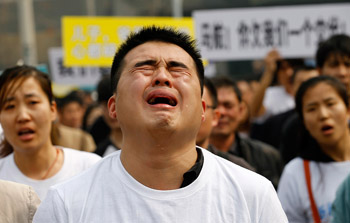
MH370Kuala Lumpur, Apr 20: The grieving families of the 239 passengers and crew of Flight MH370 will receive financial assistance from Malaysia Airlines to ease their burdens, a top official said today, 44 days after the plane vanished mysteriously from radar screens.

Deputy Foreign Minister Hamzah Zainuddin, who heads the sub-committee focusing on the next-of-kin of people on board the ill-fated plane, said that the process to identify those who would receive the assistance started two weeks ago.

The assistance would come solely from Malaysia Airlines (MAS), with the Government only stepping in to bear some of the costs if there is a need for it, he said.

Malaysia has been criticised for its handling of the tragedy, particularly by the relatives of the 154 Chinese passengers on board the ill-fated plane, besides being accused of hiding information.

During a briefing with the families, Hamzah said the families have been requested to submit their own amounts for financial assistance.

"Some of the families have lost their breadwinners and may be facing financial difficulties."Those affected will all receive some form of financial assistance from MAS. However, when the assistance will be given will be determined at a later date as we have recipients from 15 different countries," he was quoted as saying by the Star.com.

He added that two Malaysian representatives were in talks with the families in China regarding financial assistance, with MCA vice-president Paduka Chew Mei Fun expected to fly to Beijing to speak to the next-of-kin of Chinese passengers as well.

Beijing-bound Flight MH370, with 239 people aboard, including five Indians, left the Kuala Lumpur International Airport at 12.41 am on March 8 and disappeared from radar screens about an hour later while over the South China Sea.

A multinational search was mounted for the Boeing 777-200 aircraft, first in the South China Sea and then, after it was learnt that the plane had veered off course, in the southern Indian Ocean.

After an analysis of satellite data indicated that the plane's last position was in the middle of the Indian Ocean, west of Perth, Australia, Malaysian Prime Minister Najib Razak announced on March 24 that Flight MH370 had "ended in the southern Indian Ocean".

A multi-nation search operation led by Australia during the last 44 days have been scouring the Indian Ocean but has failed to find the crucial black boxes or the debris of the plane.

Comments

Add new comment

  • Coastaldigest.com reserves the right to delete or block any comments.
  • Coastaldigset.com is not responsible for its readers’ comments.
  • Comments that are abusive, incendiary or irrelevant are strictly prohibited.
  • Please use a genuine email ID and provide your name to avoid reject.
News Network
June 15,2020

Dubai, Jun 15: The global tally of Covid-19 coronavirus infections crossed the 8 million mark on Monday, with recoveries at 4.13 million, and deaths at nearly 436,000.

As of 11.40am UAE time, there were 3.43 active Covid-19 cases globally, of which 54,460 were serious or critical.

The United States still leads the charts with 2.16 million cases and 117,858 deaths. Behind US, at a distant No 2, is Brazil with 867,882 cases and 43,389 deaths.

Russia, India, the UK, Spain, Italy, Peru, Germany and Iran complete the top 10.

Comments

Add new comment

  • Coastaldigest.com reserves the right to delete or block any comments.
  • Coastaldigset.com is not responsible for its readers’ comments.
  • Comments that are abusive, incendiary or irrelevant are strictly prohibited.
  • Please use a genuine email ID and provide your name to avoid reject.
News Network
May 30,2020

May 30: Warning of the tightrope walk ahead as governments battle the coronavirus crisis, Nobel laureate Peter Charles Doherty has expressed concern about densely populated countries such as India relaxing lockdown norms while also describing a complete shutdown as “an economic and social impossibility”.

The Australian immunologist, who cautioned that the number of COVID-19 cases will rise in the coming days, said the earliest time frame for an effective vaccine “going into large numbers of people” is nine to 12 months.

"If all goes well with testing, we could know if some of the candidate vaccines are both safe and effective as early as September/October. Then, rolling a vaccine out will depend on the type of product and how quickly it can be made, put in vials and so forth," Doherty told PTI in an email interview from Melbourne.

The novel coronavirus, he added, does not change fast like influenza and, from what is known so far, “the same vaccine should work everywhere”.

Doherty, who is with the Department of Microbiology and Immunology at the Doherty Institute, University of Melbourne, won the Nobel Prize for Medicine in 1996 for his discovery of how the body’s immune system distinguishes virus-infected cells from normal ones.

Discussing the lockdown, he said, "If it was purely a matter of hard science, everywhere should stay locked down. But that’s pretty much an economic and social impossibility.”

The expectation, he said, is the numbers will rise and limiting spread will depend on people acting responsibly and the capacity for rapid response and extensive contact testing.

“And in a densely populated country like India I think that it will be very difficult," the scientist said.

Several countries, including India, began relaxing lockdown norms in mid-May despite the WHO’s warning about a second wave. India’s lockdown began on March 25 and has since been extended. The fourth phase ends on Sunday.

Asked whether there are any alternatives to a lockdown, the 79-year-old said, "There is no other option other than closing borders. South Korea, for example, conducted massive, intensive testing and contact tracing in a wealthy country with a very disciplined population. Otherwise, not till we have effective vaccines."

He added that he personally doesn’t see the point of closing borders for people coming in if there’s already a high incidence of disease in the community, “unless it’s to avoid the need to care for them and use scarce hospital beds".

According to Doherty, the coronavirus "is a new virus which has come straight out of nature".

“It (the virus) has moved so rapidly across the world because of people travelling on international planes as well as tourist ships," he added.

The immunologist also warned against the use of hydroxychloroquine to treat COVID-19, and said current and planned trials of the anti-malaria drug should be stopped.

“My understanding is that the use of the drug in severe disease is definitely contra-indicated, but it’s not yet clear whether, if taken under medical supervision, it could have some useful effect if taken early on, or as a preventive. Those trials just haven’t been done properly," Doherty noted.

The Indian Council of Medical Research (ICMR) has backed the use of hydroxychloroquine as a preventive against COVID-19 even after the WHO suspended clinical trials of the drug citing safety concerns.

Asked whether plasma therapy can be an effective treatment for COVID-19, Doherty said, "We lack good properly controlled trials but, especially if the plasma has been tested for antibody levels and there’s evidence of good activity, it could be helpful. If I had the disease and was offered plasma therapy I would certainly accept, but I would not take hydroxychloroquine."

Doherty is also very optimistic about herd immunity developing against the SARS-CoV-2 infection.

"We think that (herd immunity) will cut in and have an obvious effect when, say, 60 per cent of people have been infected. Best hope is to boost herd immunity with a vaccine," he stated.

Herd immunity is a form of indirect protection from infectious disease that occurs when a large percentage of a population has become immune to an infection, whether through vaccination or previous infections.

The number of COVID-19 cases have crossed 5.9 million and the fatalities 3,65,000, according to the Johns Hopkins University on Saturday. 

In India, the death toll has risen to 4,971 and the number of cases to 1,73,763, according to the Union Health Ministry on Saturday.

Several states, including Bihar, Uttar Pradesh, Madhya Pradesh, Jharkhand and Chhattisgarh, have reported a rise in number since lockdown norms were relaxed in early May and migrant workers reached home.

In Uttar Pradesh, for instance, the number of infections rose from around 3,000 on May 4 to 6,532 on May 26. Similarly, Bihar’s numbers increased from around 500 to over 2,700 in the period.


Comments

Add new comment

  • Coastaldigest.com reserves the right to delete or block any comments.
  • Coastaldigset.com is not responsible for its readers’ comments.
  • Comments that are abusive, incendiary or irrelevant are strictly prohibited.
  • Please use a genuine email ID and provide your name to avoid reject.
News Network
February 1,2020

Washington, Feb 1: The Indian economy experienced some abrupt slowdown in 2019 due to turbulence in non-banking financial institutions and major reform measures such as GST and demonetisation, but it is not in a recession, IMF Managing Director Kristalina Georgieva has said.

"The Indian economy indeed has experienced an abrupt slowdown in 2019. We had to revise our growth projections, downwards to four percent for last year. We are expecting 5.8 per cent (growth rate) in 2020 and then an upward trajectory to 6.5 percent in 2021," Georgieva told a group of foreign journalists here on Friday.

"It appears that the main reason for this slowdown was the non-banking financial institutions experiencing a turbulence," she said on the eve of Union Finance Minister Nirmala Sitharaman presenting the annual budget in Parliament on Saturday.

She said India had undertaken some important reforms that over the longer term would be beneficial for the country, but they do have some short-term impact.

"For example, coming with the unified tax system, and the demonetisation that took place. These are steps that over time are beneficial, but of course they might, might be somewhat disruptive over short term," Georgieva said in response to a question.

The International Monetary Fund (IMF) Managing Director said that there is not a lot of fiscal space in India. “But we also recognise that the policies of the government on that side, on the fiscal side have been prudent. We will see how the reading of the budget, the submission of the budget goes, tomorrow,” she said.

In the medium-term, she said, the IMF remains optimistic about India. “This is why we see that upswing potential for the growth in the country,” she said.

Georgieva said that the current economic slowdown cannot be described as a recession. "No.... You're far from that. But it is a significant slowdown, not the recession," she said.

The IMF managing Director noted that the consumption in India also slowed down and that contributed to the overall slowdown in the economy. The IMF would be keen to see what India does to get relatively sound macroeconomic fundamentals to pay off in terms of better growth trajectory, she said ahead of the budget.

One thing that is important for India is that budgetary revenue have been below target. "The country knows that. The finance minister knows it. They need to increase budgetary revenue collection so they can improve their fiscal position. I said it's tight on the spending side, but I also want to stress that there is room to improve collection on the revenue side," she said.

Comments

Add new comment

  • Coastaldigest.com reserves the right to delete or block any comments.
  • Coastaldigset.com is not responsible for its readers’ comments.
  • Comments that are abusive, incendiary or irrelevant are strictly prohibited.
  • Please use a genuine email ID and provide your name to avoid reject.