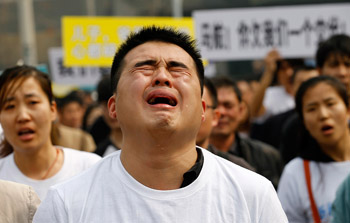
MH370: Malaysia Airlines to provide financial aid to families

April 20, 2014

MH370Kuala Lumpur, Apr 20: The grieving families of the 239 passengers and crew of Flight MH370 will receive financial assistance from Malaysia Airlines to ease their burdens, a top official said today, 44 days after the plane vanished mysteriously from radar screens.

Deputy Foreign Minister Hamzah Zainuddin, who heads the sub-committee focusing on the next-of-kin of people on board the ill-fated plane, said that the process to identify those who would receive the assistance started two weeks ago.

The assistance would come solely from Malaysia Airlines (MAS), with the Government only stepping in to bear some of the costs if there is a need for it, he said.

Malaysia has been criticised for its handling of the tragedy, particularly by the relatives of the 154 Chinese passengers on board the ill-fated plane, besides being accused of hiding information.

During a briefing with the families, Hamzah said the families have been requested to submit their own amounts for financial assistance.

"Some of the families have lost their breadwinners and may be facing financial difficulties."Those affected will all receive some form of financial assistance from MAS. However, when the assistance will be given will be determined at a later date as we have recipients from 15 different countries," he was quoted as saying by the Star.com.

He added that two Malaysian representatives were in talks with the families in China regarding financial assistance, with MCA vice-president Paduka Chew Mei Fun expected to fly to Beijing to speak to the next-of-kin of Chinese passengers as well.

Beijing-bound Flight MH370, with 239 people aboard, including five Indians, left the Kuala Lumpur International Airport at 12.41 am on March 8 and disappeared from radar screens about an hour later while over the South China Sea.

A multinational search was mounted for the Boeing 777-200 aircraft, first in the South China Sea and then, after it was learnt that the plane had veered off course, in the southern Indian Ocean.

After an analysis of satellite data indicated that the plane's last position was in the middle of the Indian Ocean, west of Perth, Australia, Malaysian Prime Minister Najib Razak announced on March 24 that Flight MH370 had "ended in the southern Indian Ocean".

A multi-nation search operation led by Australia during the last 44 days have been scouring the Indian Ocean but has failed to find the crucial black boxes or the debris of the plane.

Comments

Add new comment

  • Coastaldigest.com reserves the right to delete or block any comments.
  • Coastaldigset.com is not responsible for its readers’ comments.
  • Comments that are abusive, incendiary or irrelevant are strictly prohibited.
  • Please use a genuine email ID and provide your name to avoid reject.
News Network
March 21,2020

Rome, Mar 21: Italy on Friday reported a record 627 new deaths from the novel coronavirus, taking its overall toll past 4,000 as the pandemic gathered pace despite government efforts to halt its spread.

The total number of deaths was 4,032, with the number of infections reaching 47,021.

Italy's previous one-day record death toll was 475 on Wednesday.

The nation of 60 million now accounts for 36.6 percent of the world's coronavirus deaths.

Italy has seen more than 1,500 deaths from COVID-19 in the past three days alone.

Its current daily death rate is higher than that officially reported by China at the peak of its outbreak around Wuhan's Hubei province.

Comments

Add new comment

  • Coastaldigest.com reserves the right to delete or block any comments.
  • Coastaldigset.com is not responsible for its readers’ comments.
  • Comments that are abusive, incendiary or irrelevant are strictly prohibited.
  • Please use a genuine email ID and provide your name to avoid reject.
News Network
June 5,2020

Karachi, Jun 5: Pakistan's coronavirus cases rose to 89,249 on Friday after a record 4,896 new infections were detected in the country, while the death toll due to COVID-19 has reached 1,838, according to the health ministry.

The Ministry of National Health Service said that 68 patients died in the last 24 hours, taking the death toll to 1,838, whereas another 31,198 people have recovered.

It was the third consecutive day when a record number of cases were reported in Pakistan after the Eid holidays and easing of lockdown restrictions at the end of May.

Sindh province reported 33,536 infections, Punjab 33,144, Khyber-Pakhtunkhwa 11,890, Balochistan 5,582, Islamabad 3,946, Gilgit-Baltistan 852 and Pakistan-occupied Kashmir 299.

The authorities have conducted 638,323 tests, including a record 22,812 tests in the last 24 hours, the ministry said.

Despite the spike in number of COVID-19 cases, both houses of parliament are scheduled to meet separately on Friday. The Senate session started this morning while the National Assembly will be held in the afternoon, Radio Pakistan reported.

Chairman Senate Sadiq Sanjrani and Speaker National Assembly Asad Qaiser at a meeting at the parliament house in Islamabad reviewed arrangements made for the two sessions.

Fumigation was also carried out in the parliament house for the safety of the lawmakers and staff.

Earlier, the Opposition rejected the idea of virtual meetings and insisted that the sessions be held in person, noting that it was an important session of parliament because the budget is expected to be presented in the National Assembly in the next week.

The novel coronavirus which first originated from China's Wuhan city in December last year has claimed 391,249 lives and has infected over 6 million people globally, according to Johns Hopkins University data.

Comments

Add new comment

  • Coastaldigest.com reserves the right to delete or block any comments.
  • Coastaldigset.com is not responsible for its readers’ comments.
  • Comments that are abusive, incendiary or irrelevant are strictly prohibited.
  • Please use a genuine email ID and provide your name to avoid reject.
News Network
June 9,2020

Washington, Jun 9: When epidemiologists talked about "flattening the curve," they probably didn't mean it this way: the US hit its peak coronavirus caseload in April, but since that time the graph has been on a seemingly unending plateau.

That's unlike several other hard-hit countries which have successfully pushed down their numbers of new cases, including Spain and Italy, which now have bell-shaped curves.

Experts say the prolonged nature of the US epidemic is the result of the cumulative impact of regional outbreaks, as the virus that started out primarily on the coasts and in major cities moves inward.

Layered on top of that are the effects of lifting lockdowns in parts of the country that are experiencing rising cases, as well as a lapse in compliance with social distancing guidelines because of economic hardship, and in some cases a belief that the threat is overstated.

"The US is a large country both in geography and population, and the virus is at very different stages in different parts of the country," Tom Frieden, a former director of the Centers for Disease Control and Prevention told AFP.

The US saw more than 35,000 new cases for several days in April. While that figure has declined, it has still been exceeding 20,000 regularly in recent days.

By contrast, Italy was regularly hitting more than 5,000 cases per day in March but is currently experiencing figures in the low hundreds.

"We did not act quickly and robustly enough to stop the virus spreading initially, and data indicate that it travelled from initial hotspots along major transport routes into other urban and rural areas," added Frieden, now CEO of the non-profit Resolve to Save Lives.

To wit: the East Coast states of New York, New Jersey and Massachusetts accounted for about 50 percent of all cases until about a month or so ago -- but now the geographic footprint of the US epidemic has shifted to the Midwest and southeast, including Florida.

Another key problem, said Jennifer Nuzzo, an epidemiologist at Johns Hopkins, is that the United States is still not doing enough testing, contact tracing and isolation.

After coming late to the testing party -- for reasons ranging from technical issues to regulatory hurdles -- the US has now conducted more COVID-19 tests than any other country.

It even has one of the highest per capita rates per country of 62 per 1,000 people, according to the website ourworldindata.org -- better than Germany (52 per 1,000) and South Korea (20 per 1,000).

But according to Nuzzo, these numbers are misleading, because "the amount of testing that a country should do should be scaled to the size of its epidemic.

"The United States has the largest epidemic in the world so obviously we need to do a lot more testing than any other country."

For Johns Hopkins, the more important metric is the positivity rate -- that is, out of all tests conducted, how many came back positive for COVID-19.

As of June 7, the United States had an average daily positivity rate of 14 percent, well above the World Health Organization guideline of 5 percent over two weeks before social distancing guidelines should be relaxed.

By contrast, Germany, which has tested far fewer people in relation to its population, has a positivity rate of 5 percent.

Even if testing were scaled up, carrying out tests in of itself does very little good without the next steps -- finding out who was exposed and then asking them to isolate.

Here also, too many US states are lagging woefully behind.

Texas, which is experiencing a surge in cases after relaxing its lockdown, is a case in point. The state targeted hiring a modest 4,000 tracers by June, but according to local reports is still more than a thousand shy of even that goal.

Opt-in app based efforts have also been slow to get off the ground.

Then there is the fact that some people are growing tired of lockdowns, while others don't have the economic luxury of being able to stay home for prolonged periods.

The government sent some 160 million Americans a single stimulus check of up to $1,200 back in April but it's not clear whether more will be forthcoming.

Still others, particularly in so-called red states under Republican leadership, have chafed under restrictions and mask-wearing guidelines that they see as an affront to their personal freedom.

"The US is kind of on the extreme of the individual liberty side," Sten Vermund, dean of the Yale School of Public Health, told AFP.

Part of this has to do with mixed messaging from Republican leaders, including President Donald Trump, said Nuzzo.

"We have had at the highest political level an assertion that this is a situation that's been overblown, and that maybe certain protective behaviors are not necessary," she said.

More recently, tens of thousands of people across the country have taken to the streets to protest the killing on an unarmed black man by police, risking coronavirus infection to demonstrate against the public health threat of racialized state violence.


Comments

Add new comment

  • Coastaldigest.com reserves the right to delete or block any comments.
  • Coastaldigset.com is not responsible for its readers’ comments.
  • Comments that are abusive, incendiary or irrelevant are strictly prohibited.
  • Please use a genuine email ID and provide your name to avoid reject.