


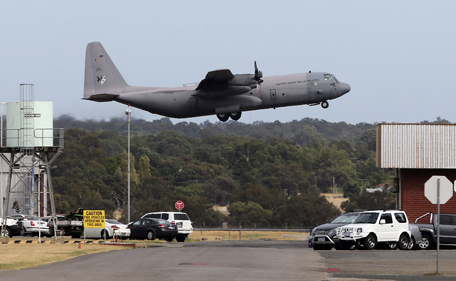
MH370: Two new 'pings' boost confidence that missing plane could be found

April 9, 2014

MH370Sydney/Perth, Apr 9: Australian officials said on Wednesday that two new "ping" signals had been detected in the search for Malaysia Airlines Flight MH370, boosting confidence after more than a month of fruitless searching for the missing jetliner.

The signals, which could be from the plane's black box recorders, bring to four the number of overall "pings" detected in recent days within the search area by a US Navy "Towed Pinger Locator"(TPL).

Angus Houston, head of the Australian agency coordinating the search, struck an optimistic tone when announcing the information, but urged caution as the task of searching the remote Indian Ocean region remained enormous.

"I believe we are searching in the right area but we need to visually identify aircraft wreckage before we can confirm with certainty that this is the final resting place of MH370," Houston told reporters in Perth.

"I'm now optimistic that we will find the aircraft, or what is left of the aircraft, in the not too distant future."

The black boxes record cockpit data and may provide answers about what happened to the plane, which was carrying 227 passengers and 12 crew when it vanished on March 8 and flew thousands of kilometres off its Kuala Lumpur-to-Beijing route.

But the batteries in the beacons have already reached the end of their 30-day expected life, making efforts to swiftly locate them all the more critical.

Authorities say evidence suggests the plane was deliberately diverted by someone familiar with the aircraft, but have not ruled out mechanical problems.

Analysis of satellite data led investigators to conclude the Boeing 777 came down in a remote area of the Indian Ocean, some 2,261 kms (1,405 miles) northwest of the Australian city of Perth.

Fresh pings but in a large area

Up to 11 military aircraft, four civilian aircraft and 14 ships were planned to carry on Wednesday with a massive search that has, so far, yielded frustratingly little concrete information.

On the weekend, the sophisticated US Navy TPL picked up what officials said were two signals consistent with black box locator beacons — the first for more than two hours and the second for about 13 minutes.

On Wednesday, Houston said that another ping was detected on Tuesday afternoon and lasted five minutes, 25 seconds, while a second was picked up on Tuesday night and lasted seven minutes. That brings to four the number of pings found in the area.

But two US Navy officers told Reuters on Wednesday that while the pings had been found within a 1,300 square kilometre area, they were not confident that they represented reoccurances of the same signal.

"I'd say they are separate acoustic events," said US Navy Captain Mark Matthews, citing the fact that the pings are not close together.

"There has been variability in the geographic position which leads me to be less optimistic than I would be if I could consistently reacquire the signal so that I have a nice, small geographic area to focus the autonomous under water vehicle search on," he added.

An autonomous underwater vehicle named Bluefin-21 is onboard the Ocean Shield and could be sent to look for wreckage on the sea floor once intelligence narrows the search area.

The potential search area is currently about 4.5 km (2.8 miles) deep, the outer reach of the Bluefin's range.

A race against time

Although the batteries in the black box recorders are thought to have a lifespan of roughly 30 days, officials have said they can last for as long as two weeks beyond that time.

That meant the search was becoming even more of a race against time than it has been up to now, said Houston.

"I mean, we are looking at this stage for transmissions that are probably weaker than they would have been early on because the batteries of both devices are passed their use-by date and they will very shortly fail," he said.

Despite the new signals being detected, Houston insisted that search teams should exhaust the capability of planes and vessels before deploying underwater vehicles.

"Bear in mind, that the time spent on the surface we're covering six times more area and any given time than we'll be able to do when we go underwater," Houston said.

"So with the batteries likely to fade or fail very shortly, we need to get as much positional data as we can so that we can define a very small search area."

Comments

Add new comment

  • Coastaldigest.com reserves the right to delete or block any comments.
  • Coastaldigset.com is not responsible for its readers’ comments.
  • Comments that are abusive, incendiary or irrelevant are strictly prohibited.
  • Please use a genuine email ID and provide your name to avoid reject.
News Network
June 20,2020

Sao Paulo, June 20: Brazil’s government confirmed on Friday that the country has risen above 1 million confirmed coronavirus cases, second only to the United States.

The country’s health ministry said that the total now stood at 10,32,913, up more than 50,000 from Thursday. The ministry said the sharp increase was due to corrections of previous days’ underreported numbers.

Brazilian President Jair Bolsonaro still downplays the risks of the virus after nearly 50,000 deaths from COVID-19 in three months, saying the impact of social isolation measures on the economy could be worse than the disease itself.

Specialists believe the actual number of cases in Brazil could be up to seven times higher than the official statistic. Johns Hopkins University says Brazil is performing an average of 14 tests per 1,00,000 people each day, and health experts say that number is up to 20 times less than needed to track the virus.

Official data show a downward trend of the virus in Brazil’s north, including the hard-hit region of the Amazon, a plateau in cases and deaths in the countries’ biggest cities near the Atlantic coast, but a rising curve in the south.

In the Brazilian countryside, which is much less prepared to handle a crisis, the pandemic is clearly growing. Many smaller cities have weaker health care systems and basic sanitation that’s insufficient to prevent contagion.

“There is a lot of regional inequality in our public health system and a shortage of professionals in the interior,” said Miguel Lago, executive director of Brazil’s Institute for Health Policy Studies, which advises public health officials.

That creates many health care deserts, with people going long distances to get attention. When they leave the hospital, the virus can go with them.

The cattle-producing state of Mato Grosso was barely touched by the virus when it hit the nation’s biggest cities in March. Sitting far from the coast, between the Bolivian border and Brazil’s capital of Brasilia, its 33 lakh residents led a mostly normal life until May. But now its people live under lockdown and meat producers have dozens of infected workers.

In Tangará da Serra, a city of 1,03,000 people in Mato Grosso, the mayor decided Friday to forbid the sale of alcoholic drinks for two weeks as an incentive for people to stay home.

Fᢩo Junqueira said the measure was needed after a spike in COVID-19 cases that filled 80% of the city’s 54 intensive care beds. The city has had nearly 300 cases of the disease, plus three fatalities.

In Rondonópolis, only 300 miles away from Tangará da Serra and home to a thriving economy, health authorities closed the local meatpacking industry after 92 cases were confirmed there. The city of 1,44,000 inhabitants counted 21 deaths from the virus and more than 600 cases. The mayor has also decided to limit sales of alcoholic beverages.

Even regions once considered examples of successful efforts against the virus are now struggling.

Porto Alegre, home to about 14 lakh people, had success in slowing the virus’ spread over the last three months. But now its mayor is considering increasing social isolation measures after ICU occupancy in the city jumped to 80% this month.

We were already making projections for schools to come back, Mayor Nelson Marchezan Jr. told The Associated Press. Now the trend is to impose more restrictions. Outside Sao Paulo city, five regions of the state’s countryside will have to close shops starting Monday due to a rise in coronavirus cases. Governor João Doria announced the decision Friday.

Dr. Mike Ryan, the World Health Organization’s executive director, said at a news conference that Brazil needs to increase its efforts to stop the spread of infections.

“The epidemic is still quite severe in Brazil. I believe health workers are working extremely hard and under pressure to be able to deal with the number of cases that they see on a daily basis,” Dr. Ryan said.

“Certainly the rise is not as exponential as it was previously, so there are some signs that the situation is stabilising. But we’ve seen this before in other epidemics in other countries.”

Margareth Dalcolmo, a clinical researcher and professor of respiratory medicine at the state-funded Oswaldo Cruz Foundation in Rio de Janeiro, believes the reopening in major cities and the virus traveling by road into Brazil’s heartland will keep the pressure on the country’s health system.

“The risk in the interior now is very big,” she said. “Our health system just can’t solve the most serious cases of COVID in many places of the countryside.”

Comments

Add new comment

  • Coastaldigest.com reserves the right to delete or block any comments.
  • Coastaldigset.com is not responsible for its readers’ comments.
  • Comments that are abusive, incendiary or irrelevant are strictly prohibited.
  • Please use a genuine email ID and provide your name to avoid reject.
News Network
May 20,2020

Washington, May 20: Once dubbed as historic by him, US President Donald Trump on Tuesday said he now feels ‘differently’ about the trade deal he signed with China earlier this year.

He said this while once again venting out his frustration with the Beijing leadership, accusing it of letting coronavirus spread.

Till Tuesday, over 92,000 Americans have died and 1.5 million tested positive for coronavirus that has globally killed around 320,000 people.

The US and China had signed a deal in January to end their 22-month-long trade war during which the two countries slapped tit-for-tat tariff hikes on products worth nearly half a trillion USD.

Under it, Beijing agreed to increase its purchase of US goods by USD 200 billion in 2020-2021.

“I feel differently now about that deal than I did three months ago,” Trump told reporters during a Cabinet meeting at the White House.

“We will see what all happens, but it's been a very disappointing situation. A very disappointing thing happened with China because the plague flowed in and that wasn't supposed to happen and it could have been stopped," he said.

Trump said he was very excited when the trade deal with China was signed.

“But once the virus came in, once the plague, as I called it, came in, I said how did they let that happen? And how come it didn't go into other sections of China? Why did they block it from leaving Wuhan? But they didn't block it from going to the rest of the world, including the United States. Why is that? Beijing doesn't have it. Other places don't have it,” he said.

Trump did not respond to questions on retaliation against China.

Meanwhile, top American senators continued to press the administration that rules of engagement with China needs to change post-coronavirus.

“As we know, they unleashed this virus on America and the world with their classic communist cover-up, deception, continued propaganda campaign, costing now over 90,000 American lives, 35 million Americans losing their jobs so far,” Senator Martha McSally said during a Congressional hearing.

“We don’t know who patient zero is, they destroyed samples, they silenced doctors, they kicked out journalists, they impacted international travel to seed this and their reckless behaviour continues to be the root of all this,” she said.

As a result of coronavirus, the American economy has been thrown into recession; more than 36 million people have lost their job – the worst ever after last century’s great depression.

Many of the US states have now started opening up, after taking necessary precautions.

By conservative estimates, it will take several quarters for the economy to be back on track.

Trump in the last a few weeks has exuded confidence that the economy will be back on track next year.

Comments

Add new comment

  • Coastaldigest.com reserves the right to delete or block any comments.
  • Coastaldigset.com is not responsible for its readers’ comments.
  • Comments that are abusive, incendiary or irrelevant are strictly prohibited.
  • Please use a genuine email ID and provide your name to avoid reject.
News Network
March 28,2020

Washington, Mar 28: A US-based lab has unveiled a portable test that can tell if someone has COVID-19 in as little as five minutes, it said in a statement Friday.

Abbot Laboratories said the US Food and Drug Administration (FDA) had given it emergency authorization to begin making the test available to healthcare providers as early as next week.

The test, which is the size of a small toaster and uses molecular technology, also shows negative results within 13 minutes, the company said in a press statement.

"The COVID-19 pandemic will be fought on multiple fronts, and a portable molecular test that offers results in minutes adds to the broad range of diagnostic solutions needed to combat this virus," said Abbot president and chief operating officer Robert Ford.

The test's small size means it can be deployed outside the "traditional four walls of a hospital in outbreak hotspots," Ford said, and Abbott is working with the FDA to send it to virus epicenters.

The test has not been cleared or approved by the FDA, and has only been authorized for emergency use by approved labs and healthcare providers, the company said.

Comments

Add new comment

  • Coastaldigest.com reserves the right to delete or block any comments.
  • Coastaldigset.com is not responsible for its readers’ comments.
  • Comments that are abusive, incendiary or irrelevant are strictly prohibited.
  • Please use a genuine email ID and provide your name to avoid reject.