


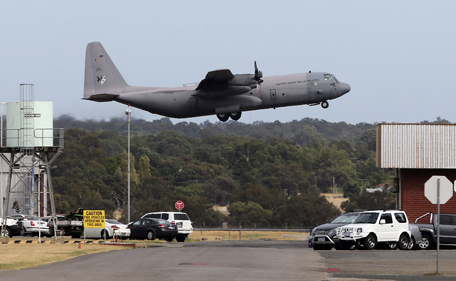
MH370: Two new 'pings' boost confidence that missing plane could be found

April 9, 2014

MH370Sydney/Perth, Apr 9: Australian officials said on Wednesday that two new "ping" signals had been detected in the search for Malaysia Airlines Flight MH370, boosting confidence after more than a month of fruitless searching for the missing jetliner.

The signals, which could be from the plane's black box recorders, bring to four the number of overall "pings" detected in recent days within the search area by a US Navy "Towed Pinger Locator"(TPL).

Angus Houston, head of the Australian agency coordinating the search, struck an optimistic tone when announcing the information, but urged caution as the task of searching the remote Indian Ocean region remained enormous.

"I believe we are searching in the right area but we need to visually identify aircraft wreckage before we can confirm with certainty that this is the final resting place of MH370," Houston told reporters in Perth.

"I'm now optimistic that we will find the aircraft, or what is left of the aircraft, in the not too distant future."

The black boxes record cockpit data and may provide answers about what happened to the plane, which was carrying 227 passengers and 12 crew when it vanished on March 8 and flew thousands of kilometres off its Kuala Lumpur-to-Beijing route.

But the batteries in the beacons have already reached the end of their 30-day expected life, making efforts to swiftly locate them all the more critical.

Authorities say evidence suggests the plane was deliberately diverted by someone familiar with the aircraft, but have not ruled out mechanical problems.

Analysis of satellite data led investigators to conclude the Boeing 777 came down in a remote area of the Indian Ocean, some 2,261 kms (1,405 miles) northwest of the Australian city of Perth.

Fresh pings but in a large area

Up to 11 military aircraft, four civilian aircraft and 14 ships were planned to carry on Wednesday with a massive search that has, so far, yielded frustratingly little concrete information.

On the weekend, the sophisticated US Navy TPL picked up what officials said were two signals consistent with black box locator beacons — the first for more than two hours and the second for about 13 minutes.

On Wednesday, Houston said that another ping was detected on Tuesday afternoon and lasted five minutes, 25 seconds, while a second was picked up on Tuesday night and lasted seven minutes. That brings to four the number of pings found in the area.

But two US Navy officers told Reuters on Wednesday that while the pings had been found within a 1,300 square kilometre area, they were not confident that they represented reoccurances of the same signal.

"I'd say they are separate acoustic events," said US Navy Captain Mark Matthews, citing the fact that the pings are not close together.

"There has been variability in the geographic position which leads me to be less optimistic than I would be if I could consistently reacquire the signal so that I have a nice, small geographic area to focus the autonomous under water vehicle search on," he added.

An autonomous underwater vehicle named Bluefin-21 is onboard the Ocean Shield and could be sent to look for wreckage on the sea floor once intelligence narrows the search area.

The potential search area is currently about 4.5 km (2.8 miles) deep, the outer reach of the Bluefin's range.

A race against time

Although the batteries in the black box recorders are thought to have a lifespan of roughly 30 days, officials have said they can last for as long as two weeks beyond that time.

That meant the search was becoming even more of a race against time than it has been up to now, said Houston.

"I mean, we are looking at this stage for transmissions that are probably weaker than they would have been early on because the batteries of both devices are passed their use-by date and they will very shortly fail," he said.

Despite the new signals being detected, Houston insisted that search teams should exhaust the capability of planes and vessels before deploying underwater vehicles.

"Bear in mind, that the time spent on the surface we're covering six times more area and any given time than we'll be able to do when we go underwater," Houston said.

"So with the batteries likely to fade or fail very shortly, we need to get as much positional data as we can so that we can define a very small search area."

Comments

Add new comment

  • Coastaldigest.com reserves the right to delete or block any comments.
  • Coastaldigset.com is not responsible for its readers’ comments.
  • Comments that are abusive, incendiary or irrelevant are strictly prohibited.
  • Please use a genuine email ID and provide your name to avoid reject.
Agencies
April 2,2020
Thailand's controversial king has created a category of his own with his idea of self-isolation.
 
According to reports, King Maha Vajiralongkorn, also known as Rama X, has hired out an entire luxury hotel in Germany, where he has been 'self-isolating' with 20 women.
 
The luxury hotel, the Grand Hotel Sonnenbichl, is in the Alpine resort town of Garmisch-Partenkirchen.
 
The 67-year-old king is self-isolating with his entourage that includes a 'harem' of 20 concubines and several servants, reported Bild.
 
However, it is unclear if his four wives are currently living in the same hotel.

Comments

Add new comment

  • Coastaldigest.com reserves the right to delete or block any comments.
  • Coastaldigset.com is not responsible for its readers’ comments.
  • Comments that are abusive, incendiary or irrelevant are strictly prohibited.
  • Please use a genuine email ID and provide your name to avoid reject.
Agencies
February 4,2020

As the deadly coronavirus has spread worldwide, it has carried with it xenophobia -- and Asian communities around the world are finding themselves subject to suspicion and fear.

When a patient on Australia's Gold Coast refused to shake the hand of her surgeon Rhea Liang, citing the virus that has killed hundreds, the medic's first response was shock.

But after tweeting about the incident and receiving a flood of responses, the respected doctor learned her experience was all too common.

There has been a spike in reports of anti-Chinese rhetoric directed at people of Asian origin, regardless of whether they have ever visited the centre of the epidemic or been in contact with the virus.

Chinese tourists have reportedly been spat at in the Italian city of Venice, a family in Turin was accused of carrying the disease, and mothers in Milan have used social media to call for children to be kept away from Chinese classmates.

In Canada, a white man was filmed telling a Chinese-Canadian woman "you dropped your coronavirus" in the parking lot of a local mall.

In Malaysia, a petition to "bar Chinese people from entering our beloved country" received almost 500,000 signatures in one week.

The incidents are part of what the Australasian College for Emergency Medicine has described as "misinformation" which it says is fuelling "racial profiling" where "deeply distressing assumptions are being made about 'Chinese' or 'Asian-looking' people." Disease has long been accompanied by suspicions of foreigners -- from Irish immigrants being targeted in the Typhoid Mary panic of 1900s America to Nepali peacekeepers being accused of bringing cholera to earthquake-struck Haiti in the last decade.

"It's a common phenomenon," said Rob Grenfell, director of health and biosecurity for Australia's science and research agency CSIRO.

"With outbreaks and epidemics along human history, we've always tried to vilify certain subsets of the population," he said, comparing the behaviour to 1300s plague-ridden medieval Europe, where foreigners and religious groups were often blamed.

"Sure it emerged in China," he said of the coronavirus, "but that's no reason to actually vilify Chinese people." In a commentary for the British Medical Journal, doctor Abraar Karan warned this behaviour could discourage people with symptoms from coming forward.

Claire Hooker, a health lecturer at the University of Sydney, said the responses from governments may have compounded prejudice.

The World Health Organisation has warned against "measures that unnecessarily interfere with international travel and trade", but this has not stopped scores of countries from introducing travel bans.

The tiny Pacific nation of Micronesia has banned its citizens from visiting mainland China altogether.

"Travel bans respond largely to people's fears," said Hooker, and while sometimes warranted, they often "have the effect of cementing an association between Chinese people and scary viruses".

Abbey Shi, a Shanghai-born student in Sydney, said the attitude shown by some of her peers has "become almost an attack on students who are Chinese".

While Australia's conservative government has banished its citizens returning from Wuhan -- the central Chinese city at the epicentre of the virus -- to a remote island for quarantine, thousands of students still stuck in China risk their studies being torpedoed.

"Right now it looks like they have to miss the semester's start and potentially the whole year, because of the way the courses are set up," Shi said.

According to Hooker, studies in Toronto on the impact of Severe Acute Respiratory Syndrome, or SARS -- another global coronavirus outbreak in 2002 -- showed the impact of xenophobic sentiment often lasted much longer than the public health scare.

"While there may be a cessation of direct forms of racism as news about the disease dies down, it takes quite a bit of time for economic recovery and people continue to feel unsafe," she said.

People may not rush back to Chinese businesses or restaurants, and may even heed some of the more outlandish viral social media disinformation -- such as one popular post imploring people to avoid eating noodles for their own safety.

"In one sense you might think the effects lasted from the last coronavirus to this one because the representation as China being a place where diseases come from has been persistent," Hooker said.

Comments

Add new comment

  • Coastaldigest.com reserves the right to delete or block any comments.
  • Coastaldigset.com is not responsible for its readers’ comments.
  • Comments that are abusive, incendiary or irrelevant are strictly prohibited.
  • Please use a genuine email ID and provide your name to avoid reject.
Agencies
March 14,2020

Nairobi, Mar 14: Kenya and Ethiopia on Friday announced their first confirmed cases of coronavirus, as East Africa, which has so far been unscathed by the global pandemic, scaled up emergency measures to contain its spread.

In Kenya, a 27-year-old Kenyan woman tested positive for the virus on Thursday in Nairobi, a week after returning from the United States via London.

She was in a stable condition and recovering, Health Minister Mutahi Kagwe told reporters.

"We wish to assure all Kenyans that the government will use all the resources available to fight coronavirus," he said, as the government rolled out a raft of new containment measures.

The government had traced all the contacts of the patient since she arrived back in Kenya on March 5, he said.

"At the moment, there is absolutely no need for panic and worry," he said.

Kenya, with a population of 50 million people, saw a spree of panic buying among the middle-class in Nairobi supermarkets, in the wake of the announcement.

Meanwhile Ethiopia, Africa's second most populous nation with over 100 million people, said a 48-year-old Japanese man who had arrived in the country on March 4 from Burkina Faso was confirmed to have contracted the virus.

"He is undergoing medical follow-up and is in a stable condition. Those who have been in contact with this person are being traced and quarantined," the health ministry said in a statement.

Burkina Faso only confirmed its first case on Tuesday -- a couple returning from France -- and the Japanese patient had been in that country since February 24.

Ethiopian Health Minister Lia Tadesse said three other patients were in isolation.

Ethiopia becomes the 15 country in Africa with a confirmed case of the virus that has swept the globe, infecting more than 130,000 people and killing nearly 5,000 since it first emerged in China.

But to date the continent has been spared the worst of the pandemic.

Only five people have succumbed to coronavirus so far -- all in north Africa -- with the sub-Saharan region recording no deaths and very low numbers of confirmed cases.

But countries in East Africa -- which until the positive case in Kenya, had only recorded negative test results -- have been taking precautions.

Some flights have been restricted, with Kenya Airways suspending its route to Rome, and charter flights from Italy to the Kenyan coast on hold.

It has also suspended international conferences, a top earner in Nairobi, a hub for such events in the region, and non-essential travel abroad for politicians.

The government announced more expansive restrictions on Friday, including a temporary ban on major public gatherings, prison visits and activities between schools.

Other countries in the region have been rolling out their own measures.

In Rwanda, which shares a border with the Democratic Republic of Congo, which has confirmed cases, washing basins with soap and sanitiser have been placed on streets for commuters to use before boarding buses.

Authorities in Kigali, the capital, have also banned concerts, rallies and trade fairs -- although like in Kenya and Uganda, church services have been proceeding and bars, restaurants and entertainment precincts remain open.

Neighbouring Burundi, meanwhile, has quarantined 34 people in a hotel in Bujumbura as a precaution.

Uganda has ordered that visitors from a number of affected countries self quarantine for 14 days, or consider simply not visiting at all.

South Sudan's health ministry said meanwhile that it was "temporarily suspending direct flights between South Sudan and all affected countries".

Kagwe, the Kenyan health minister, also addressed a rumour circulating on social media that people with black skin cannot contract the virus.

"I would like to disabuse that notion. The lady (confirmed with coronavirus in Kenya) is an African, like you and I," he said.

Comments

Add new comment

  • Coastaldigest.com reserves the right to delete or block any comments.
  • Coastaldigset.com is not responsible for its readers’ comments.
  • Comments that are abusive, incendiary or irrelevant are strictly prohibited.
  • Please use a genuine email ID and provide your name to avoid reject.