



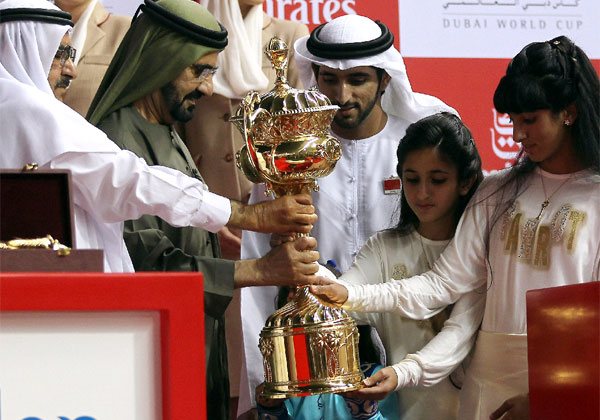
"I bring them all together", says Shaikh Mohammed

April 2, 2012

kt


Dubai, April 2: Following the triumph of Monterosso, ridden by Mikael Barzalona, at the Dubai World Cup main event on Saturday night, His Highness Shaikh Mohammed bin Rashid Al Maktoum, Vice President and Prime Minister of the UAE and Ruler of Dubai — the founder of the Godolphin stables which owns Monterosso — spoke exclusively to CNN’s Winning Post prior to and after the Dubai World Cup at the Meydan horse race course the same night.

The Dubai World Cup returned to Godolphin hands after a memorable one-two for Shaikh Mohammed’s racing operation. Monterosso, ridden by Mikael Barzalona, pulled ahead of stablemate Capponi to capture the coveted trophy. Both horses are trained by Mahmood Al Zarooni.

Excerpts from CNN’s Winning Post interview with:

Q: On why he built Meydan and started the Dubai World Cup:

A: “Well we thought about it and it was the horse you know descended from the horse in UAE and the thoroughbred is fantastic, thoroughbreds descending from these horses. So we bring the horse back home.

So actually we race in England, we race in America, we race in Australia, we race in Japan but not all the best horses come together, the Japanese stay home, sometimes they come to England, the Australians stay home, the Americans mostly stay home and also the Europeans. And we thought it if we can make a big Meydan here we can invite them all here and they are – it’s near to them, you know – centralised, so they come and see the magnificent horse race here and compete with all the countries…

Well remember it is in our blood. An Arab with a horse and a falcon… Our love to the horses and that’s why we backed this.”

Q: On thinking the Dubai World Cup would ever become so big:

A: “You have to dream. And our dream, and my dream.”

Q: On his predictions for the outcome of the race:

A: “I feel a lot of competition will be there’s a lot of beautiful horses from America, Europe, Japan, Australia, so you cannot tell. But you know really I am to bring them all together and to see this big party tonight I am honoured.”

Q: On winning the race with Monterosso:

“Yes it is really we haven’t won this race for a few years so to win it really it’s great, great feeling. For me and this is so happy not only for me but for United Arab Emirates and all our people.”

Q: On getting first and second in the race with Monterosso and Capponi:

A: “One-two finish, I mean when they came to the straight I thought will we win or is somebody coming to catch us? But it’s great.”

Q: On Mikael Barzalona (the winning jockey) celebrating before he crossed the finish line:

A: “My heart was in my throat at that time and I didn’t know what to say but thank god we won it and everybody has won — all the country, Ireland won, France won and that’s the racing. I’m double happy now!”


Comments

Add new comment

  • Coastaldigest.com reserves the right to delete or block any comments.
  • Coastaldigset.com is not responsible for its readers’ comments.
  • Comments that are abusive, incendiary or irrelevant are strictly prohibited.
  • Please use a genuine email ID and provide your name to avoid reject.
News Network
June 12,2020

Beirut, Jun 12: Angry Lebanese protesters blocked roads across the country with burning tyres, debris and their vehicles, incensed over the local currency's depreciation by more than 25 percent in just two days.

The demonstrations from northern Akkar and Tripoli to central Zouk, the eastern Bekaa Valley, Beirut and southern Tyre and Nabatieh on Thursday were some of the most widespread in months of upheaval over a calamitous economic and financial crisis.

Protesters set ablaze a branch of the Central Bank, vandalised several private banks and clashed with security forces in several areas. At least 41 people were injured in Tripoli alone, according to the Lebanese Red Cross.

"I'm really pissed off, that's all. If politicians think they can burn our hearts like this the fire is going to reach them too," unemployed computer engineer Ali Qassem, 26, told Al Jazeera after pouring fuel onto smouldering tyres on a main Beirut thoroughfare.

Tens of thousands of Lebanese have lost jobs in the past six months and hundreds of businesses have shuttered as a dollar shortage led the Lebanese pound to slide from 1,500 to $1 last summer - where it was pegged for 23 years - to roughly 4,000 for each US dollar last month.

But the slide turned into a freefall between Wednesday and Thursday when the pound plummeted to roughly 5,000 to $1 on black markets, which have become a main source of hard currency. There was widespread speculation the rate hit 6,000 or even 7,000 pounds to the dollar, though most markets stopped trading.

Protesters began amassing on streets across the country before sunset and increased into the thousands across the country as the night fell.

Prime Minister Hassan Diab cancelled all meetings scheduled for Friday to hold an emergency cabinet session at 9:30am and another at 3pm at the presidential palace to be headed by President Michel Aoun.

The pound's collapse is the perhaps the biggest challenge yet for Diab's young cabinet, which gained confidence in February after former prime minister Saad Hariri's government was toppled by an unprecedented October uprising that had the country's economic crisis at its core.

Economy Minister Raoul Nehme told Al Jazeera that there was "disinformation" being circulated about the exchange rate on social media and said he was investigating possible currency manipulation.

"I don't understand how the exchange rate increased by so much in two days," he said.

Many protesters have pitted blame on Central Bank governor Riad Salameh, nominally in charge of  keeping the currency stable. But they have also called on the government to resign.

"If people want reform between dawn and dusk, that's not going to work, and if someone thinks they can do a better job then please come forward," Nehme said.

"But what we can't have is a power vacuum - then the exchange rate won't be 5000, it'll be a catastrophe."

'Everyone paying the price'

When protesters set a large fire in Beirut's Riad al-Solh Square, which lies at the foot of a grand Ottoman-era building that serves as the seat of government, firefighters did not intervene to extinguish it.

It later became clear why: Civil Defence told local news channel LBCI they had run out of diesel to fuel their firetrucks.

Basic imports such as fuel have been hit hard by the currency crisis, making already-weak state services increasingly feeble.

A half-dozen or so police officers with Lebanon's Internal Security Forces observed the scene unfolding in front of them in the square.

"Why do you destroy shops and things and attack us security forces - do you think we're happy? Go and f****** break that wall or go to the politicians' houses," one police officer told Al Jazeera, referring to a large concrete barrier separating protesters from the seat of government.

"In the end we are with you and we want the country to change. Don't you dare think we're happy. My salary is now worth $130," the officer said.

The currency's spectacular fall seems to have pushed many Lebanese to put common interests above their differences.

Large convoys of men on motorbikes from Shia-majority areas of southern Beirut joined the demonstrations on Thursday, though they have clashed with protesters many times before - including at a protest on Saturday.

Some chanted sectarian insults, leading to brief clashes in areas that were formerly front lines during the country's devastating 15-year civil war.

Instead, the motorbike-riding demonstrators on Thursday chanted: "Shia, Sunni, F*ck sectarianism."

"We are Shia, and Sunnis and Christian are our brothers," Hisham Houri, 39, told Al Jazeera, perched on a moped with his fiancee behind him just a few metres from a pile of burning tyres.

The blaze sent thick black smoke into the sky towards an iconic blue-domed mosque and church in downtown Beirut.

"Politicians play on these sectarian issues and sometimes succeed, but in the end, they'll fail because all the people have been hurt," he said. "The dollar isn't just worth 6,000 for Shias or for Sunnis, everyone is paying that price."

Comments

Add new comment

  • Coastaldigest.com reserves the right to delete or block any comments.
  • Coastaldigset.com is not responsible for its readers’ comments.
  • Comments that are abusive, incendiary or irrelevant are strictly prohibited.
  • Please use a genuine email ID and provide your name to avoid reject.
News Network
April 5,2020

Beirut, Apr 5: The novel coronavirus has put global trade on hold, placed half of the world population in confinement and has the potential to topple governments and reshape diplomatic relations.

The United Nations has appealed for ceasefires in all the major conflicts rocking the planet, with its chief Antonio Guterres on Friday warning "the worst is yet to come". But it remains unclear what the pandemic's impact will be on the multiple wars roiling the Middle East.

Here is an overview of the impact so far on the conflicts in Syria, Yemen, Libya and Iraq:

The COVID-19 outbreak turned into a pandemic just as a ceasefire reached by the two main foreign power brokers in Syria's nine-year-old war -- Russia and Turkey -- was taking effect.

The three million people living in the ceasefire zone, in the country's northwestern region of Idlib, had little hope the deal would hold.

Yet fears the coronavirus could spread like wildfire across the devastated country appear to have given the truce an extended lease of life.

According to the Syrian Observatory for Human Rights, the month of March saw the lowest civilian death toll since the conflict started in 2011, with 103 deaths.

The ability of the multiple administrations in Syria -- the Damascus government, the autonomous Kurdish administration in the northeast and the jihadist-led alliance that runs Idlib -- to manage the coronavirus threat is key to their credibility.

"This epidemic is a way for Damascus to show that the Syrian state is efficient and all territories should be returned under its governance," analyst Fabrice Balanche said.

However the pandemic and the global mobilisation it requires could precipitate the departure of US-led troops from Syria and neighbouring Iraq.

This in turn could create a vacuum in which the Islamic State jihadist group, still reeling from the demise of its "caliphate" a year ago, could seek to step up its attacks.

The Yemeni government and the Huthi rebels initially responded positively to the UN appeal for a ceasefire, as did neighbouring Saudi Arabia, which leads a military coalition in support of the government.

That rare glimmer of hope in the five-year-old conflict was short-lived however and last week Saudi air defences intercepted ballistic missiles over Riyadh and a border city fired by the Iran-backed rebels.

The Saudi-led coalition retaliated by striking Huthi targets in the rebel-held capital Sanaa on Monday.

Talks have repeatedly faltered but the UN envoy Martin Griffiths is holding daily consultations in a bid to clinch a nationwide ceasefire.

More flare-ups in Yemen could compound a humanitarian crisis often described as the worst in the world and invite a coronavirus outbreak of catastrophic proportions.

In a country where the health infrastructure has collapsed, where water is a rare commodity and where 24 million people require humanitarian assistance, the population fears being wiped out if a ceasefire doesn't allow for adequate aid.

"People will end up dying on the streets, bodies will be rotting in the open," said Mohammed Omar, a taxi driver in the Red Sea port city of Hodeida.

Much like Yemen, the main protagonists in the Libyan conflict initially welcomed the UN ceasefire call but swiftly resumed hostilities.

Fierce fighting has rocked the south of the capital Tripoli in recent days, suggesting the risk of a major coronavirus outbreak is not enough to make guns fall silent.

Turkey has recently played a key role in the conflict, throwing its weight behind the UN-recognised Government of National Accord.

Fabrice Balanche predicted that accelerated Western disengagement from Middle East conflicts could limit Turkish support to the GNA.

That could eventually favour forces loyal to eastern-based strongman Khalifa Haftar, who launched an assault on Tripoli one year ago and has the backing of Russia, Egypt and the United Arab Emirates.

Western countries have been hit hardest by the pandemic, which could prompt them to divert both military resources and peace-brokering capacity from foreign conflicts.

A report by the International Crisis Group said European officials had reported that efforts to secure a ceasefire in Libya were no longer receiving high-level attention due to the pandemic.

Iraq is no longer gripped by fully-fledged conflict but it remains vulnerable to an IS resurgence in some regions and its two main foreign backers are at each other's throats.

Iran and the United States are two of the countries most affected by the coronavirus but there has been no sign of any let-up in their battle for influence that has largely played out on Iraqi soil.

With most non-US troops in the coalition now gone and some bases evacuated, American personnel are now regrouped in a handful of locations in Iraq.

Washington has deployed Patriot air defence missiles, prompting fears of a fresh escalation with Tehran, whose proxies it blames for a spate of rocket attacks on bases housing US troops.

Comments

Add new comment

  • Coastaldigest.com reserves the right to delete or block any comments.
  • Coastaldigset.com is not responsible for its readers’ comments.
  • Comments that are abusive, incendiary or irrelevant are strictly prohibited.
  • Please use a genuine email ID and provide your name to avoid reject.
News Network
April 26,2020

Abu Dhabi, Apr 26: Indian Ambassador to the UAE Pavan Kapoor says he is appalled after the bodies of three Indians flown back to India were returned to Abu Dhabi on Friday.

The three deceased Indian nationals had died of non-coronavirus causes and were flown to Delhi on Thursday but were promptly returned by authorities there.

“We are appalled at what has happened,” Kapoor told Gulf News. “We do not know if the bodies were returned because of coronavirus-related restrictions, but we are obviously not sending the remains of people [who have passed away from COVID-19],” he added.

“[As we understand], it happened because of new protocols at the airport and we are trying to sort it out,” he said.

Sent back a few hours later

“The remains were not offloaded from the plane, and were sent back a few hours later,” Kapoor explained.

The deceased were Kamlesh Bhatt, who passed away on April 17, and Sanjeev Kumar and Jagsir Singh who both died on April 13.

According to reports in Indian media, Kamlesh Bhat was 23 years old, and hailed from Tehri Garhwal district. He allegedly died of cardiac arrest. Along with the remains Kumar and Singh, Bhatt’s body was initially repatriated on an Etihad Airways flight, then sent back, even though his relatives had been on their way to collect them.

Kapoor explained the procedure through which remains are normally returned to family members back home, saying that the worker’s employer typically makes arrangements with cargo companies to repatriate bodies on cargo aircraft.

The employer applies for a No Objection Certificate from the Indian Embassy, which is granted once the Embassy ensures that all local formalities have been completed. The cargo company then applies for airport clearance, and the airline obtains approvals from the receiving airport.

“If airport protocols have changed, it means cargo companies have to be more careful about the clearance they’re getting,” Kapoor advised.

Additional costs
The ambassador added there may eventually be additional costs to repatriate the bodies but that it is first necessary to sort out the concerns.

The global coronavirus outbreak has spawned difficulties in repatriating mortal remains as a result of the travel restrictions imposed by countries. Remains of people dying from COVID-19 are not being sent back, but the caution surrounding the handling of bodies often affects the repatriation of those who succumb to other causes.

As Gulf News reported, Kerala chief minister Pinarayi Vijayan reached out to Indian Prime Minister Narendra Modi on Friday for intervention in bringing back the bodies of Keralites who have died in the Gulf from non-COVID-19 causes.

“I would like to draw your attention to the grievances received from Non-resident Keralites Associations (NRKs) in the Gulf Cooperation Council (GCC) countries on the delay caused in bringing home the mortal remains of NRKs who had expired due to reasons other than the COVID-19 infection,” read the letter by the CM.

“It is learnt that a ‘clearance certificate’ from the Indian Embassies is required to process the application of bringing home the mortal remains of the dead. The Embassies are [further] insisting on the production of a no-objection certificate from the Ministry of Home Affairs (MHA), New Delhi. To enable to bring back the bodies of the NRIs whose deaths occurred due to reasons other than COVID-19 infection, without necessary procedural hassles, I request your kind intervention,” Vijayan has requested.

Comments

Add new comment

  • Coastaldigest.com reserves the right to delete or block any comments.
  • Coastaldigset.com is not responsible for its readers’ comments.
  • Comments that are abusive, incendiary or irrelevant are strictly prohibited.
  • Please use a genuine email ID and provide your name to avoid reject.