



Mistaken Identity: Indian’s wait continues

April 6, 2012

trouble_copy

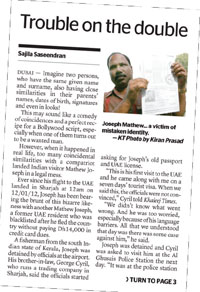
Dubai, April 6: The long wait for freedom is continuing for the Indian visitor, who has been stuck in a rare case of mistaken identity for nearly three months in the UAE, even after the Indian mission here came to his rescue.


Mathew Joseph, 47, a fisherman who was held by the UAE officials on January 2 for his close similarities with a wanted man, may have to wait for one more week to get the clearance from the local authorities, Khaleej Times has learnt.


His legal consultant, advocate Hashik T K, said on Thursday that the Dubai Police was awaiting a verification report to establish the differences in the photographs of Joseph and the man with whom he had unusual resemblances.


“The delay is due to a technical reason. We were told today that the police will get the expert opinion on the differences in the photos of both the Mathew Josephs only by next Wednesday or Thursday. So, he has to wait till then,” Hashik told Khaleej Times.


Joseph was arrested because of the close similarities he had in his full name, parents’ names, dates of birth, signatures and even in looks with that of his fellow citizen who had fled the UAE in 2010 without paying Dh14, 000 in credit card dues.


Hashik said the police had already established that the signatures of both the Josephs were different. “Though both of them sign their names in English, there are certain differences in the way they write the letters and there is an additional letter ‘j’ in the sign of the other man…”


After Khaleej Times first published a report on Joseph’s struggle to establish his identity on Monday, the Indian Consulate in Dubai issued a letter certifying that Joseph’s passport issued by the passport office in Trivandrum had been examined and verified from its records along with photograph, and found to be genuine. The Consulate also stated that it had issued another passport to another Mathew Joseph in 2004 and gave the details of that passport, as well.


“As per our records, the addresses, as well as other details like names of parents (and) dates of birth are different in respect of both passport holders,” the mission added in the letter issued on Wednesday.


Joseph’s brother-in-law George Cyril said the former was upset that he could not join his family for Easter celebrations even after securing a favourable letter from the mission. “We expected that he can be sent home at least by Sunday to celebrate Easter with my sister and children who have been longing to see him. He is upset that it is not happening.”


Cyril said Joseph had lost 10kgs after his arrival and he realised it when the latter was taken to a clinic a few days ago after he complained of chest pain. Ever since he was released on bail three days after his arrest, Cyril said, Joseph has become a very quiet man and spends at least an hour in church every day.


Comments

Add new comment

  • Coastaldigest.com reserves the right to delete or block any comments.
  • Coastaldigset.com is not responsible for its readers’ comments.
  • Comments that are abusive, incendiary or irrelevant are strictly prohibited.
  • Please use a genuine email ID and provide your name to avoid reject.
News Network
May 7,2020

Dubai, May 7: The holy month of Ramadan is expected to be a 30-day month this year, said Ibrahim Al Jarwan, member of the Arab Union for Astronomy and Space Sciences.

According to Arabic daily Emarat Al Youm, he said that Sunday, May 24, will mark the end of the holy month of Ramadan and the beginning of Shawwal.

Additionally, he said that the crescent of Shawwal will occur on Friday, May 22, at 9.39pm, after sunset, and will be visible on Sunday, May 24, the beginning of Shawal, which makes Ramadan a 30-day month this year.

He added that the next Ramadan is expected to start on April 13, 2021, and the one after that on April 2, 2022.

Comments

Add new comment

  • Coastaldigest.com reserves the right to delete or block any comments.
  • Coastaldigset.com is not responsible for its readers’ comments.
  • Comments that are abusive, incendiary or irrelevant are strictly prohibited.
  • Please use a genuine email ID and provide your name to avoid reject.
Agencies
April 8,2020

Riyadh, Apr 8: Saudi Arabia's health minister has warned the number of COVID-19 cases in the country could reach 200,000 in coming weeks.

As of Tuesday, the kingdom registered a total of 2,795 coronavirus infections, including 41 deaths.

"Within the next few weeks, studies predict the number of infections will range from a minimum of 10,000 to a maximum of 200,000," health minister Tawfiq al-Rabiah was cited as saying by the official Saudi Press Agency on Tuesday.

On Monday, Saudi Arabia extended the duration of daily curfews in four governorates and five cities to 24 hours.

The kingdom imposed round-the-clock lockdowns in the capital Riyadh, Tabuk, Dammam, Dhahran and Hofuf, the interior ministry said on Twitter.

The same measures were also imposed on the governorates of Jeddah, Taif, Qatif and Khobar, the ministry added.

Authorities had already sealed off the holy cities of Mecca and Medina, barring people from entering and exiting as well as prohibiting movement between all provinces.

Last month, Saudi Arabia suspended the year-round "Umrah" pilgrimage over fears of the coronavirus pandemic spreading to Islam's holiest cities.

Authorities are yet to announce whether they will proceed with this year's Hajj, scheduled for the end of July. Last week, authorities urged Muslims to temporarily defer preparations for the annual pilgrimage.

Last year, about 2.5 million people travelled to Saudi Arabia to take part in the Hajj, which all Muslims must perform at least once in their lives if able.

The Arab world's biggest economy has also closed down cinemas, malls and restaurants and halted flights as it steps up efforts to contain the virus.

King Salman has warned of a "more difficult" fight ahead against the virus, as the kingdom faces the economic double blow of virus-led shutdowns and crashing oil prices

Comments

Add new comment

  • Coastaldigest.com reserves the right to delete or block any comments.
  • Coastaldigset.com is not responsible for its readers’ comments.
  • Comments that are abusive, incendiary or irrelevant are strictly prohibited.
  • Please use a genuine email ID and provide your name to avoid reject.
News Network
June 12,2020

Beirut, Jun 12: Angry Lebanese protesters blocked roads across the country with burning tyres, debris and their vehicles, incensed over the local currency's depreciation by more than 25 percent in just two days.

The demonstrations from northern Akkar and Tripoli to central Zouk, the eastern Bekaa Valley, Beirut and southern Tyre and Nabatieh on Thursday were some of the most widespread in months of upheaval over a calamitous economic and financial crisis.

Protesters set ablaze a branch of the Central Bank, vandalised several private banks and clashed with security forces in several areas. At least 41 people were injured in Tripoli alone, according to the Lebanese Red Cross.

"I'm really pissed off, that's all. If politicians think they can burn our hearts like this the fire is going to reach them too," unemployed computer engineer Ali Qassem, 26, told Al Jazeera after pouring fuel onto smouldering tyres on a main Beirut thoroughfare.

Tens of thousands of Lebanese have lost jobs in the past six months and hundreds of businesses have shuttered as a dollar shortage led the Lebanese pound to slide from 1,500 to $1 last summer - where it was pegged for 23 years - to roughly 4,000 for each US dollar last month.

But the slide turned into a freefall between Wednesday and Thursday when the pound plummeted to roughly 5,000 to $1 on black markets, which have become a main source of hard currency. There was widespread speculation the rate hit 6,000 or even 7,000 pounds to the dollar, though most markets stopped trading.

Protesters began amassing on streets across the country before sunset and increased into the thousands across the country as the night fell.

Prime Minister Hassan Diab cancelled all meetings scheduled for Friday to hold an emergency cabinet session at 9:30am and another at 3pm at the presidential palace to be headed by President Michel Aoun.

The pound's collapse is the perhaps the biggest challenge yet for Diab's young cabinet, which gained confidence in February after former prime minister Saad Hariri's government was toppled by an unprecedented October uprising that had the country's economic crisis at its core.

Economy Minister Raoul Nehme told Al Jazeera that there was "disinformation" being circulated about the exchange rate on social media and said he was investigating possible currency manipulation.

"I don't understand how the exchange rate increased by so much in two days," he said.

Many protesters have pitted blame on Central Bank governor Riad Salameh, nominally in charge of  keeping the currency stable. But they have also called on the government to resign.

"If people want reform between dawn and dusk, that's not going to work, and if someone thinks they can do a better job then please come forward," Nehme said.

"But what we can't have is a power vacuum - then the exchange rate won't be 5000, it'll be a catastrophe."

'Everyone paying the price'

When protesters set a large fire in Beirut's Riad al-Solh Square, which lies at the foot of a grand Ottoman-era building that serves as the seat of government, firefighters did not intervene to extinguish it.

It later became clear why: Civil Defence told local news channel LBCI they had run out of diesel to fuel their firetrucks.

Basic imports such as fuel have been hit hard by the currency crisis, making already-weak state services increasingly feeble.

A half-dozen or so police officers with Lebanon's Internal Security Forces observed the scene unfolding in front of them in the square.

"Why do you destroy shops and things and attack us security forces - do you think we're happy? Go and f****** break that wall or go to the politicians' houses," one police officer told Al Jazeera, referring to a large concrete barrier separating protesters from the seat of government.

"In the end we are with you and we want the country to change. Don't you dare think we're happy. My salary is now worth $130," the officer said.

The currency's spectacular fall seems to have pushed many Lebanese to put common interests above their differences.

Large convoys of men on motorbikes from Shia-majority areas of southern Beirut joined the demonstrations on Thursday, though they have clashed with protesters many times before - including at a protest on Saturday.

Some chanted sectarian insults, leading to brief clashes in areas that were formerly front lines during the country's devastating 15-year civil war.

Instead, the motorbike-riding demonstrators on Thursday chanted: "Shia, Sunni, F*ck sectarianism."

"We are Shia, and Sunnis and Christian are our brothers," Hisham Houri, 39, told Al Jazeera, perched on a moped with his fiancee behind him just a few metres from a pile of burning tyres.

The blaze sent thick black smoke into the sky towards an iconic blue-domed mosque and church in downtown Beirut.

"Politicians play on these sectarian issues and sometimes succeed, but in the end, they'll fail because all the people have been hurt," he said. "The dollar isn't just worth 6,000 for Shias or for Sunnis, everyone is paying that price."

Comments

Add new comment

  • Coastaldigest.com reserves the right to delete or block any comments.
  • Coastaldigset.com is not responsible for its readers’ comments.
  • Comments that are abusive, incendiary or irrelevant are strictly prohibited.
  • Please use a genuine email ID and provide your name to avoid reject.