



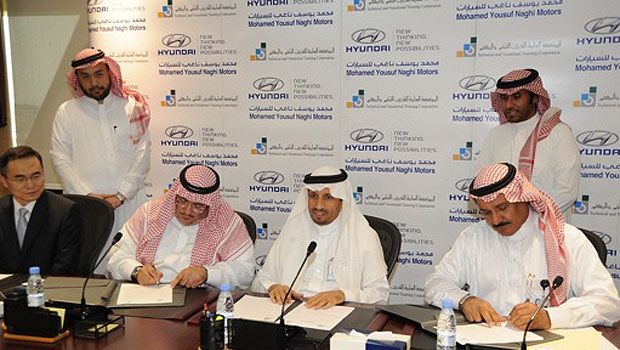
TVTC, MYNM sign deal to train 400 young Saudis

April 11, 2012

ECO_TVTC

Riyadh, April 11: As part of an ambitious public-partnership plan to reduce dependence on foreign workers, the state-owned Technical and Vocational Training Corporation (TVTC) and Mohamed Yousuf Naghi Motors (MYNM) signed a memorandum of understanding (MoU) yesterday to train 400 young Saudis for jobs in automobile sector. On completion of the training, the MYNM, which has a nationwide network of sales and after-sales facilities for Hyundai cars, will provide employment to the Saudi graduates also.

The agreement was signed in the presence of TVTC Gov. Ali Bin Nasser Al-Ghafis who said that the Kingdom was committed to develop the public-private partnership initiative to provide technology training and tools for young Saudi boys and girls. Al-Ghafis said: "This was one of the major MoUs signed by the TVTC with private organizations, which will go a long way in providing necessary skills to Saudis to work in automobile sector."

He added that the Saudi trainees under this program will receive a monthly stipend of SR1,500 during the training period besides other benefits including medical insurance. "The training program will have components of Korean car technology with focus on a range of skills, which will help the trainees after two years of their employment to open their own workshops," said Al-Ghafis.

The MoU was signed by Hamad Al-Aqla, TVTC deputy governor, in a brief ceremony organized at the headquarters of the TVTC in the Saudi capital. Hazm Sami Jamjoom, NYNM managing director, inked the agreement representing Naghi Motors. Top TVTC officials and MYNM executives attended the event. After the signing ceremony, Fahad M. Al-Otaibi, TVTC media relations manager, conducted reporters on a tour of the exhibition hall to watch the models of new TVTC colleges.

Al-Aqla said: "This program with Naghi Motors will help to provide intensive training to Saudis and eventually the company will hire the graduates." Those joining the program will be given extensive lessons and practical training to become world-class auto mechanics, diesel mechanics, spare parts salesmen, auto technicians, painters and motor electricians."

He added that there was a greater scope for employment in automotive sector of the Kingdom, which is poised to sustain a positive growth outlook over a five-year period. In fact, the sales value of the automobile sector during the five-year period is expected to reach over SR80.6 billion, precisely by 2014. "The robust growth forecast is underpinned by the positive performance of the commercial vehicle segment, which is expected to remain strong over the next five years," said an executive of NYNM/Hyundai.

Asked about the major policies and the future plans of the TVTC, Al-Ghafis said the TVTC had endorsed similar agreements with a few major companies in different sectors. "The plan is to train workers for jobs that are in demand in Saudi Arabia," he said, adding that the new initiative launched by the TVTC is intended to help better align with technical college curriculums with the demands of local companies.

"Some similar partnerships between TVTC and private companies already exist," said Al-Ghafis. The TVTC is working hard to address the training needs of young Saudi boys and girls. "A number of studies, a number of discussions and several projects currently under way to address the skills' gap among Saudis, and how that's related to unemployment and how they can be addressed," he said while giving an overview of the TVTC's programs.

"The commitments from private partners are really commendable," said the TVTC chief, adding that the TVTC is helping to prepare skilled workers for the labor market by designing appropriate training programs and developing partnerships with the private sector. He added that the plan is under way to build 40 technology institutes for girls and 50 for boys in near future. The TVTC projects include the establishment of institutes for training, especially in strategically significant fields.

In fact, the total enrolment of Saudi boys and girls at the existing TVTC colleges exceeds 100,000 now. According to a TVTC report obtained by Arab News yesterday, the TVTC also selects qualified trainers to teach specialist training courses aimed at developing the skills. "The private sector has become a genuine partner of the TVTC in training technical workers," the report added.

It is also seeking international and domestic expertise to operate its training and professional institutes, said the report. The TVTC, which is a premier Saudi government organization entrusted with the task to train Saudi youngsters for jobs in different sectors, currently has 35 technical colleges for boys and 14 technical institutes for girls. It also owns and operates three institutes for military vocational training and 69 industrial institutes across the Kingdom.

On the other hand, the Naghi Motors is a well known name in automotive business, which is one of the best distributors of Hyundai cars in the region mainly because of its excellent sales service, customer handling and innovative support service programs. Naghi Motors is the first company to introduce leasing program for Hyundai cars and offer flexible credit terms. In a short span of time, the Naghi Motors has a strong network of sub-dealers and branches across the Kingdom.

It has its branches in Makkah, Madinah, Jazan, Tabuk, Taif, Khamis Mushayit, Abha, and Bisha, aside from several outlets in Jeddah. "Our ability to provide quality products and personalized after sales service has been instrumental in our rapid and successful growth," said Naghi Motors in a press statement here Tuesday.

Comments

Add new comment

  • Coastaldigest.com reserves the right to delete or block any comments.
  • Coastaldigset.com is not responsible for its readers’ comments.
  • Comments that are abusive, incendiary or irrelevant are strictly prohibited.
  • Please use a genuine email ID and provide your name to avoid reject.
Agencies
May 25,2020

Abu Dhabi, May 25: Dusty weather to persist in the UAE on Monday as well with a chance of rainfall in parts of the country, the national Met department reported.

According to the NCM, the weather today will be fair to partly cloudy, with a chance of some convective clouds formation by afternoon - eastward and northward - extending to some internal areas that may be associated with some rainfall.

The weather will get humid by night and Tuesday morning over some coastal areas.

NCM predicts a wet Eid break.

Sharjah Police issued a weather warning as heavy rain flooded roads in Sharjah's Kalba among other areas.

Moderate to fresh winds will gain strength during the day causing blowing dust and sand.

The sea will be slight to moderate in the Arabian Gulf and in Oman Sea.

Earlier on Sunday, a weather alert was issued by authorities as moderate to heavy rain - accompanied with hail - lashed parts of the UAE. A rainbow in Dubai skies cheered up residents, celebrating a unique Eid this year amid the coronavirus Covid-19 pandemic - by mostly staying home.

Comments

Add new comment

  • Coastaldigest.com reserves the right to delete or block any comments.
  • Coastaldigset.com is not responsible for its readers’ comments.
  • Comments that are abusive, incendiary or irrelevant are strictly prohibited.
  • Please use a genuine email ID and provide your name to avoid reject.
Agencies
June 9,2020

Dubai, Jun 9: Dubai's Emirates airline has begun laying off employees to reduce cost and save cash as the carrier looks to rightsize its workforce.

"We at Emirates have been doing everything possible to retain the talented people that make up our workforce for as long as we can. However, given the significant impact that the pandemic has had on our business, we simply cannot sustain excess resources and have to rightsize our workforce in line with our reduced operations. After reviewing all scenarios and options, we deeply regret that we have to let some of our people go," the spokesperson said in the statement.

Citing sources, Reuters and Bloomberg earlier reported that a majority of those being made redundant are cabin crew workers as well as a minority of its engineers and pilots, including those flew the Airbus A380.

"This was a very difficult decision and not one that we took lightly. The company is doing everything possible to protect the workforce wherever we can. Where we are forced to take tough decisions we will treat people with fairness and respect. We will work with impacted employees to provide them with all possible support," said the statement.

The spokesperson, however, didn't disclose how many employees are being made redundant in this latest round of rightsizing the workforce.

Emirates on Sunday confirmed that it extended the period of reduced pay for its staff for another three months till September. It had previously reduced basic wages by 25 to 50 per cent for three months from April, with junior employees exempted.

The airline had employed around 60,000 people at the end of its 2019-20 financial year.

Saj Ahmad, chief analyst at StrategicAero Research, said the announced job cuts at Emirates will likely not be the last given the unprecedented damage that Covid-19 has had not just on air travel, but on the entire aviation industry as a whole.

"Emirates' massive international network means that job reductions were always a last resort option as the company staves off cash burn and expenses at a time when revenues are dried up. While Emirates SkyCargo is enjoying a resurgence in activities, the reality is that this income will never offset the lost money from passenger operations," he added.

"Whilst some salary reduction schemes have prevented bigger job cuts for now, the absence of a cure or medicinal suppressant of Covid-19 means that air travel is unlikely to even reach pre-9/11 levels within 3-5 years, let alone pre-Covid-19 levels in that same time period. For that reason, Emirates' reduction in headcount is necessary to stay competitive, agile and be ready for when air travel can resume with a degree of normalcy that we have been accustomed to for decades," said Ahmad.

Comments

Add new comment

  • Coastaldigest.com reserves the right to delete or block any comments.
  • Coastaldigset.com is not responsible for its readers’ comments.
  • Comments that are abusive, incendiary or irrelevant are strictly prohibited.
  • Please use a genuine email ID and provide your name to avoid reject.
News Network
May 11,2020

May 11: Saudi Arabia will triple its value-added tax rate and suspend a cost of living allowance for state workers, it said on Monday, seeking to shield finances hit by low oil prices and a slump in demand for its lifeline export worsened by the new coronavirus.

Historic oil output cuts agreed by Riyadh and other major producers have given only limited support to prices after they sank on oversupply caused by a war for petroleum market share between the kingdom and its fellow oil titan Russia.

Saudi Arabia, the world's largest oil exporter, is also being hit hard by measures to fight the new coronavirus, which are likely to curb the pace and scale of economic reforms launched by Crown Prince Mohammed bin Salman.

"The cost of living allowance will be suspended as of June 1, and the value added tax will be increased to 15% from 5% as of July 1," Finance Minister Mohammed al-Jadaan said in a statement reported by the state news agency. "These measures are painful but necessary to maintain financial and economic stability over the medium to long term...and to overcome the unprecedented coronavirus crisis with the least damage possible."

The austerity measures come after the kingdom posted a $9 billion budget deficit in the first quarter.

The minister said non-oil revenues were affected by the suspension and decline in economic activity, while spending had risen due to unplanned strains on the healthcare sector and the initiatives taken to support the economy.

"All these challenges have cut state revenues, pressured public finances to a level that is hard to deal with going forward without affecting the overall economy in the medium to long term, which requires more spending cuts and measures to support non-oil revenues stability," he added.

The government has cancelled and put on hold some operating and capital expenditures for some government agencies, and cut allocations for some reform initiatives and projects worth a total 100 billion riyals ($26.6 billion), the statement said.

Central bank foreign reserves fell in March at their fastest rate in at least 20 years and to their lowest since 2011, while oil revenues in the first three months of the year fell 24% from a year earlier to $34 billion, pulling total revenues down 22%.

"The reforms are positive from a fiscal side as greater adjustment is essential. However, the tripling of VAT is unlikely to help that much in 2020 revenue wise with the expected fall in consumption," said Monica Malik, chief economist at Abu Dhabi Commercial Bank.

She said she kept unchanged her deficit forecast of 16.3% of GDP for this year, which already factors in a greater than previously announced spending cut.

About 1.5 million Saudis are employed in the government sector, according to official figures released in December.

In 2018, Saudi Arabia's King Salman ordered a monthly payment of 1,000 riyals ($267) to every state employee to compensate them for the rising living costs after the government hiked domestic gas prices and introduced value-added tax.

DIFFICULT TIMES

A committee has been formed to study all financial benefits paid to public sector employees and contractors, and will submit recommendations within 30 days, the statement said.

In late 2015, when oil prices fell from record highs, the kingdom slashed lavish bonuses, overtime payments and other benefits once considered routine perks in the public sector.

In a country without elections and with political legitimacy resting partly on distribution of oil revenue, the ability of citizens to adapt to such reforms is crucial for stability.

"Tripling the VAT will test the limits of the balance between revenues and consumption as the economy dives into a deep recession. The move will impact consumption and could also lower the expected revenues," said John Sfakianakis, a Gulf expert at the University of Cambridge.

"These are pro-austerity and pro-revenue moves rather than pro-growth ones," he said.

Hasnain Malik, head of equity strategy at Tellimer, said the VAT rise could bring about $24-$26.5 billion in additional non-oil fiscal revenue. The rise would hit consumer spending further but was a needed step towards fiscal sustainability, he said.

Comments

Add new comment

  • Coastaldigest.com reserves the right to delete or block any comments.
  • Coastaldigset.com is not responsible for its readers’ comments.
  • Comments that are abusive, incendiary or irrelevant are strictly prohibited.
  • Please use a genuine email ID and provide your name to avoid reject.