Avoid travel to quake-hit countries: UAE

April 12, 2012

quake_copy

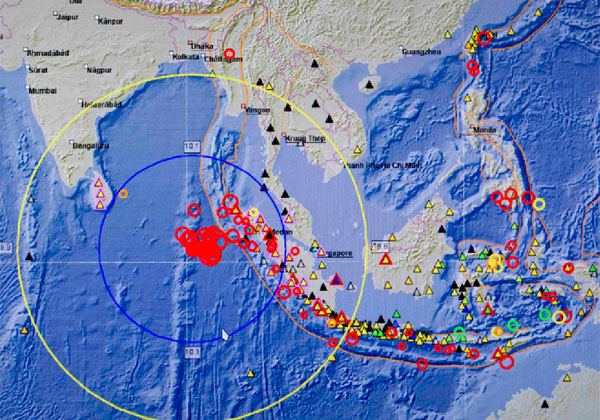
Abu Dhabi, April 12: The National Centre for Metrology and Seismology (NCMS) said the UAE was safe from the earthquake and tsunami in the Indian Ocean, but the UAE Foreign Ministry urged its citizens to take precautions and avoid travelling to the quake-hit countries except in situations of ultimate necessity.

Undersecretary of the Foreign Ministry Juma Mubarak Al Junaibi said the government is seriously following-up through its diplomatic missions in the South-East Asian countries the present conditions of Emirati citizens there. He also appealed to the citizens to register at the online ‘Tawajudee’ service through the ministry’s portal when travelling abroad.

The NCMS said the UAE has not been and will not be affected by the earthquake. It said there was no need to panic as the country and its coastlines were safe from the tsunami.

According to the centre, the 8.4-magnitude earthquake was recorded at 12:38pm local time northwest of Sumatra, in Indonesia.

“This kind of magnitude may cause tsunami in the area and this is the strongest earthquake to hit the region since the earthquake in 2004, causing 200,000 deaths,” the centre advisory said.

According to reports, most of the countries in south Asia, including Sri Lanka, Bangladesh, India and Pakistan have issued alerts after the earthquake report.


Comments

Add new comment

  • Coastaldigest.com reserves the right to delete or block any comments.
  • Coastaldigset.com is not responsible for its readers’ comments.
  • Comments that are abusive, incendiary or irrelevant are strictly prohibited.
  • Please use a genuine email ID and provide your name to avoid reject.
News Network
April 16,2020

Dubai, Apr 16: Most of the patients who have fully recovered from Covid-19 in the UAE followed healthy behaviours that helped strengthen their immune systems, said Dr Farida Al Hosani, Official Spokesperson for the UAE Health Sector.

Dr Al Hosani made the remarks during the UAE Government's regular briefing on the latest developments related to the spread of coronavirus in the country, which was held on Wednesday in Abu Dhabi.

During the briefing, Dr Al Hosani spoke about the precautionary measures that aimed to prevent the spread of the virus.

Ammar Al Muaini, Official Spokesperson of the National Programme for Happiness and Quality of Life, also explained the outcomes of the National Mental Health Programme.

During the briefing, Dr Al Hosani affirmed that recorded cases in the country, especially recoveries, were related to key factors and reasons.

"In most cases of recoveries, we noticed that they have followed several daily health behaviours, such as doing exercise, eating a healthy diet, strengthening the immune system, and maintaining an ideal weight, as well as abstaining from bad habits, such as smoking and unhealthy eating. The psychological aspect is also important, and it is necessary to support the mental health of individuals, along with their physical health," she said.

"These practices, which we always emphasise and promote, will help raise a person's immunity and resistance to diseases, in addition to medicines, and can speed up the process of recovering from disease," she added.

Dr Al Hosani also talked about the importance of not being complacent if one's temperature rises. "We highlight the importance of periodic temperature checks for family members at home. This step is one of the health measures that we are encouraging.

"Everyone who has a high temperature must contact the nearest health centre or hospital or go to a drive-through testing centre because personal health is linked to the health of those around us and we are responsible for it. There is no room for hesitation in protecting our families," she stressed.

Dr Al Hosani highlighted the importance of covering the nose and mouth, whether by wearing surgical, paper or cloth masks, or any other covering or clothing.

"This procedure is important for everyone leaving home to avoiding the transmission of any infection and preserving the safety of everyone, along with leaving a safe physical distance between people in public places, markets and workplaces, and following the precautions," she explained.

Regarding high temperatures and their relationship to the coronavirus, Dr. Al Hosani said: "All studies that attempt to understand the relationship between the virus and climate have not been able to confirm that higher temperatures will help kill the virus. We are continuing to monitor the results of these studies."

Al Muaini explained the details and developments of the national campaign, titled, 'Don't Worry,' which aims to support the mental health of community members.

"The UAE Government, represented by the National Programme for Happiness and Quality of Life, has launched, under the current circumstances, the national campaign, titled, 'Don't Worry,' that aims to provide psychological support to members of society facing the repercussions of the novel coronavirus, in line with relevant national efforts," Al Muaini said.

"The campaign reflects the directives of His Highness Sheikh Mohammed bin Rashid Al Maktoum, Vice President and Prime Minister of the UAE and Ruler of Dubai, and His Highness Sheikh Mohamed bin Zayed Al Nahyan, Crown Prince of Abu Dhabi and Deputy Supreme Commander of the UAE Armed Forces, affirming that quality of life is a high priority, and health is the most important pillar of quality of human and society," Al Muaini added.

Al Muaini stated that the phrase, 'Don't Worry,' is profound in its meaning, according to His Highness Sheikh Mohamed bin Zayed, and reassures everyone that everything will be fine. "Today, the concept of health is not limited to physical health, but it also includes mental health. During this period, and due to the social, professional, and educational changes that directly affect our lives, we need to support and enhance our mental health to overcome these challenges," he  added.

Al Muaini said that over 50 specialists, psychologists and social workers are voluntarily participating in the national campaign to serve the country, which includes three main components focusing on providing psychological support to all members of society, especially as this type of support is one of the necessary community needs during the current circumstances.

The first component, 'Let's Support Together,' aims to answer enquiries regarding psychological challenges, provide educational advice, and support individuals in facing challenges, through daily live broadcasts on the social media networks of the National Programme for Happiness and Quality of Life, @HappyUAE. Two events are broadcast every day, with the first being at 17:30 in English and the second at 20:30 in Arabic to benefit all segments of society.

Al Muaini explained that the number of live broadcasts on the programme's social media accounts has reached 30 and covers various topics, including psychological care for senior citizens, psychological care for children, psychological support for working mothers, and how to address anxiety and psychological concerns.

According to scientific studies, fear and anxiety are among the strongest influences that weaken human immunity, and, therefore, it is necessary to learn about how to deal with them. The duration of each broadcast is one hour, attracting some 250,000 views each.

Al Muaini explained that the second component of the campaign is the hosting of closed virtual sessions, entitled, 'Let's Talk Together,' which aim to provide psychosocial support to specific groups of society, to enable them to talk to each other in a safe environment to discuss the psychological challenges they are facing.

The programme has organised over eight closed psychological support sessions to maintain the privacy of participants, under the supervision of certified physicians and psychologists. Some 300 people have participated and some sessions were held for those under quarantine, including working mothers, school and university students, and doctors working in the first line of defence.

Some 300,000 people watched "Let's Reassure Each Other" programme Al Muaini noted that the third component of the campaign, titled, "Let's Reassure Each Other," focuses on raising awareness of the importance of psychological resilience and promoting its importance to society. The programme has so far posted more than 21 video clips containing messages of support and reassurance to the community.

The number of people who watched the programme reached some 300,000 viewers.

Al Muaini stressed that the campaign is an effective interactive platform available on a daily basis, to provide psychological support to all segments of society at a time when people require reassurance and psychological support to overcome the current crisis. The campaign hosted doctors working in the first line of defence and their enquiries were answered directly. A group of people under quarantine was also involved in the closed support sessions, which were also popular with participating doctors.


Comments

Add new comment

  • Coastaldigest.com reserves the right to delete or block any comments.
  • Coastaldigset.com is not responsible for its readers’ comments.
  • Comments that are abusive, incendiary or irrelevant are strictly prohibited.
  • Please use a genuine email ID and provide your name to avoid reject.
Agencies
March 15,2020

Riyadh, Mar 15: Saudi Aramco on Sunday reported a 20.6 percent drop in its net profit for 2019 due to low oil prices and production levels, the company said in a statement.

These are the first annual results to be announced by the energy giant after its historical $29.4 billion initial public offering and listing on the Saudi Tadawul market last December.

Aramco posted net profits of $88.2 billion last year compared to $111.1 billion in 2018, Monday's statement said.

"The decrease was primarily due to lower crude oil prices and production volumes, coupled with declining refining and chemical margins," it said.

The company also made $1.6 billion of impairment provisions for losses associated with Sadara Chemical Company, an Aramco subsidiary.

"2019 was an exceptional year for Saudi Aramco. Through a variety of circumstances -- some planned and some not -- the world was offered unprecedented insight into Saudi Aramco's agility and resilience," CEO Amin Nasser said.

"Our unique scale, low costs, and resilience came together to deliver both growth and world-leading returns, while also maintaining our position as one of the world's most reliable energy companies," Nasser said.

The earnings for last year are not affected by the coronavirus outbreak or the ongoing price war between Saudi Arabia and Russia that has sent oil prices crashing.

Aramco said it will distribute dividends worth $73.2 billion for 2019 but based on its commitments under the IPO, its dividends for the next five years starting this year will be at least $75 billion.

It said its capital spending last year dropped to $32.8 billion from $35.1 billion in 2018.

The company expects capital spending, which is expenditure on projects, to be between $25 billion and $30 billion this year "in light of current market conditions and recent commodity price volatility."

But it said that capital expenditure for 2021 and beyond is currently under review.

The results were announced amid a price war between Saudi Arabia and Russia after they failed to agree on additional output cuts to support prices dented by the outbreak of the coronavirus pandemic.

"The recent COVID-19 outbreak and its rapid spread illustrate the importance of agility and adaptability in an ever-changing global landscape," Nasser said.

The kingdom said last week Aramco will pump 12.3 million barrels of oil per day, boosting output by at least 2.5 million bpd.

It also announced plans to raise production capacity from 12 million bpd to 13 million bpd.

Forecasts for future crude prices and demand are also bleak.

In its latest monthly report, the Organization of Petroleum Exporting Countries lowered its forecast for global average daily demand by 0.92 million barrels to 99.73 million barrels.

Saudi Arabia is also in the midst of a royal purge that saw King Salman's brother and nephew detained after sources said they were accused of plotting a palace coup to unseat the crown prince, heir to the Saudi throne.

Aramco shares rallied immediately after the listing on December 11, rising by 19 percent to 38 riyals ($10.1) and temporarily lifting the company's valuation above the $2 trillion mark, which was sought by Crown Prince Mohammed bin Salman, Saudi Arabia's de facto ruler.

But as oil prices tumble, Aramco shares have lost 29 percent from its highest point, slipping below the listing price.

On Thursday, Aramco's market value dropped to around $1.55 trillion, but it still remains the world's largest publicly listed company.

Comments

Add new comment

  • Coastaldigest.com reserves the right to delete or block any comments.
  • Coastaldigset.com is not responsible for its readers’ comments.
  • Comments that are abusive, incendiary or irrelevant are strictly prohibited.
  • Please use a genuine email ID and provide your name to avoid reject.
Agencies
August 2,2020

Dubai, Aug 2: The United Arab Emirates (UAE) announced on Saturday that it has started operations in the first of four reactors at the Barakah nuclear power station - the first nuclear power plant in the Arab world.

Emirates Nuclear Energy Corporation (ENEC), which is building and operating the plant with Korea Electric Power Corporation (KEPCO) said in a press release that its subsidiary Nawah Energy Company "has successfully started up Unit 1 of the Barakah Nuclear Energy Plant, located in the Al Dhafrah Region of Abu Dhabi".

That signals that Unit 1, which had fuel rods loaded in March, has achieved "criticality" - a sustained fission chain reaction.

"The start-up of Unit 1 marks the first time that the reactor safely produces heat, which is used to create steam, turning a turbine to generate electricity," said ENEC.

Barakah, which was originally scheduled to open in 2017, has been dogged by delays and is billions of dollars over budget. It has also raised myriad concerns among nuclear energy veterans who are concerned about the potential risks Barakah could visit upon the Arabian Peninsula, from an environmental catastrophe to a nuclear arms race.

Paul Dorfman, an honorary senior research fellow at the Energy Institute, University College London and founder and chair of the Nuclear Consulting Group, has criticised the Barakah reactors' "cheap and cheerful" design that he says cuts corners on safety.

Dorfman authored a report (PDF) last year detailing key safety features Barakah's reactors lack, such as a "core catcher" to literally stop the core of a reactor from breaching the containment building in the event of a meltdown. The reactors are also missing so-called Generation III Defence-In-Depth reinforcements to the containment building to shield against a radiological release resulting from a missile or fighter jet attack.

Both of these engineering features are standard on new reactors built in Europe, says Dorfman.

There have been at least 13 aerial attacks on nuclear facilities in the Middle East - more than any other region on earth.

The vulnerability of critical infrastructure in the Arabian Peninsula was further laid bare last year after Saudi Arabia's oil facilities at Abqaiq and Khurais were attacked by 18 drones and seven cruise missiles - an assault that temporarily knocked out more than half of the kingdom's oil production.

On Saturday, Dorfman reiterated his concern that there is no regional protocol in place to determine liability should an accident or incident at Barakah result in radioactive contamination spreading from the UAE to its neighbours. 

"Given Barakah has started up, because of all the well-rehearsed nuclear safety and security problems, it may be critically important that the Gulf states collectively evolve a Nuclear Accident Liability Convention, so that if anything does go wrong, victim states may have some sort of redress," Dorfman told Al Jazeera. 

The UAE has substantial oil and gas reserves, but it has made huge investments in developing alternative energy sources, including nuclear and solar.

Experts though have questioned why the UAE - which is bathed in sunlight and wind - has pushed ahead with nuclear energy - a far more expensive and riskier option than renewable energy sources.

When the UAE first announced Barakah in 2009, nuclear power was cheaper than solar and wind. But by 2012 - when the Emirates started breaking ground to build the reactors - solar and wind costs had plummeted dramatically.

Between 2009 and 2019, utility-scale average solar photovoltaic costs fell 89 percent and wind fell 43 percent, while nuclear jumped 26 percent, according to an analysis by the financial advisory and asset manager Lazard.

There are also concerns about the potential for Barakah to foment nuclear proliferation in the Middle East - a region rife with geopolitical fault lines and well-documented history of nuclear secrecy.

The UAE has sought to distance itself from the region's bad behaviour by agreeing not to enrich its own uranium or reprocess spent fuel. It has also signed up to the United Nation's nuclear watchdog's Additional Protocol, significantly enhancing inspection capabilities, and secured a 123 Agreement with the United States that allows bilateral civilian nuclear cooperation.

Comments

Add new comment

  • Coastaldigest.com reserves the right to delete or block any comments.
  • Coastaldigset.com is not responsible for its readers’ comments.
  • Comments that are abusive, incendiary or irrelevant are strictly prohibited.
  • Please use a genuine email ID and provide your name to avoid reject.