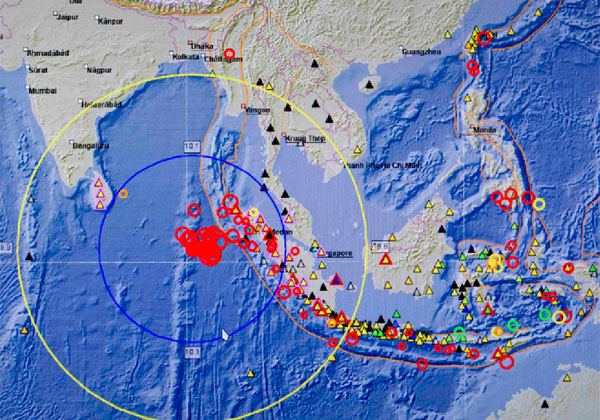
Avoid travel to quake-hit countries: UAE

April 12, 2012

quake_copy

Abu Dhabi, April 12: The National Centre for Metrology and Seismology (NCMS) said the UAE was safe from the earthquake and tsunami in the Indian Ocean, but the UAE Foreign Ministry urged its citizens to take precautions and avoid travelling to the quake-hit countries except in situations of ultimate necessity.

Undersecretary of the Foreign Ministry Juma Mubarak Al Junaibi said the government is seriously following-up through its diplomatic missions in the South-East Asian countries the present conditions of Emirati citizens there. He also appealed to the citizens to register at the online ‘Tawajudee’ service through the ministry’s portal when travelling abroad.

The NCMS said the UAE has not been and will not be affected by the earthquake. It said there was no need to panic as the country and its coastlines were safe from the tsunami.

According to the centre, the 8.4-magnitude earthquake was recorded at 12:38pm local time northwest of Sumatra, in Indonesia.

“This kind of magnitude may cause tsunami in the area and this is the strongest earthquake to hit the region since the earthquake in 2004, causing 200,000 deaths,” the centre advisory said.

According to reports, most of the countries in south Asia, including Sri Lanka, Bangladesh, India and Pakistan have issued alerts after the earthquake report.


Comments

Add new comment

  • Coastaldigest.com reserves the right to delete or block any comments.
  • Coastaldigset.com is not responsible for its readers’ comments.
  • Comments that are abusive, incendiary or irrelevant are strictly prohibited.
  • Please use a genuine email ID and provide your name to avoid reject.
Arab News
March 21,2020

Jeddah, Mar 21: Saudi government ministers on Friday announced a war chest of more than SR120 billion ($32 billion) to fight the “unprecedented” health and economic challenges facing the country as a result of the killer coronavirus pandemic.

During a press conference in Riyadh, finance minister and acting minister of economy and planning, Mohammed Al-Jadaan, unveiled a SR70 billion stimulus package to support the private sector, especially small- and medium-sized enterprises (SMEs) and businesses worst-hit by the virus outbreak.

And the Saudi Arabian Monetary Authority (SAMA) has also sidelined SR50 billion to help the Kingdom’s banking sector, financial institutions and SMEs.

Al-Jadaan said the government had introduced tough measures to protect the country’s citizens while immediately putting in place a financial safety net. He added that the Kingdom was moving decisively to address the global COVID-19 disease crisis and cushion the financial and economic impact of the outbreak on the country.

The SR70 billion package of initiatives revealed by the minister will include exemptions and postponement of some government dues to help provide liquidity for private-sector companies.

Minister of Health Dr. Tawfig Al-Rabiah noted the raft of precautionary measures that had been introduced by the Kingdom in cooperation with the private sector and government agencies to combat the spread of the coronavirus, highlighting the important contribution of the data communication services sector.

He reassured the Saudi public that the Kingdom would continue to do whatever was required to tackle the crisis.

“This pandemic has a lot of challenges. It’s difficult to make presumptions at this moment as we’ve seen; many developed countries did not expect the rate of transmission of this virus.

“We see that the reality of the situation is different from what many expected. The virus is still being studied and though we know the means of transmission, it is transmitted at a very fast rate, having spread to many countries faster than expected.

“We see that many countries have not taken the strong precautionary measures from the beginning of the crisis which led to the vast spread of the virus in these countries,” Al-Rabiah said.

He pointed out that social distancing would help slow the spread.

Al-Jadaan said the Saudi government had the financial and economic capacity to deal with the situation. “We have large reserves and large investments, but we do not want to withdraw from the reserves more than what was already announced in the budget. We do not want to liquidate any of the government’s investments so we will borrow.

“We have approval from the government after the finance committee raised its recommendations to increase the proportion of the domestic product borrowing from 30 percent to 50 percent. We do not expect to exceed 50 percent from now until the end of 2022,” he added.

The government would use all the tools available to it to finance the private sector, especially SMEs, and ensure its ongoing stability.

The finance minister said that at this stage it was difficult to predict the economic impact of the pandemic on the private sector, but he emphasized that international coordination, most notably through G20 countries and health organizations, was ongoing.

On recorded cases of the COVID-19 disease in the Kingdom, Al-Rabiah said: “Many of the confirmed cases are without symptoms, this is due to the precautionary measures being considered.

“As soon as a case is confirmed, we contact and examine anyone who was in direct contact with the patient. This epidemiological investigation, is conducted on a large scale to investigate any case that was in contact with the patient.”

Al-Jadaan also announced the formation of a committee made up of the ministers of finance, economy and planning, commerce, and industry and mineral resources, along with the vice chairman of the board of the Saudi National Development Fund, and its governor.

The committee will be responsible for identifying and reviewing incentives, facilities, and other initiatives led by the fund.

Committees had also been established, said Al-Jadaan, to study the impact and repercussions of the coronavirus crisis on all sectors and regions, and look at ways of overcoming them through subsidies or stimulus packages.


Comments

Add new comment

  • Coastaldigest.com reserves the right to delete or block any comments.
  • Coastaldigset.com is not responsible for its readers’ comments.
  • Comments that are abusive, incendiary or irrelevant are strictly prohibited.
  • Please use a genuine email ID and provide your name to avoid reject.
News Network
July 23,2020

Beirut, Jul 23: The pandemic will exact a heavy toll on Arab countries, causing an economic contraction of 5.7% this year, pushing millions into poverty and compounding the suffering of those affected by armed conflict, a U.N. report said Thursday.

The U.N.'s Economic and Social Commission for Western Asia expects some Arab economies to shrink by up to 13%, amounting to an overall loss for the region of $152 billion.

Another 14.3 million people are expected to be pushed into poverty, raising the total number to 115 million — a quarter of the total Arab population, it said. More than 55 million people in the region relied on humanitarian aid before the COVID-19 crisis, including 26 million who were forcibly displaced.

Arab countries moved quickly to contain the virus in March by imposing stay-at-home orders, restricting travel and banning large gatherings, including religious pilgrimages.

Arab countries as a whole have reported more than 830,000 cases and at least 14,717 deaths. That equates to an infection rate of 1.9 per 1,000 people and 17.6 deaths per 1,000 cases, less than half the global average of 42.6 deaths, according to the U.N.

But the restrictions exacted a heavy economic toll, and authorities have been forced to ease them in recent weeks. That has led to a surge in cases in some countries, including Lebanon, Iraq and the Palestinian territories.

Wealthy Gulf countries were hit by the pandemic at a time of low oil prices, putting added strain on already overstretched budgets. Middle-income countries like Jordan and Egypt have seen tourism vanish overnight and a drop in remittances from citizens working abroad.

War-torn Libya and Syria have thus far reported relatively small outbreaks. But in Yemen, where five years of civil war had already generated the world's worst humanitarian crisis, the virus is running rampant in the government-controlled south while rebels in the north conceal its toll.

Rola Dashti, the head of the U.N. commission, said Arab countries need to “turn this crisis into an opportunity” and address longstanding issues, including weak public institutions, economic inequality and over-reliance on fossil fuels.

“We need to invest in survival, survival of people and survival of businesses,” she said.

Comments

Add new comment

  • Coastaldigest.com reserves the right to delete or block any comments.
  • Coastaldigset.com is not responsible for its readers’ comments.
  • Comments that are abusive, incendiary or irrelevant are strictly prohibited.
  • Please use a genuine email ID and provide your name to avoid reject.
News Network
January 16,2020

Abu Dhabi, Jan 16: The number of people being killed by terrorism activities worldwide has decreased significantly over the recent years, according to the latest Global Terrorism Index.

The 2019 Global Terrorism Index, which was presented at a forum in Abu Dhabi on Wednesday also showed that the UAE improved its ranking in the index by coming down to 130th rank among the 163 countries. The terrorism impact in the UAE is categorised as 'very low'. In the UAE, only two terrorism incidents were reported over the past decade - one in 2010 and another in 2014 - and there were no casualties.

Commenting on the report, Mansour Al Mansouri, director of the UAE National Media Council (NMC) said: "These findings rightly show the UAE as one of the safest countries in the world in terms of terror threat."

The index showed that the total number of deaths from terrorism declined for the fourth consecutive year in 2018, falling by 15.2 per cent to 15,952 deaths. This represents a 53 per cent reduction since its peak in 2014 when 33,555 people were killed in terrorist attacks.

The index published for the seventh year in a row, ranks 163 countries across the globe according to the relative impact of terrorism. This takes into account the number of terrorist incidents, deaths caused by terror and total value of property damage.

The latest results saw three Middle East countries - Iraq, Syria and Yemen - continue in the top 10 positions of the index.

The findings also showed Taleban overtaking Daesh as the deadliest terrorist group in the world, accounting for 38 per cent of all terrorist deaths. This is an increase of 71 per cent. Afghanistan is the country most affected by terrorism in 2018 followed by Iraq, Nigeria, Syria and Pakistan, according to the report. The least impacted nations were Belarus, Guinea-Bissau, Oman, The Gambia and North Korea.

During his presentation of the key findings of the index at the Foreign Correspondent's Club of the UAE (FCC), Serge Stroobants, director of Europe and Mena at the Institute of Economics and Peace, said lesser people were now being killed in terrorism activities.

"There have been long-term trends in global terrorism, with deaths caused by terror down by 52 per cent compared to high point of 2014, which saw Daesh and Boko Haram at their peak," said Stroobants attributing the decrease in the deaths to the increase in security measures and cooperation among nations in the fight against terrorism.

In contrast to this, there has been a 320 per cent increase in far-right terrorist incidents in the West, with political ideology being the driving force behind an increased proportion of terror motivation.

"There has been an increase in far-right terrorism in Western Europe, North America and Oceania for the third consecutive year," said Stroobants.

Terrorism still remains a global security threat, according the index, with 71 countries recording more than one death - the second highest number of countries since 2002.

Stroobants said conflicts remain the main cause of terrorism with 90 per cent of terrorist incidents occurring in places where there are conflicts or insurgencies.

The report said the global economic impact of terrorism was $33 billion in 2018, a substantial decrease of 38 per cent from the previous year.

Boko Haram was responsible for 80 per cent of all female suicide attacks, said the terrorism index.

Global Terrorism Index: Most affected countries

>Afghanistan (7379 deaths)

>Iraq (1,054 deaths)

>Nigeria (2,040 deaths)

>Syria (662 deaths)

>Pakistan (537 deaths)

>Somalia (646 deaths)

>India (350 deaths)

>Yemen (301 deaths)

>The Philippines (297 deaths)

>Democratic Republic of the Congo (410 deaths)

Comments

Add new comment

  • Coastaldigest.com reserves the right to delete or block any comments.
  • Coastaldigset.com is not responsible for its readers’ comments.
  • Comments that are abusive, incendiary or irrelevant are strictly prohibited.
  • Please use a genuine email ID and provide your name to avoid reject.