


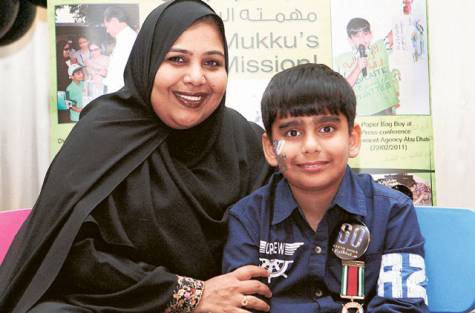
Indian boy in UAE helps save environment

April 18, 2012

boy


Abu Dhabi, April 18: A 10-year-old Indian boy in the United Arab Emirates ( UAE) is doing his own bit to save the environment. Every day, he makes paper bags and distributes them to supermarkets, stores and malls.

Abdul Muqeet started his project when he was only eight. Abdul's father explained to him the negative impact the non-biodegradable plastic bags have on nature. This led Abdul to think about eco-friendly ideas -- what he could do personally and how he could get other people to act, the Gulf News reported.

Every day after school, Abdul began making bags from old newspapers. In two years, he has made and distributed about 4,500 bags to supermarkets, stores and malls.

"I make 10-15 bags a day, except on exam days," Abdul said.

His schoolmates have nicknamed the bags "Abdul Muqeet Bags", and he is popularly known as the " paper bag boy".

Abdul is never shy about stopping a stranger in a supermarket to deliver his message. He waits at the check-out counters and politely asks for a minute of their time to talk about the environment.

"I tell them that recycling one tonne of paper saves 17 trees," he said.

Abdul has held demonstrations in Marina Mall, Abu Dhabi Mall, Khalidiya Mall, Jimi Mall in Al Ain, Dubai Festival City and Dubai Marina Mall.

His mother Andaleeb Fatima said Abdul has received several awards for his commitment to environmental conservation.

His parents now accompany him to his demonstrations.

"When we saw his enthusiasm, we wanted to nurture his interest. I want to tell mothers that every child can give back to the community," she said.


Comments

Add new comment

  • Coastaldigest.com reserves the right to delete or block any comments.
  • Coastaldigset.com is not responsible for its readers’ comments.
  • Comments that are abusive, incendiary or irrelevant are strictly prohibited.
  • Please use a genuine email ID and provide your name to avoid reject.
News Network
March 6,2020

Riyadh, Mar 6: Saudi Arabia on Thursday emptied Islam's holiest site for sterilisation over fears of the new coronavirus, an unprecedented shutdown state media said will last while the year-round Umrah pilgrimage is suspended.

The kingdom halted the pilgrimage for its own citizens and residents on Wednesday, on top of restrictions announced last week on foreign pilgrims to stop the disease from spreading.

State television relayed images of an empty white-tiled area surrounding the Kaaba -- a large black cube structure inside Mecca's Grand Mosque -- which is usually packed with tens of thousands of pilgrims.

As a "precautionary measure", the area will remain closed as long as the umrah suspension lasts but prayers will be allowed inside the mosque, state-run Saudi Press Agency cited a mosque official as saying.

Additionally, the Grand Mosque and the Prophet's Mosque in the city of Medina will be closed an hour after the evening "Isha" prayer and will reopen an hour before the dawn "Fajr" prayer to allow cleaning and sterilisation, the official added.

A group of cleaners was seen scrubbing and mopping the tiles around the Kaaba, a structure draped in gold-embroidered gold cloth towards which Muslims around the world pray.

A Saudi official told news agency the decision to close the area was "unprecedented".

On Wednesday, Saudi Arabia suspended the umrah for its own citizens and residents over fears of the coronavirus spreading to Islam's holiest cities.

The move came after authorities last week suspended visas for the umrah and barred citizens from the six-nation Gulf Cooperation Council from entering Mecca and Medina.

Saudi Arabia on Thursday declared three new coronavirus cases, bringing the total number of reported infections to five.

The umrah, which refers to the Islamic pilgrimage to Mecca that can be undertaken at any time of year, attracts millions of Muslims from across the globe annually.

The decision to suspend the umrah mirrors a precautionary approach across the Gulf to cancel mass gatherings from concerts to sporting events.

It comes ahead of the holy fasting month of Ramadan starting in late April, which is a favoured period for pilgrimage.

It is unclear how the coronavirus will affect the hajj, due to start in late July.

Some 2.5 million faithful travelled to Saudi Arabia from across the world in 2019 to take part in the hajj, which is one of the five pillars of Islam as Muslim obligations are known.

The event is a massive logistical challenge for Saudi authorities, with colossal crowds cramming into relatively small holy sites, making attendees vulnerable to contagion.

Already reeling from slumping oil prices, the kingdom risks losing billions of dollars annually from religious tourism as it tightens access to the sites.

Comments

Add new comment

  • Coastaldigest.com reserves the right to delete or block any comments.
  • Coastaldigset.com is not responsible for its readers’ comments.
  • Comments that are abusive, incendiary or irrelevant are strictly prohibited.
  • Please use a genuine email ID and provide your name to avoid reject.
News Network
June 17,2020

Abu Dhabi, Jun 17: The Ministry of Education (MoE) has allowed students still enrolled in universities overseas to obtain exceptions to attendance policies at their respective academic institutions in light of the Covid-19 pandemic.

In a statement, the ministry said that the move stems from its keenness to ensure the continuity of education for those students and to maintain effective channels of communication with them.

Students' applications for exceptions to academic attendance in universities due to Covid-19 should be submitted following the end of the academic year, and not after the academic semester, via the following email: [email protected].

In their email, students have to explain the reasons for the required exceptions and should include an official message from the university concerned.

Scholarship approval issued by the Ministry of Education for studying abroad should also be attached.

The student's score reports for the academic years spent in the host countries and the duration of each academic year should also be attached, in addition to an entry and exit report of the student from the Federal Authority for Identity and Citizenship.

Comments

Add new comment

  • Coastaldigest.com reserves the right to delete or block any comments.
  • Coastaldigset.com is not responsible for its readers’ comments.
  • Comments that are abusive, incendiary or irrelevant are strictly prohibited.
  • Please use a genuine email ID and provide your name to avoid reject.
News Network
April 20,2020

Apr 20: Eight Indians, including two engineers, have died due to the novel coronavirus in Saudi Arabia, according to a media report on Sunday.

Mohammed Aslam Khan, an electrical engineer in Makkah, and Azmatullah Khan, an engineer at the Makkah Haram power station, have died due to the COVID-19, Saudi Gazette reported.

Aslam Khan, aged 51, who hailed from Meerut in Uttar Pradesh, was admitted to King Faisal Hospital, Makkah on April 3, following worsening of his condition after being infected with fever and throat pain.

He had been on ventilator for more than two weeks and breathed his last on Saturday night, the paper said.

Khan is survived by wife and a daughter and a son. His wife and children are under self-imposed home quarantine.

Azmatullah Khan, from Telangana, died of coronavirus on Friday.

Mujeeb Pukkottoor, a prominent Indian social worker and general secretary of Makkah chapter of Kerala Muslim Cultural Center, told the paper that the body of Khan was buried in Makkah on Sunday.

Khan, aged 65, had been working with Saudi Binladin Group for the last 32 years.

Fakre Alam, an employee at the Haram Project of Saudi Binladin Group in Makkah, died on Sunday due to infection, the paper said.

Barkt Ali Abdullatif Fakir, an electrical technician working in Medina, also died of coronavirus, it said.

According to the Saudi Ministry of Health’s daily report published on April 14, the number of coronavirus infected cases among workers of Saudi Binladin Group in various parts of the Kingdom stood at 117, and these included 70 cases in Makkah.

The first two Indian fatalities were reported from Medina and Riyadh earlier this month with the death of Shebnaz Pala Kandiyil (29) and Safvan Nadamal (41), both from Kerala.

Mohammed Sadiq, from Hyderabad, working in Jeddah and Suleman Sayyid Junaid (Maharashtra) are other Indians who died due to COVID-19 in the Gulf kingdom, the paper said.

Shebnaz from Panoor in Kannoor district died on April 3 and his body was buried in Medina on April 7. He came back to the Kingdom March 3 after his marriage in January.

Safvan, a taxi driver from Chemmad in Malappuram district, died on April 2 and was buried in Riyadh on April 8.

Comments

Add new comment

  • Coastaldigest.com reserves the right to delete or block any comments.
  • Coastaldigset.com is not responsible for its readers’ comments.
  • Comments that are abusive, incendiary or irrelevant are strictly prohibited.
  • Please use a genuine email ID and provide your name to avoid reject.