



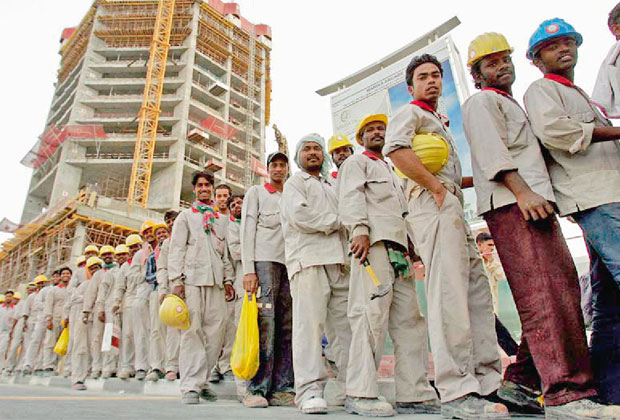
New electronic system to ensure UAE Labours’ rights

April 20, 2012

Labour


Dubai, April 20: The Second consultative ministerial meeting of the Abu Dhabi Dialogue II today unanimously adopted the ‘The Manila Communique’ at the conclusion of its work at the International Convention Center here in Manila.


In a speech at the closing session, UAE Minister of Labour Saqr Ghobash expressed thanks and appreciation of UAE’s leadership and government to the Philippines President, Vice President and Secretary of the Department of Labor and Employment on the opening of the ministerial meeting.


He said that this highlights Philippines’s keenness to have excellent relations with the UAE and the rest of the labor receiving countries.


Ahmed Al Nasser, Deputy Director for Information Technology, Ministry of Labour made a brief presentation at the closing session of the meeting on the latest electronic system for the protection of labours’ rights in the UAE.


He said that this electronic ratification system on the labor contracts over the Internet is a quantum leap providing greater protection to the interests of workers coming or departing the UAE.


Following a brief presentation of the new electronic system, Humaid bin Deemas, Assistant Undersecretary of the Ministry of Labour told the audience that UAE is ready to provide support to the Countries of Origin and Destination for the application of this system.


He declared that the system will start operating from May, adding that the electronic system to verify the contracts has been designed in collaboration with India, noting that this initiative is one of the outcome of Abu Dhabi dialogue and considered as a practical example of its importance.


He also highlighted the importance of these initiatives and programs that sought to improve the Temporary Contractual Employment Cycle and the labor welfare.


In this respect, Rosalinda Baldoz, Secretary of the Philippines Department of Labor and Employment said that the new system is unique and works to reduce violations of employment systems in countries of origin and protect workers’ rights.


She expressed appreciation to the UAE and its leadership on this extraordinary effort to protect the rights of foreign workers.


Comments

Add new comment

  • Coastaldigest.com reserves the right to delete or block any comments.
  • Coastaldigset.com is not responsible for its readers’ comments.
  • Comments that are abusive, incendiary or irrelevant are strictly prohibited.
  • Please use a genuine email ID and provide your name to avoid reject.
Agencies
April 27,2020

Riyadh, Apr 27: A Saudi Arabia-led coalition said on Monday that all parties need to return to the status that existed before the Southern Transitional Council (STC) in Yemen declared an emergency in Aden, according to a statement published by Spa.

The Coalition to Restore Legitimacy in Yemen, led by Saudi Arabia and the UAE, stresses the need to restore conditions to their previous state following the announcement of a state of emergency by the Southern Transitional Council and the consequential development of affairs in the interim capital (Aden) and some Southern governorates in the Republic of Yemen.

The Coalition urges for an immediate end to any steps contrary to the Riyadh Agreement, and work rapidly toward its implementation, citing the wide support for the agreement by the international community and the United Nations.

The Coalition has and will continue to undertake practical and systematic steps to implement the Riyadh Agreement between the parties to unite Yemeni ranks, restore state institutions and combat the scourge of terrorism. The responsibility rests with the signatories to the Agreement to undertake national steps toward implementing its provisions, which were signed and agreed upon with a time matrix for implementation. The Coalition demands an end to any escalation and calls for return to the Agreement by the participating parties, stressing the immediate need for implementation without delay, and the need to prioritise the Yemeni peoples' interests above all else, as well as working to achieve the stated goals of restoring the state, ending the coup and combatting terrorist organizations.

The Coalition reaffirms its ongoing support to the legitimate Yemeni government, and its support for implementing the Riyadh Agreement, which entails forming a competent government that operate from the interim capital Aden to tackle economic and developmental challenges, in light of natural disasters such as floods, fears of the coronavirus (Covid-19) pandemic outbreak, and work to provide services to the brotherly people of Yemen.

Comments

Add new comment

  • Coastaldigest.com reserves the right to delete or block any comments.
  • Coastaldigset.com is not responsible for its readers’ comments.
  • Comments that are abusive, incendiary or irrelevant are strictly prohibited.
  • Please use a genuine email ID and provide your name to avoid reject.
News Network
July 1,2020

Riyadh, Jul 1: Saudis braced Wednesday for a tripling in value added tax, another unpopular austerity measure after the twin shocks of coronavirus and an oil price slump triggered the kingdom's worst economic decline in decades.

Retailers in the country reported a sharp uptick in sales this week of everything from gold and electronics to cars and building materials, as shoppers sought to stock up before VAT is raised to 15 percent.

The hike could stir public resentment as it weighs on household incomes, pushing up inflation and depressing consumer spending as the kingdom emerges from a three-month coronavirus lockdown.

"Cuts, cuts, cuts everywhere," a Saudi teacher in Riyadh told AFP, bemoaning vanishing subsidies as salaries remain stagnant.

"Air conditioner, television, electronic items," he said, rattling off a list of items he bought last week ahead of the VAT hike.

"I can't afford these things from Wednesday."

With its vast oil wealth funding the Arab world's biggest economy, the kingdom had for decades been able to fund massive spending with no taxes at all.

It only introduced VAT in 2018, as part of a push to reduce its dependence on crude revenues.

Then, seeking to shore up state finances battered by sliding oil prices and the coronavirus crisis, it announced in May that it would triple VAT and halt a cost-of-living monthly allowance to citizens.

The austerity push underscores how Saudi Arabia's once-lavish spending is becoming a thing of the past, with the erosion of the welfare system leaving a mostly young population to cope with reduced incomes and a lifestyle downgrade.

That could pile strain on a decades-old social contract whereby citizens were given generous subsidies and handouts in exchange for loyalty to the absolute monarchy.

The rising cost of living may prompt many to ask why state funds are being lavished on multi-billion-dollar projects and overseas assets, including the proposed purchase of English football club Newcastle United.

Shopping malls in the kingdom have drawn large crowds in recent days as retailers offered "pre-VAT sales" and discounts before the hike kicks in.

A gold shop in Riyadh told AFP it saw a 70 percent jump in sales in recent weeks, while a car dealership saw them tick up by 15 percent.

Once the new rate is in place, businesses are predicting depressed sales of everything from cars to cosmetics and home appliances.

Capital Economics forecast inflation will jump up to six percent year-on-year in July, from 1.1 percent in May, as a result.

"The government ended the country's lockdown (in June) and there are signs that economic activity has started to recover," Capital Economics said in a report.

"Nonetheless, we expect the recovery to be slow-going as fiscal austerity measures bite."

The kingdom also risks losing its edge against other Gulf states, including its principal ally the United Arab Emirates, which introduced VAT at the same time but has so far refrained from raising it beyond five percent.

"Saudi Arabia is taking massive risks with contractionary fiscal policies," said Tarek Fadlallah, chief executive officer of the Middle East unit of Nomura Asset Management.

But the kingdom has few choices as oil revenue declines.

Its finances have taken another blow as authorities massively scaled back this year's hajj pilgrimage, from 2.5 million pilgrims last year to around a thousand already inside the country, and suspended the lesser umrah because of coronavirus.

Together the rites rake in some $12 billion annually.

The International Monetary Fund warned the kingdom's GDP will shrink by 6.8 percent this year -- its worst performance since the 1980s oil glut.

The austerity drive would boost state coffers by 100 billion riyals ($26.6 billion), according to state media.

But the measures are unlikely to plug the kingdom's huge budget deficit.

The Saudi Jadwa Investment group forecasts the shortfall will rise to a record $112 billion this year.

Comments

Add new comment

  • Coastaldigest.com reserves the right to delete or block any comments.
  • Coastaldigset.com is not responsible for its readers’ comments.
  • Comments that are abusive, incendiary or irrelevant are strictly prohibited.
  • Please use a genuine email ID and provide your name to avoid reject.
Agencies
May 7,2020

A patient in hospital with Covid-19 has given birth to a healthy baby boy in Dubai.

The 25-year-old Indian was admitted to Al Zahra Hospital after testing positive on May 2.

Although the baby was not due to arrive until May 19, the woman went into labour three days later and delivered a healthy boy weighing 3.8kg.

The parents are yet to name the child, who has also been tested for the virus.

“When we first received the Covid-19 positive diagnosis, we were afraid for the health of both my wife and the baby,” said the boy’s father, who did not want to give his name.

“Thankfully with the help of the doctors and nurses at Al Zahra Hospital, my son was born with no complications and my wife remains in stable condition.

“We couldn’t be more grateful.”

Despite arriving two weeks early, both mother and child are doing well but will only be allowed to leave the hospital to return to their home in Dubai after they return three negative tests on the trot.

“The contractions started very suddenly and it all happened very quickly,” said Al Zahra Hospital nursing director Maysoon Yousef.

“The delivery took about 10 to 15 minutes which is something we do not see very often.

“There were no complications and both the mother and baby are in good condition.”

Strict measures are in place to ensure hygiene for those inside the hospital, as well as visitors.

The new mum and her son are in the same room as the baby needs to be nursed.

According to the Centres for Disease Control and Prevention, a US national public health institute, there is no evidence that suggests the virus can be transmitted through breastfeeding.

New mothers infected with the virus should wear a mask, wash their hands before and after touching the baby.

“We operate by the latest Covid-19 international and local guidelines when it comes to the management of our maternity patients and otherwise,” said Dr Ghassan Lutfi, head of obstetrics and gynaecology at the hospital.

“We take strict measures to guarantee that there is no risk of cross contamination and that all our patients are in safe hands.”

Comments

Add new comment

  • Coastaldigest.com reserves the right to delete or block any comments.
  • Coastaldigset.com is not responsible for its readers’ comments.
  • Comments that are abusive, incendiary or irrelevant are strictly prohibited.
  • Please use a genuine email ID and provide your name to avoid reject.