



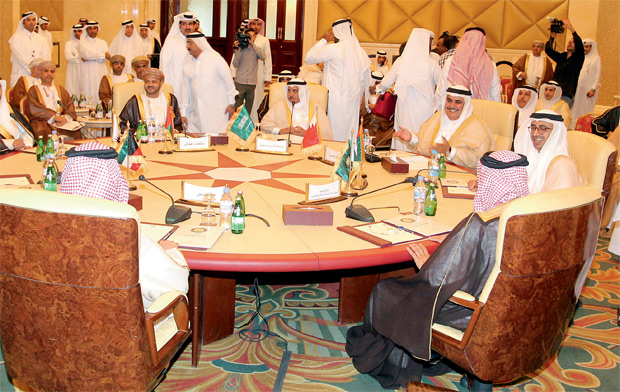
UAE to sharpen islands strategy

April 22, 2012

UAE

Dubai, April 22: Minister of State for Foreign Affairs Dr Anwar Mohammed Gargash has called on Iran to enter into negotiations with the UAE over the three islands occupied by Tehran and to refrain from using arrogant language.

“The UAE today is not that small baby born on 2nd December 1971, rather it’s a key state with huge potentials,” Gargash reminded, calling on Iran to be a mature state and to take into consideration the “neighbourly relationship” that link the two countries.

“We will remain neighbours forever despite our differences,” the minister told Dubai TV in an interview. The UAE, he affirmed, is a wise, respectable state adopting civilised approaches to restore its right. “We are following a long-patience policy”.

The statement came in the wake of the UAE’s reaction — which analysts considered as “unprecedented in term of its strength” — to a recent visit made by Iranian President Mahmoud Ahmedinejad to Abu Mousa Island, which Iran occupied, along with the Greater and Lesser Tunbs, in 1971 on the eve of the birth of the UAE Federation.

Meanwhile, a senior Arab League official said in Cairo that implications of Ahmedinejad’s visit to Abu Mousa will top the agenda of the extraordinary meeting of the Arab foreign ministers on Thursday.

League Deputy Secretary-General Ahmed bin Heli said the foreign ministers would take a common Arab stand on the issue.

In the Dubai TV interview, Gargash said the UAE will adopt a new political strategy in pressing for the demand to solve the issue through peaceful diplomatic channels under the umbrella of the international law. “We are mulling all possible options before us in this respect,” he said, adding that the next phase will see intensive drive for UAE diplomacy.

He emphasised that it’s not in the interest of either the UAE or Iran to escalate the situation because solution to a bilateral problem cannot be reached through provocative statements.

Gargash noted that the UAE’s firm and decisive reaction to the Iranian violation of its sovereignty has nothing to do with what the Iranians were talking about a foreign move. “We are fed up with the record of foreign pressure which the Iranians kept parroting”.

The UAE’s reaction was strong, he went on to say, because Ahmedinejad’s visit to Abu Mousa was an “unprecedented development”.


“It is the first time an Iranian president paid a visit to our occupied islands”. The visit, he indicated, has circumvented a year’s efforts to initiate bilateral negotiations.

The minister said the UAE was shocked by Ahmedinejad’s visit to Abu Mousa island, which undermined Tehran’s credibility.

He attributed the UAE’s surprise to the fact that “the visit was conducted at a time when the two countries reached an understanding on negotiation over the islands. After months of arduous efforts, the two sides had agreed that it was time to solve the problem. The UAE had even named its negotiator and Iran assigned a senior adviser of Ahmedinejad to the mission.

Gargash said the UAE’s claim of ownership to the islands is “based on realistic and tangible historic evidence”.

But he said “the UAE stands ready to risk its historic and legal facts and win or lose at the International Court of Justice”.

Refuting Iran’s allegations of having historic evidences to claim ownership of the islands, Gargash said: “He who has such evidences is supposed to accept international arbitration”.


Comments

Add new comment

  • Coastaldigest.com reserves the right to delete or block any comments.
  • Coastaldigset.com is not responsible for its readers’ comments.
  • Comments that are abusive, incendiary or irrelevant are strictly prohibited.
  • Please use a genuine email ID and provide your name to avoid reject.
News Network
April 18,2020

Apr 18: Taking a strong notice of Islamophobia on social media, Princess Hend Al Qassimi, a member of the royal family of United Arab Emirates, called out a series of tweets by a user named Saurabh Upadhyay.

Upadhyay had posted tweets attacking Muslims over the Tablighi Jamaat congregation held in March in Delhi that led to surge of coronavirus cases cases in India. He also gave into rumours of muslims ‘spiting on food’ to spread the virus.

Princess Qassimi shared the screenshots of his tweets and warned that those engaging in racism and Islamophobia will have to pay penalty and will be made to leave UAE. Upadhyay has apparently deactivated his Twitter handle now.

Responding to his earlier posts, she though the ruling family of UAE is “friends with Indians”, his rudeness was “not welcome”.

“All employees are paid to work, no one comes for free. You make your bread and butter from this land which you scorn and your ridicule will not go unnoticed,” she wrote.

Comments

Add new comment

  • Coastaldigest.com reserves the right to delete or block any comments.
  • Coastaldigset.com is not responsible for its readers’ comments.
  • Comments that are abusive, incendiary or irrelevant are strictly prohibited.
  • Please use a genuine email ID and provide your name to avoid reject.
News Network
July 1,2020

Riyadh, Jul 1: Saudis braced Wednesday for a tripling in value added tax, another unpopular austerity measure after the twin shocks of coronavirus and an oil price slump triggered the kingdom's worst economic decline in decades.

Retailers in the country reported a sharp uptick in sales this week of everything from gold and electronics to cars and building materials, as shoppers sought to stock up before VAT is raised to 15 percent.

The hike could stir public resentment as it weighs on household incomes, pushing up inflation and depressing consumer spending as the kingdom emerges from a three-month coronavirus lockdown.

"Cuts, cuts, cuts everywhere," a Saudi teacher in Riyadh told AFP, bemoaning vanishing subsidies as salaries remain stagnant.

"Air conditioner, television, electronic items," he said, rattling off a list of items he bought last week ahead of the VAT hike.

"I can't afford these things from Wednesday."

With its vast oil wealth funding the Arab world's biggest economy, the kingdom had for decades been able to fund massive spending with no taxes at all.

It only introduced VAT in 2018, as part of a push to reduce its dependence on crude revenues.

Then, seeking to shore up state finances battered by sliding oil prices and the coronavirus crisis, it announced in May that it would triple VAT and halt a cost-of-living monthly allowance to citizens.

The austerity push underscores how Saudi Arabia's once-lavish spending is becoming a thing of the past, with the erosion of the welfare system leaving a mostly young population to cope with reduced incomes and a lifestyle downgrade.

That could pile strain on a decades-old social contract whereby citizens were given generous subsidies and handouts in exchange for loyalty to the absolute monarchy.

The rising cost of living may prompt many to ask why state funds are being lavished on multi-billion-dollar projects and overseas assets, including the proposed purchase of English football club Newcastle United.

Shopping malls in the kingdom have drawn large crowds in recent days as retailers offered "pre-VAT sales" and discounts before the hike kicks in.

A gold shop in Riyadh told AFP it saw a 70 percent jump in sales in recent weeks, while a car dealership saw them tick up by 15 percent.

Once the new rate is in place, businesses are predicting depressed sales of everything from cars to cosmetics and home appliances.

Capital Economics forecast inflation will jump up to six percent year-on-year in July, from 1.1 percent in May, as a result.

"The government ended the country's lockdown (in June) and there are signs that economic activity has started to recover," Capital Economics said in a report.

"Nonetheless, we expect the recovery to be slow-going as fiscal austerity measures bite."

The kingdom also risks losing its edge against other Gulf states, including its principal ally the United Arab Emirates, which introduced VAT at the same time but has so far refrained from raising it beyond five percent.

"Saudi Arabia is taking massive risks with contractionary fiscal policies," said Tarek Fadlallah, chief executive officer of the Middle East unit of Nomura Asset Management.

But the kingdom has few choices as oil revenue declines.

Its finances have taken another blow as authorities massively scaled back this year's hajj pilgrimage, from 2.5 million pilgrims last year to around a thousand already inside the country, and suspended the lesser umrah because of coronavirus.

Together the rites rake in some $12 billion annually.

The International Monetary Fund warned the kingdom's GDP will shrink by 6.8 percent this year -- its worst performance since the 1980s oil glut.

The austerity drive would boost state coffers by 100 billion riyals ($26.6 billion), according to state media.

But the measures are unlikely to plug the kingdom's huge budget deficit.

The Saudi Jadwa Investment group forecasts the shortfall will rise to a record $112 billion this year.

Comments

Add new comment

  • Coastaldigest.com reserves the right to delete or block any comments.
  • Coastaldigset.com is not responsible for its readers’ comments.
  • Comments that are abusive, incendiary or irrelevant are strictly prohibited.
  • Please use a genuine email ID and provide your name to avoid reject.
News Network
January 16,2020

Abu Dhabi, Jan 16: The number of people being killed by terrorism activities worldwide has decreased significantly over the recent years, according to the latest Global Terrorism Index.

The 2019 Global Terrorism Index, which was presented at a forum in Abu Dhabi on Wednesday also showed that the UAE improved its ranking in the index by coming down to 130th rank among the 163 countries. The terrorism impact in the UAE is categorised as 'very low'. In the UAE, only two terrorism incidents were reported over the past decade - one in 2010 and another in 2014 - and there were no casualties.

Commenting on the report, Mansour Al Mansouri, director of the UAE National Media Council (NMC) said: "These findings rightly show the UAE as one of the safest countries in the world in terms of terror threat."

The index showed that the total number of deaths from terrorism declined for the fourth consecutive year in 2018, falling by 15.2 per cent to 15,952 deaths. This represents a 53 per cent reduction since its peak in 2014 when 33,555 people were killed in terrorist attacks.

The index published for the seventh year in a row, ranks 163 countries across the globe according to the relative impact of terrorism. This takes into account the number of terrorist incidents, deaths caused by terror and total value of property damage.

The latest results saw three Middle East countries - Iraq, Syria and Yemen - continue in the top 10 positions of the index.

The findings also showed Taleban overtaking Daesh as the deadliest terrorist group in the world, accounting for 38 per cent of all terrorist deaths. This is an increase of 71 per cent. Afghanistan is the country most affected by terrorism in 2018 followed by Iraq, Nigeria, Syria and Pakistan, according to the report. The least impacted nations were Belarus, Guinea-Bissau, Oman, The Gambia and North Korea.

During his presentation of the key findings of the index at the Foreign Correspondent's Club of the UAE (FCC), Serge Stroobants, director of Europe and Mena at the Institute of Economics and Peace, said lesser people were now being killed in terrorism activities.

"There have been long-term trends in global terrorism, with deaths caused by terror down by 52 per cent compared to high point of 2014, which saw Daesh and Boko Haram at their peak," said Stroobants attributing the decrease in the deaths to the increase in security measures and cooperation among nations in the fight against terrorism.

In contrast to this, there has been a 320 per cent increase in far-right terrorist incidents in the West, with political ideology being the driving force behind an increased proportion of terror motivation.

"There has been an increase in far-right terrorism in Western Europe, North America and Oceania for the third consecutive year," said Stroobants.

Terrorism still remains a global security threat, according the index, with 71 countries recording more than one death - the second highest number of countries since 2002.

Stroobants said conflicts remain the main cause of terrorism with 90 per cent of terrorist incidents occurring in places where there are conflicts or insurgencies.

The report said the global economic impact of terrorism was $33 billion in 2018, a substantial decrease of 38 per cent from the previous year.

Boko Haram was responsible for 80 per cent of all female suicide attacks, said the terrorism index.

Global Terrorism Index: Most affected countries

>Afghanistan (7379 deaths)

>Iraq (1,054 deaths)

>Nigeria (2,040 deaths)

>Syria (662 deaths)

>Pakistan (537 deaths)

>Somalia (646 deaths)

>India (350 deaths)

>Yemen (301 deaths)

>The Philippines (297 deaths)

>Democratic Republic of the Congo (410 deaths)

Comments

Add new comment

  • Coastaldigest.com reserves the right to delete or block any comments.
  • Coastaldigset.com is not responsible for its readers’ comments.
  • Comments that are abusive, incendiary or irrelevant are strictly prohibited.
  • Please use a genuine email ID and provide your name to avoid reject.