



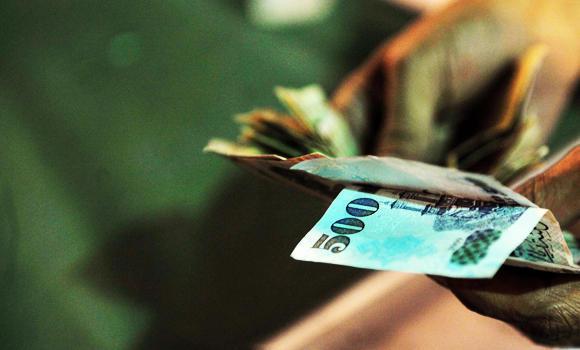
Saudi personal income levels show sharp rise

February 23, 2013

Saudi_personal

Riyadh, Feb 23: Saudi Arabia’s per capita income rose 27.2 percent from 2010 to 2011 following an increase of 17.1 percent from 2009 to 2010, according to a report by the Saudi Arabian Monetary Agency (SAMA).

Preliminary figures indicate that expenditure on GDP increased by 31 percent to SR 2.239 billion, “including import duties,” during 2011, said the report. This compares to SR 1.709 billion during 2010. The rise was attributed to a 103.3 percent increase in net exports of goods and services during 2011. This translates into a rise from SR 328.6 billion in 2010 to SR 668 billion in 2011.

Meanwhile, Fadl Bu Aynain, an economic expert, told Asharq Al-Awsat that “what matters in these figures is the constituents of GDP, since an increase in GDP, and hence per capita income, is more reliable when there is diversity of production and a dominance of industrial production.”

He added: “When oil revenues dominate the GDP, this gives a skewed view of economic growth. In other words, the rise of oil prices and the increase in oil output have influenced the total GDP. So we can say that without knowing the details of the factors that contribute to GDP, you cannot have a meaningful picture of the economy.”

He explained: “The economy that depends on royalties may cause major problems in the future, unless the growth in GDP is based on diversifying and broadening the base of industrial and service production.

“This will create jobs, increase real per capita income, and create sustained development, through the private sector, in particular. If that does not happen, Saudi Arabia may face major challenges in fulfilling its obligations in the future in case there were substantial changes in oil prices or in the ratio of exports to the total GDP.”

Tal’at Hafidh, secretary-general of the Commission for Orientation and Education in the Banks, said one of the major causes of inflation in Saudi Arabia is “what we call imported inflation, when the prices of imported goods are hiked for various reasons in the country of origin, or when there are extra expenses added on the goods, like an increase in shipping and insurance costs, etc.”

Comments

Add new comment

  • Coastaldigest.com reserves the right to delete or block any comments.
  • Coastaldigset.com is not responsible for its readers’ comments.
  • Comments that are abusive, incendiary or irrelevant are strictly prohibited.
  • Please use a genuine email ID and provide your name to avoid reject.
News Network
January 16,2020

Abu Dhabi, Jan 16: The number of people being killed by terrorism activities worldwide has decreased significantly over the recent years, according to the latest Global Terrorism Index.

The 2019 Global Terrorism Index, which was presented at a forum in Abu Dhabi on Wednesday also showed that the UAE improved its ranking in the index by coming down to 130th rank among the 163 countries. The terrorism impact in the UAE is categorised as 'very low'. In the UAE, only two terrorism incidents were reported over the past decade - one in 2010 and another in 2014 - and there were no casualties.

Commenting on the report, Mansour Al Mansouri, director of the UAE National Media Council (NMC) said: "These findings rightly show the UAE as one of the safest countries in the world in terms of terror threat."

The index showed that the total number of deaths from terrorism declined for the fourth consecutive year in 2018, falling by 15.2 per cent to 15,952 deaths. This represents a 53 per cent reduction since its peak in 2014 when 33,555 people were killed in terrorist attacks.

The index published for the seventh year in a row, ranks 163 countries across the globe according to the relative impact of terrorism. This takes into account the number of terrorist incidents, deaths caused by terror and total value of property damage.

The latest results saw three Middle East countries - Iraq, Syria and Yemen - continue in the top 10 positions of the index.

The findings also showed Taleban overtaking Daesh as the deadliest terrorist group in the world, accounting for 38 per cent of all terrorist deaths. This is an increase of 71 per cent. Afghanistan is the country most affected by terrorism in 2018 followed by Iraq, Nigeria, Syria and Pakistan, according to the report. The least impacted nations were Belarus, Guinea-Bissau, Oman, The Gambia and North Korea.

During his presentation of the key findings of the index at the Foreign Correspondent's Club of the UAE (FCC), Serge Stroobants, director of Europe and Mena at the Institute of Economics and Peace, said lesser people were now being killed in terrorism activities.

"There have been long-term trends in global terrorism, with deaths caused by terror down by 52 per cent compared to high point of 2014, which saw Daesh and Boko Haram at their peak," said Stroobants attributing the decrease in the deaths to the increase in security measures and cooperation among nations in the fight against terrorism.

In contrast to this, there has been a 320 per cent increase in far-right terrorist incidents in the West, with political ideology being the driving force behind an increased proportion of terror motivation.

"There has been an increase in far-right terrorism in Western Europe, North America and Oceania for the third consecutive year," said Stroobants.

Terrorism still remains a global security threat, according the index, with 71 countries recording more than one death - the second highest number of countries since 2002.

Stroobants said conflicts remain the main cause of terrorism with 90 per cent of terrorist incidents occurring in places where there are conflicts or insurgencies.

The report said the global economic impact of terrorism was $33 billion in 2018, a substantial decrease of 38 per cent from the previous year.

Boko Haram was responsible for 80 per cent of all female suicide attacks, said the terrorism index.

Global Terrorism Index: Most affected countries

>Afghanistan (7379 deaths)

>Iraq (1,054 deaths)

>Nigeria (2,040 deaths)

>Syria (662 deaths)

>Pakistan (537 deaths)

>Somalia (646 deaths)

>India (350 deaths)

>Yemen (301 deaths)

>The Philippines (297 deaths)

>Democratic Republic of the Congo (410 deaths)

Comments

Add new comment

  • Coastaldigest.com reserves the right to delete or block any comments.
  • Coastaldigset.com is not responsible for its readers’ comments.
  • Comments that are abusive, incendiary or irrelevant are strictly prohibited.
  • Please use a genuine email ID and provide your name to avoid reject.
News Network
May 10,2020

Dubai, May 10: Kuwait will enact a "total curfew" from 4pm (1300 GMT) on Sunday through to May 30 to help to curb the spread of the new coronavirus, the Information Ministry said on Twitter on Friday.

Further details of the curfew will be announced soon, it said.

Kuwait on April 20 expanded a nationwide curfew to 16 hours a day, from 4pm to 8am, and extended a suspension of work in the public sector, including government ministries, until May 31.

On Friday the Gulf state announced 641 new coronavirus cases and three deaths, bringing its total number of confirmed cases to 7,208, with 47 deaths.

Comments

Add new comment

  • Coastaldigest.com reserves the right to delete or block any comments.
  • Coastaldigset.com is not responsible for its readers’ comments.
  • Comments that are abusive, incendiary or irrelevant are strictly prohibited.
  • Please use a genuine email ID and provide your name to avoid reject.
Agencies
July 2,2020

With the launch of the Emirates Mars Mission less than a couple of weeks away, the spacecraft that will carry the UAE's Hope Probe to outer space has already been fuelled, it was announced today.

At a virtual briefing by the Mohammed bin Rashid Space Centre (MBRSC) today, the media was informed that scientists are busy giving finishing touches to the Hope Mars Mission, which will give mankind a complete picture of the Martian atmosphere once the UAE's indigenous probe reaches the Red Planet's orbit in 2021.

As the monitoring continues, final charging of the batteries is also ongoing, scientists said.

The space engineers averred that with this mission, the momentum in the region for space awareness will continue not only among young Emiratis but also among other youngsters in the Arab world.

The Hope Probe is scheduled to take off from Japan's Tanegashima Space Centre on July 15 at 00:51:27 UAE time.

The first Arab space mission to the Red Planet remained on track despite the challenges arising from the Covid-19 pandemic.

The spacecraft will provide the first global pictures of the Martian atmosphere and data will be shared freely with over 200 research centres across the world. It will help answer key questions about the global Martian atmosphere and the loss of hydrogen and oxygen gases into space over the span of one Martian year.

450 engineers, technicians and experts are involved in the project.  This comprises of 12,000 tasks in 6 years and entails 5.5 million working hours.

It includes 200 new technologies and 15 scientific partnerships with global universities and institutions.

The spaceship will travel 495 million km. It has a cruise speed of 121,000km/hour.

MBRSC is responsible for the execution and supervision of all stages of the design, development and launch of the Hope Probe. The UAE Space Agency is funding and supervising procedures and necessary details for the implementation of this project. After its launch in mid-July and following a journey of several months, the probe is expected to enter the Red Planet's orbit in 2021, coinciding with the Golden Jubilee of the Union.

Comments

Add new comment

  • Coastaldigest.com reserves the right to delete or block any comments.
  • Coastaldigset.com is not responsible for its readers’ comments.
  • Comments that are abusive, incendiary or irrelevant are strictly prohibited.
  • Please use a genuine email ID and provide your name to avoid reject.