



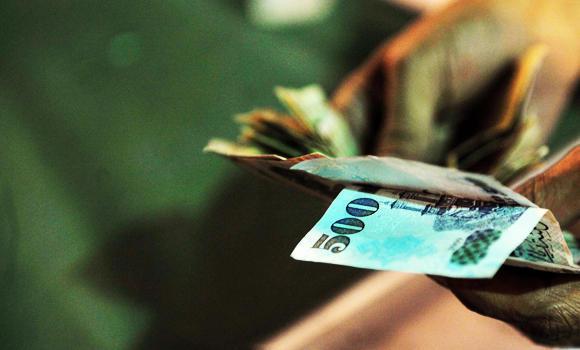
Saudi personal income levels show sharp rise

February 23, 2013

Saudi_personal

Riyadh, Feb 23: Saudi Arabia’s per capita income rose 27.2 percent from 2010 to 2011 following an increase of 17.1 percent from 2009 to 2010, according to a report by the Saudi Arabian Monetary Agency (SAMA).

Preliminary figures indicate that expenditure on GDP increased by 31 percent to SR 2.239 billion, “including import duties,” during 2011, said the report. This compares to SR 1.709 billion during 2010. The rise was attributed to a 103.3 percent increase in net exports of goods and services during 2011. This translates into a rise from SR 328.6 billion in 2010 to SR 668 billion in 2011.

Meanwhile, Fadl Bu Aynain, an economic expert, told Asharq Al-Awsat that “what matters in these figures is the constituents of GDP, since an increase in GDP, and hence per capita income, is more reliable when there is diversity of production and a dominance of industrial production.”

He added: “When oil revenues dominate the GDP, this gives a skewed view of economic growth. In other words, the rise of oil prices and the increase in oil output have influenced the total GDP. So we can say that without knowing the details of the factors that contribute to GDP, you cannot have a meaningful picture of the economy.”

He explained: “The economy that depends on royalties may cause major problems in the future, unless the growth in GDP is based on diversifying and broadening the base of industrial and service production.

“This will create jobs, increase real per capita income, and create sustained development, through the private sector, in particular. If that does not happen, Saudi Arabia may face major challenges in fulfilling its obligations in the future in case there were substantial changes in oil prices or in the ratio of exports to the total GDP.”

Tal’at Hafidh, secretary-general of the Commission for Orientation and Education in the Banks, said one of the major causes of inflation in Saudi Arabia is “what we call imported inflation, when the prices of imported goods are hiked for various reasons in the country of origin, or when there are extra expenses added on the goods, like an increase in shipping and insurance costs, etc.”

Comments

Add new comment

  • Coastaldigest.com reserves the right to delete or block any comments.
  • Coastaldigset.com is not responsible for its readers’ comments.
  • Comments that are abusive, incendiary or irrelevant are strictly prohibited.
  • Please use a genuine email ID and provide your name to avoid reject.
Agencies
April 27,2020

Riyad, Apr 27: The Saudi-led Arab Coalition supporting Yemen’s UN-recognized government on Monday urged all parties to end any escalation of hostilities and return to the status that existed before the Southern Transitional Council (STC) declared self-rule.

In a statement carried by the Saudi Press Agency (SPA), the coalition emphasized “the need to cancel any step that violates the Riyadh agreement and work to accelerate its implementation.” 

On Sunday, the United Arab Emirates-backed STC scrapped a peace deal with the internationally recognized government of President Abed Rabbo Mansour Hadi.

Accusing the government of corruption and mismanagement, the separatists said they would “self-govern” the key southern port city of Aden and other southern provinces.

Yemen’s Foreign Minister Mohammed Al-Hadhrami described the move as a “resumption of its (STC’s) armed insurgency and rejection and complete withdrawal from the Riyadh agreement.” 

Authorities in Yemen’s southern provinces of Hadramawt, Abyan, Shabwa, Al-Mahra and the remote island of Socotra also rejected the separatist group’s claim to self-rule.

The government said local and security authorities in the five provinces dismissed the move as a “clear and definite coup.” 

Some of the provinces issued their own statements condemning it.

The coalition appealed to all parties to “give priority to the interests of the Yemeni people over any other interests”. 

It also urged the parties involved not to lose their focus on working to achieve the goal of restoring the state, ending the Houthi “coup” and “countering terrorist organizations”.

“The Coalition has and will continue to undertake practical and systematic steps to implement the Riyadh Agreement between the parties to unite Yemeni ranks, restore state institutions and combat the scourge of terrorism,” the statement said. “The responsibility rests with the signatories to the Agreement to undertake national steps toward implementing its provisions, which were signed and agreed upon with a time matrix for implementation.”

The STC has been part of the coalition-backed forces fighting the Iran-backed Houthi militia, which seized control of the Yemeni capital Sanaa and other provinces in 2014.

The Houthi “coup” has led to the formation of the Saudi-led coalition, which had since driven away the Houthis from the south and other provinces. President Hadi’s government has made Aden as its temporary seat.

Comments

Add new comment

  • Coastaldigest.com reserves the right to delete or block any comments.
  • Coastaldigset.com is not responsible for its readers’ comments.
  • Comments that are abusive, incendiary or irrelevant are strictly prohibited.
  • Please use a genuine email ID and provide your name to avoid reject.
News Network
March 11,2020

Riyadh, Mar 11: Energy titan Saudi Aramco said Tuesday it will boost crude oil supplies to 12.3 million barrels per day in April, flooding markets as it escalates a price war with Russia.

Riyadh had already slashed its price for April delivery after Russia refused its proposal that producer alliance OPEC+ orchestrate a co-ordinated cut of 1.5 million barrels per day.

The production cut had been mooted to shore up global oil prices, which have gone into meltdown as the deadly new coronavirus casts a pall over the world economy, but now price cuts and rising output indicate an unravelling of OPEC+ co-operation.

"Saudi Aramco announces that it will provide its customers with 12.3 million barrels per day of crude oil in April," the company said in a statement to the Saudi stock exchange.

Saudi Arabia, the world's biggest crude exporter has been pumping some 9.8 million bpd so its announcement on Tuesday means it will be adding at least 2.5 million bpd from April.

"The Company has agreed with its customers to provide them with such volumes starting 1 April 2020. The Company expects that this will have a positive, long-term financial effect," the statement said.

Saudi Arabia says it has an output capacity of 12 million bpd but it is not known for how long it can sustain such levels.

The kingdom also has millions of barrels of crude stored in strategic reserves to be used when needed and is expected to use it to provide the extra supply to the global market.

"Production above 12 million bpd shows the Saudis have something to prove," director of Britain-based RS Energy Bill Farren-Price said.

"This is a grab for market share. The taps are open and the prices have been cut sharply," Farren-Price told AFP.

In a quick response, Russian Energy Minister Alexander Novak said Moscow could boost production in the short term "by 200,00-300,000 bpd, with a potential of 500,000 bpd in the near future".

But he stressed that Moscow was in favour of extending a December agreement that had seen OPEC and Russia agree to cut production by 500,000 barrels per day in 2020, lowering output from October 2018 levels by 1.7 million barrels per day.

The events of recent days have signalled a disintegration of collaboration between OPEC and Russia.

Russia is a non-OPEC member and the world's second-biggest oil producer, but Moscow and other non-members have in recent years co-operated with the oil cartel in an arrangement known as OPEC+.

The Saudi price cuts over the weekend, which were the first salvo in the price war, sent oil prices crashing -- registering the single biggest one-day loss in three decades on Monday.

Saudi Arabia draws around 70 per cent of its revenues from oil, and the revenues are key to ambitious reform programmes launched by Crown Prince Mohammed bin Salman.

Comments

Add new comment

  • Coastaldigest.com reserves the right to delete or block any comments.
  • Coastaldigset.com is not responsible for its readers’ comments.
  • Comments that are abusive, incendiary or irrelevant are strictly prohibited.
  • Please use a genuine email ID and provide your name to avoid reject.
News Network
May 25,2020

May 25: A total of 241 Indians including 136 people who were jailed in Kuwait would return to the country soon, a senior minister said on Sunday.

The other 105 people were stranded in Bangladesh, Law Minister Ratan Lal Nath said.

"Altogether 136 people from Tripura and Assam, who are at present in jail in Kuwait for violating that country's laws, would be deported. They will reach Guwahati between May 27 and June 4 in a special flight," Nath told reporters.

He said the matter has been officially informed by the Kuwaiti government, but the reason for their imprisonment is not known.

"We had requested the Kuwaiti authorities to drop the Tripura residents here. However, they informed us that the flight would land in a single airport," the minister added.

Nath said 105 residents of Tripura, who are stranded in different places of Bangladesh will return to the state through the Agartala-Akhaura integrated check post on May 28.

"They would be taken to institutional quarantine and swabs of all the passengers would be collected for COVID-19 test," Nath said.

If the report of their samples tests negative, they would be allowed to leave the facility and remain under 14 days of home quarantine. And those who test positive would be hospitalized, he said.

Comments

Add new comment

  • Coastaldigest.com reserves the right to delete or block any comments.
  • Coastaldigset.com is not responsible for its readers’ comments.
  • Comments that are abusive, incendiary or irrelevant are strictly prohibited.
  • Please use a genuine email ID and provide your name to avoid reject.