



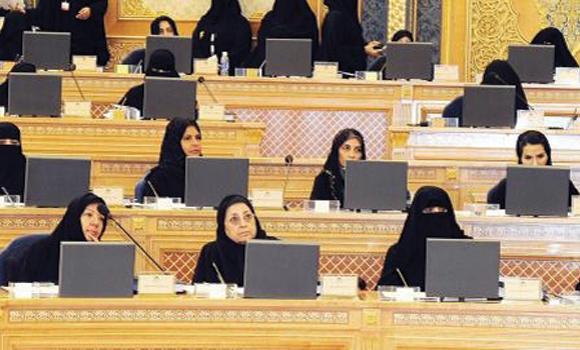
Historic day: Women get down to business at Shoura

February 25, 2013

Women_get_down

Jeddah, Feb 25: Thirty women Shoura members took part in the discussions of the Saudi consultative body for the first time yesterday. “It was a historic day for Saudi women,” said one female member. The meeting appointed three women as deputy chairpersons of subsidiary panels.

Zainab Abutaleb said yesterday’s Shoura session that began at 10 a.m. was well organized, adding that it discussed a number of important topics. At the outset of the meeting, Shoura President Abdullah Al-Asheikh spoke about how the council works. There was a documentary on the participation and voting of members.

Forms were distributed among the members giving them an opportunity to pick three committees they intend to work with. “Shoura is an integrated system and its discussions are free and fair,” said Abutaleb, who has been named deputy chairperson of the Cultural and Media Committee.

Asked why women members were not asking for a separate committee, she said: “Female members have been appointed to different committees to take up issues of women.”

Six women members have been appointed to the Social, Family and Youth Committee. They are Hamda bint Khalaf Al-Anazi, Noura bint Abdullah Al-Asqa, Noura bint Abdullah Al-Odwan, Hiba bint Abdul Aziz Al-Munie, Fatma bint Muhammad Al-Qarni and Princess Sara bint Faisal.

There are two women in the Management and Human Resource Committee. Lubna Al-Ansari is deputy chairperson of the Health and Environment Affairs Committee while Thuraya Obaid is deputy chairperson of the Human Rights Committee.

Comments

Add new comment

  • Coastaldigest.com reserves the right to delete or block any comments.
  • Coastaldigset.com is not responsible for its readers’ comments.
  • Comments that are abusive, incendiary or irrelevant are strictly prohibited.
  • Please use a genuine email ID and provide your name to avoid reject.
News Network
May 31,2020

Dubai, May 31: As many as 84 beggars have been arrested in Dubai during the Eid Al Fitr holiday, the Dubai Police have said.

The arrests were carried out as part of their anti-begging campaign to prevent begging during the holy month of Ramadan.

Some illegal vendors, too, have been arrested in different areas of the emirate, the police added.

Colonel Ali Salem, Director of the Infiltrators Department at the Criminal Investigations Department of Dubai Police, said that the campaign aims to maintain the safety and security of the society, adding that the campaign was successful and helped reduce the number of beggars across the emirate.

He called on the public to report begging activities to the number 901 or the Dubai Police app.

Comments

Add new comment

  • Coastaldigest.com reserves the right to delete or block any comments.
  • Coastaldigset.com is not responsible for its readers’ comments.
  • Comments that are abusive, incendiary or irrelevant are strictly prohibited.
  • Please use a genuine email ID and provide your name to avoid reject.
News Network
April 18,2020

Apr 18: Taking a strong notice of Islamophobia on social media, Princess Hend Al Qassimi, a member of the royal family of United Arab Emirates, called out a series of tweets by a user named Saurabh Upadhyay.

Upadhyay had posted tweets attacking Muslims over the Tablighi Jamaat congregation held in March in Delhi that led to surge of coronavirus cases cases in India. He also gave into rumours of muslims ‘spiting on food’ to spread the virus.

Princess Qassimi shared the screenshots of his tweets and warned that those engaging in racism and Islamophobia will have to pay penalty and will be made to leave UAE. Upadhyay has apparently deactivated his Twitter handle now.

Responding to his earlier posts, she though the ruling family of UAE is “friends with Indians”, his rudeness was “not welcome”.

“All employees are paid to work, no one comes for free. You make your bread and butter from this land which you scorn and your ridicule will not go unnoticed,” she wrote.

Comments

Add new comment

  • Coastaldigest.com reserves the right to delete or block any comments.
  • Coastaldigset.com is not responsible for its readers’ comments.
  • Comments that are abusive, incendiary or irrelevant are strictly prohibited.
  • Please use a genuine email ID and provide your name to avoid reject.
News Network
July 23,2020

Beirut, Jul 23: The pandemic will exact a heavy toll on Arab countries, causing an economic contraction of 5.7% this year, pushing millions into poverty and compounding the suffering of those affected by armed conflict, a U.N. report said Thursday.

The U.N.'s Economic and Social Commission for Western Asia expects some Arab economies to shrink by up to 13%, amounting to an overall loss for the region of $152 billion.

Another 14.3 million people are expected to be pushed into poverty, raising the total number to 115 million — a quarter of the total Arab population, it said. More than 55 million people in the region relied on humanitarian aid before the COVID-19 crisis, including 26 million who were forcibly displaced.

Arab countries moved quickly to contain the virus in March by imposing stay-at-home orders, restricting travel and banning large gatherings, including religious pilgrimages.

Arab countries as a whole have reported more than 830,000 cases and at least 14,717 deaths. That equates to an infection rate of 1.9 per 1,000 people and 17.6 deaths per 1,000 cases, less than half the global average of 42.6 deaths, according to the U.N.

But the restrictions exacted a heavy economic toll, and authorities have been forced to ease them in recent weeks. That has led to a surge in cases in some countries, including Lebanon, Iraq and the Palestinian territories.

Wealthy Gulf countries were hit by the pandemic at a time of low oil prices, putting added strain on already overstretched budgets. Middle-income countries like Jordan and Egypt have seen tourism vanish overnight and a drop in remittances from citizens working abroad.

War-torn Libya and Syria have thus far reported relatively small outbreaks. But in Yemen, where five years of civil war had already generated the world's worst humanitarian crisis, the virus is running rampant in the government-controlled south while rebels in the north conceal its toll.

Rola Dashti, the head of the U.N. commission, said Arab countries need to “turn this crisis into an opportunity” and address longstanding issues, including weak public institutions, economic inequality and over-reliance on fossil fuels.

“We need to invest in survival, survival of people and survival of businesses,” she said.

Comments

Add new comment

  • Coastaldigest.com reserves the right to delete or block any comments.
  • Coastaldigset.com is not responsible for its readers’ comments.
  • Comments that are abusive, incendiary or irrelevant are strictly prohibited.
  • Please use a genuine email ID and provide your name to avoid reject.