



Clashes return to streets of Cairo in another blow for Egypt

July 16, 2013

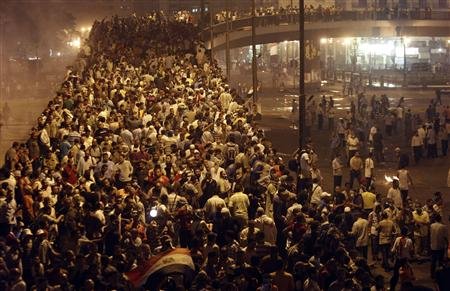
Cairo_clashesCairo, Jul 16: Egyptian police and protesters clashed in central Cairo early on Tuesday after fights broke out between supporters of ousted Islamist President Mohamed Morsi and locals angered when they tried to block major thoroughfares crossing the River Nile.

The MENA state news agency said at least 22 people were injured in the violence, which began just after 9pm (1900 GMT) on Monday and lasted into the early hours of Tuesday.

The clashes were smaller and more localised than the earlier deadly unrest since Morsi was deposed by the military on July 3, and most of Cairo was unaffected.

Still, after a week of relative calm, scenes of running street battles close to the Egyptian Museum, one of the country's main tourist attractions, may raise further concerns about stability in the Arab world's most populous country.

"I've had enough of this chaos," said Ashraf Mohamed, who watched the clashes from a distance. "Egypt is just rubbish."

Young men, their mouths covered to protect them from tear gas, threw stones at police and shouted pro-Morsi and anti-military slogans, as well as "Allahu Akbar!" (God is greatest).

Military helicopters hovered overhead and police vans were brought in to quell the trouble, but when that didn't work, dozens of riot police moved in. Medics treated men with deep gashes to their eyes and faces nearby.

Mohamed's frustration echoed the view of millions of Egyptians who rallied for Morsi's resignation on June 30. The military said it deposed him to fulfil the wish of the people. Morsi's Muslim Brotherhood movement said it was a coup.

"It's the army against the people, these are our soldiers, we have no weapons," said Alaa el-Din, a 34-year-old computer engineer, clutching a laptop.

"The army is killing our brothers, you are meant to defend me and you are attacking me. The army turned against the Egyptian people."

Egypt has become increasingly polarised by the crisis, but one thing the two sides share is a deep mistrust of the United States and its perceived role in the unrest.

Burns spurned?

US deputy secretary of state William Burns told reporters in Cairo that Washington had no desire to meddle in Egypt, which it supports with $1.5 billion in aid each year, most of which goes to the military.

"Only Egyptians can determine their future," Burns told reporters at the US embassy. "I did not come with American solutions. Nor did I come to lecture anyone. We will not try to impose our model on Egypt."

Washington, never comfortable with the rise of the Islamist Brotherhood, has so far refused to say whether it views Morsi's removal as a coup, which would require it to halt aid.

The Islamist Nour Party and the Tamarud anti-Morsi protest movement both said they turned down invitations to meet Burns.

But a senior State Department official denied Burns had been shunned. "I don't think we're losing influence at all," the US official said, adding that Burns was still in Cairo.

"I don't know what meetings he has, but he has seen a range of people in Cairo in the interim government, in civil society ... so it's hard to say he has been spurned by both sides. I don't accept that is the case."

Marches in Cairo and beyond

Tens of thousands of Brotherhood supporters gathered late on Monday at the Rabaa Adawiya mosque in northeastern Cairo, where they have staged a sit-in vigil for the last three weeks vowing to stay until Morsi is reinstated.

Another large crowd rallied outside Cairo University, and there were protests in the coastal city of Alexandria and the Nile city of Assiut. There also were minor clashes in Giza, home of the pyramids, just outside Cairo.

The army warned demonstrators that it would respond with "the utmost severity and firmness and force" if they approached military bases or "vital state institutes."

At least 92 people were killed in the days after Morsi was toppled, more than half of them shot by troops outside the Republican Guard compound near the Rabaa mosque on July 8. Protests since then had been tense but peaceful until Monday night.

The political turmoil and unrest in major cities has also fuelled violence in Egypt's lawless North Sinai province bordering Israel and the Palestinian Gaza Strip.

Attacks in the area have killed 13 people, mainly police, since July 3. In the latest, suspected Islamist militants fired grenades at a bus carrying workers from a factory in the Sinai city of El Arish on Monday, killing three and wounding 17.

US calls for restraint

Morsi is being held incommunicado at an undisclosed location. He has not been charged with a crime but the authorities say they are investigating him over complaints of inciting violence, spying and wrecking the economy. Scores of Morsi supporters were rounded up after violence last week.

Many of the top Brotherhood figures have been charged with inciting violence, but have not been arrested and are still at large. The public prosecutors' office announced new charges against seven Brotherhood and Islamist leaders on Monday.

Burns had earlier called for restraint on both sides.

"If representatives of some of the largest parties in Egypt are detained or excluded, how are dialogue and participation possible?" he asked. He also urged those opposed to Morsi's ouster to participate in the political process peacefully.

Interim President Adli Mansour and his prime minister Hazem el-Beblawi head a transitional cabinet full of technocrats that is paving the way for parliamentary elections in around six months, in a bid to restore civilian rule.

US-educated economist Ahmed Galal, as finance minister, has the task of rescuing an economy and state finances wrecked by two and a half years of turmoil.

That task became easier, at least in the short term, after Saudi Arabia, the United Arab Emirates and Kuwait - rich Gulf Arab states happy at the downfall of the Brotherhood - promised a total of $12 billion in cash, loans and fuel.

The new planning minister, Ashraf al-Arabi, said the Arab money would be enough to sustain Egypt through its transition period and it did not need to restart talks with the International Monetary Fund.

Egypt had sought $4.8 billion in IMF aid last year, but months of talks ran aground with the government unable to agree on cuts in unaffordable subsidies for food and fuel. Arabi's comments could worry investors who want the IMF to prod reform.

"I think it's inappropriate to be making such a strong statement, given how new he is to the position," said Angus Blair, president of the Signet Institute, an economic think tank.

Comments

Add new comment

  • Coastaldigest.com reserves the right to delete or block any comments.
  • Coastaldigset.com is not responsible for its readers’ comments.
  • Comments that are abusive, incendiary or irrelevant are strictly prohibited.
  • Please use a genuine email ID and provide your name to avoid reject.
News Network
June 26,2020

Dubai, Jun 26: As summers in Dubai bloom in its full glory, the most savoured summer fruit - Mongo - is getting the most special treatment in the city as it gets delivered to customers via an emperor like ride of a Lamborghini.

As per a video report by Gulf News, the Pakistan Supermarket in Dubai is delivering the king of fruits to the doorsteps of its customers in a green coloured Lamborghini to match the level of its supremacy among fruits.

"The king should travel like a king," says the managing director of the store, Mohammad Jehanzeb who delivers the pulpy fruit by himself and also takes the customers on a short ride in the luxury car.

In order to avail the offer rolled out on the Facebook page of the famous supermarket, customers are required to make a minimum order of Dh100, reports the Gulf News.

"The idea is to put a smile on people's faces and make them feel special," says Jehanzeb who has put a smile on the face of dozens of Dubai residents amidst the throes of a pandemic with his 'Mangoes in Lamborghini' campaign.

The delicacy this year has gone viral with videos of delighted mango lovers taking a joy ride in the supercar doing rounds over the internet.

"The joy ride was essentially meant for kids who have been sequestered at homes because of the coronavirus but adults are equally thrilled at the prospect of getting behind the wheels of my Lamborghini Huracan. I am happy to oblige them too," says Jehanzeb.

"Each order takes about an hour. We do about 7-8 home deliveries a day but are hoping to ramp up the numbers to 12," he adds.

Arshad Khan who hails from the Indian city of nawabs - Lucknow- ordered the 'nawabi' varieties - Sindhri and Anwar Ratol - and said that his children were exhilarated after hearing the roar of the Lamborghini outside their Falcon City villa.

"For someone who hails from Lucknow -- the land of the famous dussheri and landga mangoes -- I was a bit skeptical about the taste of Pakistani mangoes. I ordered them for the sheer experience of seeing them come to my place in a luxury supercar," Gulf News quoted Khan as saying.

"It was quite exhilarating and I must confess that the mangoes were as delicious as the ones back home," he added.

Mango fruit has been a delicacy in the 16th-century Hindustan sub-continent. It holds a fascinating narrative in Babur Nama which is an autobiography of the Mughal emperor Zahiruddin Muhammad Babur.

Comments

Add new comment

  • Coastaldigest.com reserves the right to delete or block any comments.
  • Coastaldigset.com is not responsible for its readers’ comments.
  • Comments that are abusive, incendiary or irrelevant are strictly prohibited.
  • Please use a genuine email ID and provide your name to avoid reject.
Agencies
July 28,2020

Dubai, Jul 28: Abu Dhabi Commercial Bank (ADCB) (ADCB.AD) is letting go hundreds of employees, sources said, the latest in a round of lay-offs by regional banks as pressure mounts to cut costs amid lower oil prices and the coronavirus crisis.

The UAE’s third-biggest lender is laying off 400 employees, two sources familiar with the matter said, after it had committed to not cutting staff because of the crisis.

In a statement, a spokesman said ADCB had pursued efficiency over the last decade by managing out its lowest underachievers after regular reviews, while ensuring talent was deployed in high-growth areas, such as digital banking.

“A certain number of redundancies are therefore expected every year in the normal course of business,” the bank spokesman added.

The sources said the cuts would involve ADCB’s consumer business and several in top management were among those being let go. One source said the bank was looking to close 20 branches.

In March, ADCB had declared, “No employee will be made redundant during 2020 as a result of the COVID-19 pandemic.”

UAE banks have been hit by government measures to rein in the spread of the virus, forcing many businesses to shut temporarily.

Last week, Dubai’s largest bank, Emirates NBD, reported a slump of 58% in profits. In June, sources told Reuters the bank started a new round of hundreds of lay-offs.

In May, ADCB reported a fall of 84% in first-quarter net profit as it took impairments of $292 million on debt exposure to troubled hospital operator NMC Health and payments group Finablr.

It was a major lender, with an exposure of about $981 million, to NMC Health, which went into administration this year after months of turmoil following questions over financial reporting.

Comments

Add new comment

  • Coastaldigest.com reserves the right to delete or block any comments.
  • Coastaldigset.com is not responsible for its readers’ comments.
  • Comments that are abusive, incendiary or irrelevant are strictly prohibited.
  • Please use a genuine email ID and provide your name to avoid reject.
Agencies
March 15,2020

Riyadh, Mar 15: Saudi Aramco on Sunday reported a 20.6 percent drop in its net profit for 2019 due to low oil prices and production levels, the company said in a statement.

These are the first annual results to be announced by the energy giant after its historical $29.4 billion initial public offering and listing on the Saudi Tadawul market last December.

Aramco posted net profits of $88.2 billion last year compared to $111.1 billion in 2018, Monday's statement said.

"The decrease was primarily due to lower crude oil prices and production volumes, coupled with declining refining and chemical margins," it said.

The company also made $1.6 billion of impairment provisions for losses associated with Sadara Chemical Company, an Aramco subsidiary.

"2019 was an exceptional year for Saudi Aramco. Through a variety of circumstances -- some planned and some not -- the world was offered unprecedented insight into Saudi Aramco's agility and resilience," CEO Amin Nasser said.

"Our unique scale, low costs, and resilience came together to deliver both growth and world-leading returns, while also maintaining our position as one of the world's most reliable energy companies," Nasser said.

The earnings for last year are not affected by the coronavirus outbreak or the ongoing price war between Saudi Arabia and Russia that has sent oil prices crashing.

Aramco said it will distribute dividends worth $73.2 billion for 2019 but based on its commitments under the IPO, its dividends for the next five years starting this year will be at least $75 billion.

It said its capital spending last year dropped to $32.8 billion from $35.1 billion in 2018.

The company expects capital spending, which is expenditure on projects, to be between $25 billion and $30 billion this year "in light of current market conditions and recent commodity price volatility."

But it said that capital expenditure for 2021 and beyond is currently under review.

The results were announced amid a price war between Saudi Arabia and Russia after they failed to agree on additional output cuts to support prices dented by the outbreak of the coronavirus pandemic.

"The recent COVID-19 outbreak and its rapid spread illustrate the importance of agility and adaptability in an ever-changing global landscape," Nasser said.

The kingdom said last week Aramco will pump 12.3 million barrels of oil per day, boosting output by at least 2.5 million bpd.

It also announced plans to raise production capacity from 12 million bpd to 13 million bpd.

Forecasts for future crude prices and demand are also bleak.

In its latest monthly report, the Organization of Petroleum Exporting Countries lowered its forecast for global average daily demand by 0.92 million barrels to 99.73 million barrels.

Saudi Arabia is also in the midst of a royal purge that saw King Salman's brother and nephew detained after sources said they were accused of plotting a palace coup to unseat the crown prince, heir to the Saudi throne.

Aramco shares rallied immediately after the listing on December 11, rising by 19 percent to 38 riyals ($10.1) and temporarily lifting the company's valuation above the $2 trillion mark, which was sought by Crown Prince Mohammed bin Salman, Saudi Arabia's de facto ruler.

But as oil prices tumble, Aramco shares have lost 29 percent from its highest point, slipping below the listing price.

On Thursday, Aramco's market value dropped to around $1.55 trillion, but it still remains the world's largest publicly listed company.

Comments

Add new comment

  • Coastaldigest.com reserves the right to delete or block any comments.
  • Coastaldigset.com is not responsible for its readers’ comments.
  • Comments that are abusive, incendiary or irrelevant are strictly prohibited.
  • Please use a genuine email ID and provide your name to avoid reject.