



Clashes return to streets of Cairo in another blow for Egypt

July 16, 2013

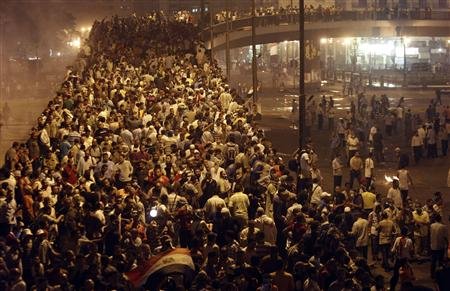
Cairo_clashesCairo, Jul 16: Egyptian police and protesters clashed in central Cairo early on Tuesday after fights broke out between supporters of ousted Islamist President Mohamed Morsi and locals angered when they tried to block major thoroughfares crossing the River Nile.

The MENA state news agency said at least 22 people were injured in the violence, which began just after 9pm (1900 GMT) on Monday and lasted into the early hours of Tuesday.

The clashes were smaller and more localised than the earlier deadly unrest since Morsi was deposed by the military on July 3, and most of Cairo was unaffected.

Still, after a week of relative calm, scenes of running street battles close to the Egyptian Museum, one of the country's main tourist attractions, may raise further concerns about stability in the Arab world's most populous country.

"I've had enough of this chaos," said Ashraf Mohamed, who watched the clashes from a distance. "Egypt is just rubbish."

Young men, their mouths covered to protect them from tear gas, threw stones at police and shouted pro-Morsi and anti-military slogans, as well as "Allahu Akbar!" (God is greatest).

Military helicopters hovered overhead and police vans were brought in to quell the trouble, but when that didn't work, dozens of riot police moved in. Medics treated men with deep gashes to their eyes and faces nearby.

Mohamed's frustration echoed the view of millions of Egyptians who rallied for Morsi's resignation on June 30. The military said it deposed him to fulfil the wish of the people. Morsi's Muslim Brotherhood movement said it was a coup.

"It's the army against the people, these are our soldiers, we have no weapons," said Alaa el-Din, a 34-year-old computer engineer, clutching a laptop.

"The army is killing our brothers, you are meant to defend me and you are attacking me. The army turned against the Egyptian people."

Egypt has become increasingly polarised by the crisis, but one thing the two sides share is a deep mistrust of the United States and its perceived role in the unrest.

Burns spurned?

US deputy secretary of state William Burns told reporters in Cairo that Washington had no desire to meddle in Egypt, which it supports with $1.5 billion in aid each year, most of which goes to the military.

"Only Egyptians can determine their future," Burns told reporters at the US embassy. "I did not come with American solutions. Nor did I come to lecture anyone. We will not try to impose our model on Egypt."

Washington, never comfortable with the rise of the Islamist Brotherhood, has so far refused to say whether it views Morsi's removal as a coup, which would require it to halt aid.

The Islamist Nour Party and the Tamarud anti-Morsi protest movement both said they turned down invitations to meet Burns.

But a senior State Department official denied Burns had been shunned. "I don't think we're losing influence at all," the US official said, adding that Burns was still in Cairo.

"I don't know what meetings he has, but he has seen a range of people in Cairo in the interim government, in civil society ... so it's hard to say he has been spurned by both sides. I don't accept that is the case."

Marches in Cairo and beyond

Tens of thousands of Brotherhood supporters gathered late on Monday at the Rabaa Adawiya mosque in northeastern Cairo, where they have staged a sit-in vigil for the last three weeks vowing to stay until Morsi is reinstated.

Another large crowd rallied outside Cairo University, and there were protests in the coastal city of Alexandria and the Nile city of Assiut. There also were minor clashes in Giza, home of the pyramids, just outside Cairo.

The army warned demonstrators that it would respond with "the utmost severity and firmness and force" if they approached military bases or "vital state institutes."

At least 92 people were killed in the days after Morsi was toppled, more than half of them shot by troops outside the Republican Guard compound near the Rabaa mosque on July 8. Protests since then had been tense but peaceful until Monday night.

The political turmoil and unrest in major cities has also fuelled violence in Egypt's lawless North Sinai province bordering Israel and the Palestinian Gaza Strip.

Attacks in the area have killed 13 people, mainly police, since July 3. In the latest, suspected Islamist militants fired grenades at a bus carrying workers from a factory in the Sinai city of El Arish on Monday, killing three and wounding 17.

US calls for restraint

Morsi is being held incommunicado at an undisclosed location. He has not been charged with a crime but the authorities say they are investigating him over complaints of inciting violence, spying and wrecking the economy. Scores of Morsi supporters were rounded up after violence last week.

Many of the top Brotherhood figures have been charged with inciting violence, but have not been arrested and are still at large. The public prosecutors' office announced new charges against seven Brotherhood and Islamist leaders on Monday.

Burns had earlier called for restraint on both sides.

"If representatives of some of the largest parties in Egypt are detained or excluded, how are dialogue and participation possible?" he asked. He also urged those opposed to Morsi's ouster to participate in the political process peacefully.

Interim President Adli Mansour and his prime minister Hazem el-Beblawi head a transitional cabinet full of technocrats that is paving the way for parliamentary elections in around six months, in a bid to restore civilian rule.

US-educated economist Ahmed Galal, as finance minister, has the task of rescuing an economy and state finances wrecked by two and a half years of turmoil.

That task became easier, at least in the short term, after Saudi Arabia, the United Arab Emirates and Kuwait - rich Gulf Arab states happy at the downfall of the Brotherhood - promised a total of $12 billion in cash, loans and fuel.

The new planning minister, Ashraf al-Arabi, said the Arab money would be enough to sustain Egypt through its transition period and it did not need to restart talks with the International Monetary Fund.

Egypt had sought $4.8 billion in IMF aid last year, but months of talks ran aground with the government unable to agree on cuts in unaffordable subsidies for food and fuel. Arabi's comments could worry investors who want the IMF to prod reform.

"I think it's inappropriate to be making such a strong statement, given how new he is to the position," said Angus Blair, president of the Signet Institute, an economic think tank.

Comments

Add new comment

  • Coastaldigest.com reserves the right to delete or block any comments.
  • Coastaldigset.com is not responsible for its readers’ comments.
  • Comments that are abusive, incendiary or irrelevant are strictly prohibited.
  • Please use a genuine email ID and provide your name to avoid reject.
News Network
July 23,2020

Beirut, Jul 23: The pandemic will exact a heavy toll on Arab countries, causing an economic contraction of 5.7% this year, pushing millions into poverty and compounding the suffering of those affected by armed conflict, a U.N. report said Thursday.

The U.N.'s Economic and Social Commission for Western Asia expects some Arab economies to shrink by up to 13%, amounting to an overall loss for the region of $152 billion.

Another 14.3 million people are expected to be pushed into poverty, raising the total number to 115 million — a quarter of the total Arab population, it said. More than 55 million people in the region relied on humanitarian aid before the COVID-19 crisis, including 26 million who were forcibly displaced.

Arab countries moved quickly to contain the virus in March by imposing stay-at-home orders, restricting travel and banning large gatherings, including religious pilgrimages.

Arab countries as a whole have reported more than 830,000 cases and at least 14,717 deaths. That equates to an infection rate of 1.9 per 1,000 people and 17.6 deaths per 1,000 cases, less than half the global average of 42.6 deaths, according to the U.N.

But the restrictions exacted a heavy economic toll, and authorities have been forced to ease them in recent weeks. That has led to a surge in cases in some countries, including Lebanon, Iraq and the Palestinian territories.

Wealthy Gulf countries were hit by the pandemic at a time of low oil prices, putting added strain on already overstretched budgets. Middle-income countries like Jordan and Egypt have seen tourism vanish overnight and a drop in remittances from citizens working abroad.

War-torn Libya and Syria have thus far reported relatively small outbreaks. But in Yemen, where five years of civil war had already generated the world's worst humanitarian crisis, the virus is running rampant in the government-controlled south while rebels in the north conceal its toll.

Rola Dashti, the head of the U.N. commission, said Arab countries need to “turn this crisis into an opportunity” and address longstanding issues, including weak public institutions, economic inequality and over-reliance on fossil fuels.

“We need to invest in survival, survival of people and survival of businesses,” she said.

Comments

Add new comment

  • Coastaldigest.com reserves the right to delete or block any comments.
  • Coastaldigset.com is not responsible for its readers’ comments.
  • Comments that are abusive, incendiary or irrelevant are strictly prohibited.
  • Please use a genuine email ID and provide your name to avoid reject.
News Network
April 26,2020

Dubai, Apr 26: The Central Bank of the UAE (CBUAE) has instructed financial institutions in the country to search and freeze all bank accounts of Indian billionaire BR Shetty and his family along with those of companies where he has a stake.

The apex bank has also blacklisted several firms associated with Shetty along with their entire senior management.

In an advisory issued last week, CBUAE cited decisions of the Federal Attorney General and asked financial institutions to search and freeze any bank accounts, deposits or investments in the name of Shetty or his family members.

Financial institutions have been directed to stop transfers from these accounts and deny access to deposit boxes.

Currently in India and facing a string of charges, Shetty is the founder of NMC Health.

The heathcare provider was placed into administration by a UK court recently following an application by the Abu Dhabi Commercial Bank (ADCB) which alone has an exposure of $981 million (Dh3.6 billion).

Overall, UAE banks have a combined exposure of more than Dh8bn to NMC which owes money to Oman-based banks and financial institutions as well.

Probing credit facilities
The Central Bank has sought information about credit facilites extended to the Shettys along with details of their safe deposit boxes and the financial transfers they have made till date.

A similar advisory has been issued for NMC Healthcare and NMC Holding, based on the decision of the Head of Plenary Fund Prosecution.

The Central Bank has also blacklisted several companies associated with Shetty. Key staff members of these firms have been similarly blacklisted.

Comments

Angry Indian
 - 
Monday, 27 Apr 2020

when you make money with good country you should not make doka to that country, first of all we indian have bad name in GCC now this will make more dought on indian hindus..


after BJP come to power in india,our country is acting like maron, this will only end with final WAR.

Add new comment

  • Coastaldigest.com reserves the right to delete or block any comments.
  • Coastaldigset.com is not responsible for its readers’ comments.
  • Comments that are abusive, incendiary or irrelevant are strictly prohibited.
  • Please use a genuine email ID and provide your name to avoid reject.
Agencies
May 26,2020

Riyadh, May 26: The authorities in Saudi Arabia have decided to ease some restrictions put in place over coronavirus fears, allowing movement and resumption of some economic and commercial activities, Saudi Press Agency reported early Tuesday citing an official source at the Interior Ministry.

The move also allows restarting of domestic flights, opening of mosques, restaurants and cafes and work attendance, however, the temporary suspension of Umrah pilgrimage remains in force.

The easing of restrictions will be carried out in a phased manner, with the first phase beginning on Thursday (May 28) and ending on May 30.

In the first phase, the movement within and between all regions of the Kingdom in private cars will be allowed from 6 a.m. to 3 p.m. except in Makkah. Economic and commercial activities will resume in retail and wholesale shops and malls but beauty salons, barber shops, sports clubs, health clubs, entertainment centers and cinemas will continue to remain shut due to social distancing concerns.

In the second phase, which begins on May 31 and ends on June 20, the movement is allowed from 6 a.m. and 8 p.m. in all areas of the Kingdom, except in Makkah. All congregational prayers, including Friday prayers, will resume in all mosques across the Kingdom except in Makkah.

The suspension of workplace attendance will end, allowing all employees in ministries, government entities and private sector companies to return to working from their offices provided that they follow strict precautionary guidelines.

The suspension on travel between regions in the Kingdom using various transport methods will no longer be in place. Airlines will be allowed to operate domestic flights if they adhere to precautionary measures set by the civil aviation authority and the Ministry of Health. The suspension of international flights, will, however, continue until further notice.

Restaurants and cafes serving food and beverages can reopen, however, beauty salons, barber shops, sports clubs, health clubs, entertainment centers and cinemas will be barred from reopening in the second phase. The ban on social gatherings of more than fifty people, such as weddings and funerals will also continue to remain in force.

In the third phase commencing on June 21, the Kingdom will return to "normal" conditions as it was before the coronavirus lockdown measures were implemented.

Meanwhile in Makkah, the first phase measures will be implemented between May 31 to June 20 and the second phase will begin on May 21. Friday prayers and all congregational prayers will continue to be held in the Grand Mosque, only to be attended by Imams and the employees.

Comments

Mohammed Sarfraz
 - 
Tuesday, 26 May 2020

I think second phase is May 31 to June 20. Must be a typo. 

Add new comment

  • Coastaldigest.com reserves the right to delete or block any comments.
  • Coastaldigset.com is not responsible for its readers’ comments.
  • Comments that are abusive, incendiary or irrelevant are strictly prohibited.
  • Please use a genuine email ID and provide your name to avoid reject.