


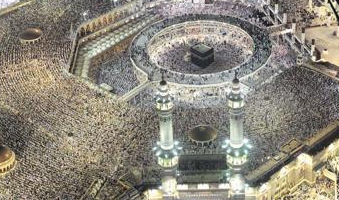
2 million faithful seek God’s blessings in Grand Mosque

August 6, 2013

Grand_MosqueMakkah, Aug 6: Two million worshippers spent the 27th night of the holy month of Ramadan in the Grand Mosque seeking God's blessings. High security and integrated services contributed to a smooth flow of movement among worshippers filing in and out of the Grand Mosque.

Security forces were deployed for crowd management, in addition to a special emergency force, the security force for Haj and Umrah and the security force responsible for training police staff. In addition, 10 government agencies extended support to these forces by providing health and other services to worshippers.

“With the beginning of the 27th of Ramadan, the third stage of the crowd management plan at the Grand Mosque was successfully implemented to control and manage the huge influx of people entering the Grand Mosque and its courtyards,” said Brig. Saad Al-Khlaiwi, deputy commander of Haj forces and director of Haj Training Centers.

Col. Saeed Salem Al-Qarni, director of security patrols in Makkah, said about 300 security personnel were patrolling the areas and helping other agencies streamline the movement of pilgrims.

Brig. Khalaf Al-Mutrafi, director general of Civil Defense in Makkah, said that Civil Defense forces exercised a high degree of efficiency during this holy night. “The number of staff was increased to meet the stiff increase in the number of pilgrims and visitors,” Al-Mutrafi said, adding that the situation required further precautionary measures to maintain order and minimize hazards as much as possible for the safety of people there. “It is a blessing that all worshippers performed the holy rituals safely and with ease,” he added.

Yahiya Al-Zahrani, commander of the Grand Mosque force, said that although the premises of the Grand Mosque, the roofs, the first floor, the corridors and the courts surrounding the mosque reached maximum capacity, worshippers performed their prayers and the holy rituals comfortably. “The implementation of the plan of this night in particular greatly contributed to the smooth streamlining of people,” he added.

“The movement of worshippers inside and outside the Grand Mosque was being monitored by 750 display screens and more than 1,000 digital cameras,” Al-Zahrani said, adding that a special security force was dedicated to safeguarding the Al-Mataf Bridge.

Brig. Gen. Abdulrahman Al-Muqbil, director-general of the traffic department, said that more than 4,000 security men, including 2,500 police trainees and 1,500 members of the General Directorate of Traffic, as well as the traffic department staff in Makkah, implemented the traffic plan for the night. “This greatly contributed to the smooth flow of crowds within the holy city,” he said, adding that they were deployed in the central area, shopping centers, streets and squares.

Comments

Add new comment

  • Coastaldigest.com reserves the right to delete or block any comments.
  • Coastaldigset.com is not responsible for its readers’ comments.
  • Comments that are abusive, incendiary or irrelevant are strictly prohibited.
  • Please use a genuine email ID and provide your name to avoid reject.
Agencies
May 1,2020

Saudi Arabia has initiated refund of work visa fee to foreigners unable to travel to the Kingdom due to the suspension of international flights in the aftermath of Covid-19 pandemic.

Several work visas were cancelled, following which the Ministry of Human Resources and Social Development, in cooperation and coordination with the Ministry of Foreign Affairs, announced the refund. The cancellation and refunding of the stamped visas will be considered effective from the date of issuance of the royal decree on March 18, reported Saudi Gazette.

As a precautionary measure to curb the spread of coronavirus, the Kingdom suspended all international flight. The ministry of health in Saudi Arabia on Wednesday announced 1,325 new Covid-19 coronavirus cases and 169 recoveries. With this, the total number of cases in the Kingdom now stands at 21,402, while recoveries stand at 2,953, as on Wednesday reported KT.

Comments

Add new comment

  • Coastaldigest.com reserves the right to delete or block any comments.
  • Coastaldigset.com is not responsible for its readers’ comments.
  • Comments that are abusive, incendiary or irrelevant are strictly prohibited.
  • Please use a genuine email ID and provide your name to avoid reject.
Agencies
January 4,2020

Baghdad, Jan 4: At least five people were killed on Saturday by an airstrike on a vehicle convoy of Iraq's Shia Popular Mobilization Forces in northern Baghdad, a source in security forces told Sputnik.

Earlier in the day, the source told Sputnik about a powerful explosion in Baghdad's northern district of Taji.

"A vehicle convoy of the Popular Mobilization Forces has been attacked. According to preliminary data, five people have died. Their names have not been clarified so far," the source said.

On Friday, several senior members of the Popular Mobilization Forces, as well as commander of the elite Quds Force of Iran's Revolutionary Guard Corps Qasem Soleimani, were killed by a US drone attack near the Baghdad International Airport.

Comments

Add new comment

  • Coastaldigest.com reserves the right to delete or block any comments.
  • Coastaldigset.com is not responsible for its readers’ comments.
  • Comments that are abusive, incendiary or irrelevant are strictly prohibited.
  • Please use a genuine email ID and provide your name to avoid reject.
News Network
April 5,2020

Beirut, Apr 5: The novel coronavirus has put global trade on hold, placed half of the world population in confinement and has the potential to topple governments and reshape diplomatic relations.

The United Nations has appealed for ceasefires in all the major conflicts rocking the planet, with its chief Antonio Guterres on Friday warning "the worst is yet to come". But it remains unclear what the pandemic's impact will be on the multiple wars roiling the Middle East.

Here is an overview of the impact so far on the conflicts in Syria, Yemen, Libya and Iraq:

The COVID-19 outbreak turned into a pandemic just as a ceasefire reached by the two main foreign power brokers in Syria's nine-year-old war -- Russia and Turkey -- was taking effect.

The three million people living in the ceasefire zone, in the country's northwestern region of Idlib, had little hope the deal would hold.

Yet fears the coronavirus could spread like wildfire across the devastated country appear to have given the truce an extended lease of life.

According to the Syrian Observatory for Human Rights, the month of March saw the lowest civilian death toll since the conflict started in 2011, with 103 deaths.

The ability of the multiple administrations in Syria -- the Damascus government, the autonomous Kurdish administration in the northeast and the jihadist-led alliance that runs Idlib -- to manage the coronavirus threat is key to their credibility.

"This epidemic is a way for Damascus to show that the Syrian state is efficient and all territories should be returned under its governance," analyst Fabrice Balanche said.

However the pandemic and the global mobilisation it requires could precipitate the departure of US-led troops from Syria and neighbouring Iraq.

This in turn could create a vacuum in which the Islamic State jihadist group, still reeling from the demise of its "caliphate" a year ago, could seek to step up its attacks.

The Yemeni government and the Huthi rebels initially responded positively to the UN appeal for a ceasefire, as did neighbouring Saudi Arabia, which leads a military coalition in support of the government.

That rare glimmer of hope in the five-year-old conflict was short-lived however and last week Saudi air defences intercepted ballistic missiles over Riyadh and a border city fired by the Iran-backed rebels.

The Saudi-led coalition retaliated by striking Huthi targets in the rebel-held capital Sanaa on Monday.

Talks have repeatedly faltered but the UN envoy Martin Griffiths is holding daily consultations in a bid to clinch a nationwide ceasefire.

More flare-ups in Yemen could compound a humanitarian crisis often described as the worst in the world and invite a coronavirus outbreak of catastrophic proportions.

In a country where the health infrastructure has collapsed, where water is a rare commodity and where 24 million people require humanitarian assistance, the population fears being wiped out if a ceasefire doesn't allow for adequate aid.

"People will end up dying on the streets, bodies will be rotting in the open," said Mohammed Omar, a taxi driver in the Red Sea port city of Hodeida.

Much like Yemen, the main protagonists in the Libyan conflict initially welcomed the UN ceasefire call but swiftly resumed hostilities.

Fierce fighting has rocked the south of the capital Tripoli in recent days, suggesting the risk of a major coronavirus outbreak is not enough to make guns fall silent.

Turkey has recently played a key role in the conflict, throwing its weight behind the UN-recognised Government of National Accord.

Fabrice Balanche predicted that accelerated Western disengagement from Middle East conflicts could limit Turkish support to the GNA.

That could eventually favour forces loyal to eastern-based strongman Khalifa Haftar, who launched an assault on Tripoli one year ago and has the backing of Russia, Egypt and the United Arab Emirates.

Western countries have been hit hardest by the pandemic, which could prompt them to divert both military resources and peace-brokering capacity from foreign conflicts.

A report by the International Crisis Group said European officials had reported that efforts to secure a ceasefire in Libya were no longer receiving high-level attention due to the pandemic.

Iraq is no longer gripped by fully-fledged conflict but it remains vulnerable to an IS resurgence in some regions and its two main foreign backers are at each other's throats.

Iran and the United States are two of the countries most affected by the coronavirus but there has been no sign of any let-up in their battle for influence that has largely played out on Iraqi soil.

With most non-US troops in the coalition now gone and some bases evacuated, American personnel are now regrouped in a handful of locations in Iraq.

Washington has deployed Patriot air defence missiles, prompting fears of a fresh escalation with Tehran, whose proxies it blames for a spate of rocket attacks on bases housing US troops.

Comments

Add new comment

  • Coastaldigest.com reserves the right to delete or block any comments.
  • Coastaldigset.com is not responsible for its readers’ comments.
  • Comments that are abusive, incendiary or irrelevant are strictly prohibited.
  • Please use a genuine email ID and provide your name to avoid reject.