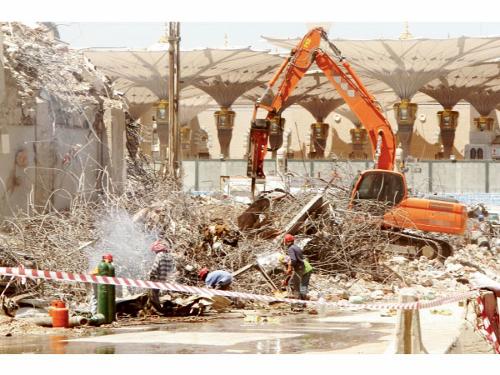
Prophet’s Mosque expansion: Most east-side buildings razed

August 13, 2013
madinah
Madinah, Aug 13: The demolition of over two-thirds of buildings surrounding the Prophet's Mosque from the east have been completed for the mosque’s grand expansion ordered by Custodian of the Two Holy Mosques King Abdullah.

The demolition work started early July and has been continuing ever since. So far, 10 big buildings have been demolished, including the Awkaf building, the Al-Wiladah mosque and the Al-Ansar market.

Director of PR at the Presidency of the Affairs of the Prophet's Mosque Abdul Wahid Al-Hattab said when the expansion is completed from all four corners, the mosque will raise its intake capacity to more than 1.6 million worshipers.

He noted that the demolition process did not impede the large number of visitors from entering the Prophet's Mosque during the just-concluded month of Ramadan.

Meanwhile, director of the Haj Ministry in Madinah Mohammed Al-Neejawi revealed that since the start of the Umrah season in February, more than 5.2 million people visited the Prophet's Mosque to pay homage to Prophet Muhammad (peace be upon him) and pray.

He said these visitors were accommodated in about 1,000 buildings containing more than 300,000 beds thanks to a grouping system that would not allow the arrival of newcomers before the visiting groups have left.

Al-Beejawi said under the new system, not more than 450,000 visitors would be allowed to stay in Madinah at the same time.

Comments

Add new comment

  • Coastaldigest.com reserves the right to delete or block any comments.
  • Coastaldigset.com is not responsible for its readers’ comments.
  • Comments that are abusive, incendiary or irrelevant are strictly prohibited.
  • Please use a genuine email ID and provide your name to avoid reject.
Agencies
January 4,2020

Dubai, Jan 4: Three UAE airlines have made it to lists of the safest carriers in 2020, reinforcing the value these companies provide passengers in the increasingly competitive aviation scene.

Abu Dhabi's Etihad Airways and Dubai's Emirates are in the list of the top 20 safest airlines, while Sharjah-based Air Arabia is in the list of the top 10 low-cost carriers, safety and product rating website AirlineRatings.com reported on Thursday.

It named Qantas as the safest airline for 2020 out of the 405 carriers it monitors.

The top 20, in order, are Qantas, Air New Zealand, EVA Air, Etihad Airways, Singapore Airlines, Emirates, Alaska Airlines, Qatar Airways, Cathay Pacific Airways, Virgin Australia, Hawaiian Airlines, Virgin Atlantic Airlines, TAP Portugal, SAS, Royal Jordanian, Swiss, Finnair, Lufthansa, Aer Lingus and KLM.

"These airlines are clear standouts in the airline industry and are at the forefront of safety," said AirlineRatings.com editor-in-chief Geoffrey Thomas.

"For instance, Australia's Qantas has been recognised by the British Advertising Standards Association in a test case in 2008 as the world's most experienced airline."

"Qantas has been the lead airline in virtually every major operational safety advancement over the past 60 years and has not had a fatality in the pure-jet era," said Thomas.

AirlineRatings.com editors also identified their top 10 safest low-cost airlines; they are, in alphabetical order, Air Arabia, Flybe, Frontier, HK Express, IndiGo, Jetblue, Volaris, Vueling, Westjet and Wizz.

Saj Ahmad, chief analyst at StrategicAero Research in London, says that it isn't a surprise that UAE carriers are on those lists.

"UAE airlines almost always feature in the top rankings for safety because they value the equipment that they fly their passengers on each and every day," he told Khaleej Times on Thursday.

"All airlines do; but for the UAE, where airlines have expanded rapidly in the last couple of decades, it's an amazing feat that they rank so highly while inducting so many new aeroplanes."

There's little benefit to adding luxurious cabins if maintenance, security and safety protocols as well as routine engineering schedules are not adhered to, he stressed.

"And with the UAE itself sporting MRO activities as well as through companies like Strata, which supply components to Airbus and Boeing directly, airlines here have harnessed that tech-change to ensure that their fleets have the highest redundancy and safety checks at every possible chance," Ahmad added. "That translates into passenger confidence - and we can see the brand and loyalty strength across Emirates, flydubai, Air Arabia and Etihad; it's no surprise that each year, they all fly more and more passengers across their network."

In making its selections, AirlineRatings.com editors and its industry advisors take into account numerous critical factors that include: Audits from aviation's governing bodies and lead associations, government audits, airline's crash and serious incident record, fleet age, financial position and pilot training and culture.

"All airlines have incidents every day and many are aircraft or engine manufacture issues instead of airline operational problems. And it is the way the flight crew handles incidents that determines a good airline from an unsafe one. So just lumping all incidents together is very misleading," said Thomas.

Comments

Add new comment

  • Coastaldigest.com reserves the right to delete or block any comments.
  • Coastaldigset.com is not responsible for its readers’ comments.
  • Comments that are abusive, incendiary or irrelevant are strictly prohibited.
  • Please use a genuine email ID and provide your name to avoid reject.
News Network
May 21,2020

May 21: Mosques across the UAE will remain closed during Eid Al Fitr, a top official has said. The Takbeer, which is chanted before the special prayers performed on Eid, will be broadcast from mosques 10 minutes before the prayer time.

During the virtual press briefing held on Wednesday, Dr Farida Al Hosani, official spokesperson of the UAE health sector, reminded citizens and expats about the importance of adhering to the safety measures as laid out by the authorities.

Contact tracing process

"Before we began to use Al Hosn app to trace the contacts of Covid-19 cases, the tracking process used to take more than 48 hours. It also depended on the memory and honesty of people. The app is an AI-enabled methodological way to trace individuals who came in contact with Covid-19 cases so that they are isolated. It has proven to be an efficient way to stop the spread of the coronavirus," Dr Farida said.

Install the app

She called on all the public to install the app on their smart phones. "The success of the tracing system via Al Hosn app relies on its use. We hope 50 to 70 per cent of people in the UAE instal and use the app in an effective way."

No sermon

Sheikh Abdul Rahman Al Shamsi, Spokesperson for the General Authority of Islamic Affairs and Endowments, said there will be no sermon for the Eid prayers.

He called on everyone to welcome Eid with joy and positivity and to stay connected with their loved ones via social media.

Mass testing

Dr Amna Al Dahhak Al Shamsi, the official spokesperson of the UAE Government, said mass testing continues across the country.

She stressed on the importance of adhering to precautionary measures and cooperating with the authorities.

Comments

Add new comment

  • Coastaldigest.com reserves the right to delete or block any comments.
  • Coastaldigset.com is not responsible for its readers’ comments.
  • Comments that are abusive, incendiary or irrelevant are strictly prohibited.
  • Please use a genuine email ID and provide your name to avoid reject.
News Network
July 1,2020

Riyadh, Jul 1: Saudis braced Wednesday for a tripling in value added tax, another unpopular austerity measure after the twin shocks of coronavirus and an oil price slump triggered the kingdom's worst economic decline in decades.

Retailers in the country reported a sharp uptick in sales this week of everything from gold and electronics to cars and building materials, as shoppers sought to stock up before VAT is raised to 15 percent.

The hike could stir public resentment as it weighs on household incomes, pushing up inflation and depressing consumer spending as the kingdom emerges from a three-month coronavirus lockdown.

"Cuts, cuts, cuts everywhere," a Saudi teacher in Riyadh told AFP, bemoaning vanishing subsidies as salaries remain stagnant.

"Air conditioner, television, electronic items," he said, rattling off a list of items he bought last week ahead of the VAT hike.

"I can't afford these things from Wednesday."

With its vast oil wealth funding the Arab world's biggest economy, the kingdom had for decades been able to fund massive spending with no taxes at all.

It only introduced VAT in 2018, as part of a push to reduce its dependence on crude revenues.

Then, seeking to shore up state finances battered by sliding oil prices and the coronavirus crisis, it announced in May that it would triple VAT and halt a cost-of-living monthly allowance to citizens.

The austerity push underscores how Saudi Arabia's once-lavish spending is becoming a thing of the past, with the erosion of the welfare system leaving a mostly young population to cope with reduced incomes and a lifestyle downgrade.

That could pile strain on a decades-old social contract whereby citizens were given generous subsidies and handouts in exchange for loyalty to the absolute monarchy.

The rising cost of living may prompt many to ask why state funds are being lavished on multi-billion-dollar projects and overseas assets, including the proposed purchase of English football club Newcastle United.

Shopping malls in the kingdom have drawn large crowds in recent days as retailers offered "pre-VAT sales" and discounts before the hike kicks in.

A gold shop in Riyadh told AFP it saw a 70 percent jump in sales in recent weeks, while a car dealership saw them tick up by 15 percent.

Once the new rate is in place, businesses are predicting depressed sales of everything from cars to cosmetics and home appliances.

Capital Economics forecast inflation will jump up to six percent year-on-year in July, from 1.1 percent in May, as a result.

"The government ended the country's lockdown (in June) and there are signs that economic activity has started to recover," Capital Economics said in a report.

"Nonetheless, we expect the recovery to be slow-going as fiscal austerity measures bite."

The kingdom also risks losing its edge against other Gulf states, including its principal ally the United Arab Emirates, which introduced VAT at the same time but has so far refrained from raising it beyond five percent.

"Saudi Arabia is taking massive risks with contractionary fiscal policies," said Tarek Fadlallah, chief executive officer of the Middle East unit of Nomura Asset Management.

But the kingdom has few choices as oil revenue declines.

Its finances have taken another blow as authorities massively scaled back this year's hajj pilgrimage, from 2.5 million pilgrims last year to around a thousand already inside the country, and suspended the lesser umrah because of coronavirus.

Together the rites rake in some $12 billion annually.

The International Monetary Fund warned the kingdom's GDP will shrink by 6.8 percent this year -- its worst performance since the 1980s oil glut.

The austerity drive would boost state coffers by 100 billion riyals ($26.6 billion), according to state media.

But the measures are unlikely to plug the kingdom's huge budget deficit.

The Saudi Jadwa Investment group forecasts the shortfall will rise to a record $112 billion this year.


Comments

Add new comment

  • Coastaldigest.com reserves the right to delete or block any comments.
  • Coastaldigset.com is not responsible for its readers’ comments.
  • Comments that are abusive, incendiary or irrelevant are strictly prohibited.
  • Please use a genuine email ID and provide your name to avoid reject.