


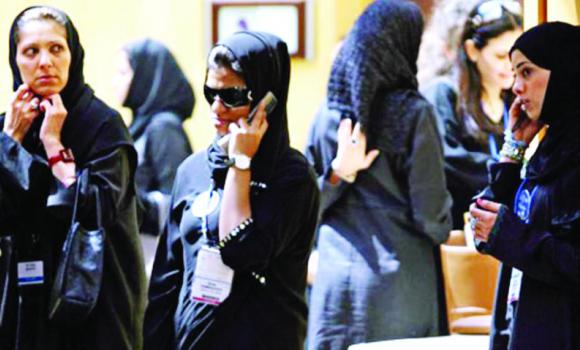
Daughters of expat workers see no future in Kingdom

September 1, 2013

Daughters_of_expat

Jeddah, Sep 1: The recent ministerial decision that prohibits daughters of expatriate workers to transfer their sponsorship from their guardian to their employer and the decision that disallows them to work at all has sparked disagreement among expat families and working daughters in the Kingdom.

Shabal Amri, a Jordanian national working at Al-Rajhi Bank in Jeddah, says that there is no way the Kingdom can put away working female expats and get Saudis to take over. “For example, Saudi staff at female branches of banks are for the most part unable to help expat English-speaking customers simply because they are not bilingual. At this point, they expect us expats to provide help.”

Amri suggests that the Ministry of Labor needs to consider this decision because it will inevitably result in expat working daughters living in the Kingdom going back to their home countries to seek employment.

Many institutions, especially international schools that used to hire youth as substitute teachers, will suffer from this recent ministerial decision.

“I think the ministry should revisit this decision,” says Naila Haq, vice-principal at a girls’ school in Dammam and mother of a female MBA graduate who is currently seeking employment in the Kingdom. “Otherwise there won’t have been any use educating our daughters. If the government is seeking to tackle unemployment problems among Saudi youth, I can safely predict that this decision is not going to make things right or fill the gaps they hope to fill.”

Haq says that expat daughters are not studying so that they can stay at home after completing their studies. “They need to be given opportunities in this country too. After being born and bred in Saudi Arabia, it is completely unfair to send them back to their countries to seek employment.”

“Several international schools will also face a big loss because of this decision to disallow expatriate daughters to work,” says Haq. “Many applications we receive for interviews are mostly expat wives or daughters that are living in the kingdom. This decision may upset a lot of expatriates in the Kingdom.”

“I applauded the decision by King Abdullah to grant all expats more time to correct their status once the initial deadline was up in July,” says Qurratulain Ashfaq, account manager at a digital ad agency in Jeddah. “However, the recent news has come as a shock and has left me extremely disappointed. This country and its ever-changing laws just keep affirming the belief that I have held for quite some time now, which is that I have been raised in an extremely sexist country.”

Ashfaq says that it makes absolutely no sense to that she should stay at home while her brother goes out for work, calling it “sexism.”

“Am I supposed to sit at home now? Is the ministry going to give me my monthly allowance?” asks Ashfaq. “At the age of 24, I am no longer a child who has to be financially dependent on her parents. I have a right to earn my own living.”

Ashfaq adds that since she heard about this decision, she has been under a lot of stress. “I can foresee a bleak future ahead of me. I am not the kind of girl who can sit at home and do nothing. I am young and educated and I like to work hard and earn a living to support my and my family. Yet it seems I will be losing my job soon, thanks to the Ministry of Labor.”

Comments

Add new comment

  • Coastaldigest.com reserves the right to delete or block any comments.
  • Coastaldigset.com is not responsible for its readers’ comments.
  • Comments that are abusive, incendiary or irrelevant are strictly prohibited.
  • Please use a genuine email ID and provide your name to avoid reject.
News Network
April 2,2020

Dubai, Apr 2: A senior Saudi official urged more than 1 million Muslims intending to perform the hajj to delay making plans this year in comments suggesting the pilgrimage could be cancelled due to the new coronavirus pandemic.

In February, the kingdom took the extraordinary decision to close off the holy cities of Mecca and Medina to foreigners over the virus, a step which wasn’t taken even during the 1918 flu epidemic that killed tens of millions worldwide.

Restrictions have tightened in the kingdom as it grapples with over 1,500 confirmed cases of the new virus. The kingdom has reported 10 deaths so far. The Middle East has more than 71,000 confirmed cases of the virus, most of those in Iran, and over 3,300 deaths.

“The kingdom of Saudi Arabia is prepared to secure the safety of all Muslims and nationals,” Saudi Hajj and Umrah Minister Muhammad Saleh bin Taher Banten told state television. “That’s why we have requested from all Muslims around the world to hold onto signing any agreements (with tour operators) until we have a clear vision.”

Saudi Arabia has barred people from entering or exiting three major cities, including Mecca and Medina, and imposed a nighttime curfew across the country. Like other countries around the world and in the Middle East, Saudi Arabia has suspended all inbound and outbound commercial flights.

Each year, up to 2 million Muslims perform the hajj, a physically demanding and often costly pilgrimage that draws the faithful from around the world. The hajj, required of all able-bodied Muslims to perform once in their lifetime, is seen as a chance to wipe clean past sins and bring about greater humility and unity among Muslims.

Standing in Mecca in front of the cube-shaped Kaaba that Muslims pray toward five times daily, Banten also said the kingdom was already providing care for 1,200 pilgrims stuck in the holy city due to global travel restrictions. A number of them are being quarantined in hotels in Mecca, he said.

Comments

Add new comment

  • Coastaldigest.com reserves the right to delete or block any comments.
  • Coastaldigset.com is not responsible for its readers’ comments.
  • Comments that are abusive, incendiary or irrelevant are strictly prohibited.
  • Please use a genuine email ID and provide your name to avoid reject.
Agencies
July 31,2020

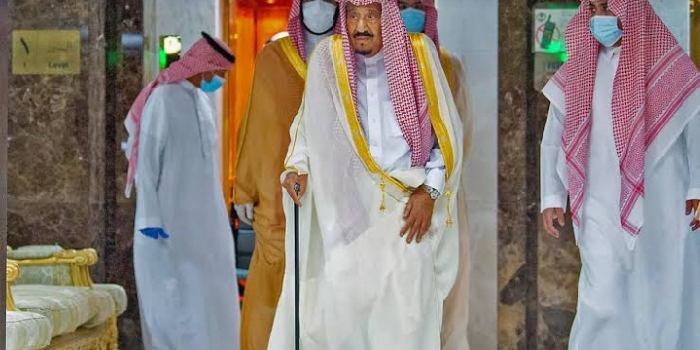
Makkah, Jul 31: Organising this year's scaled-down hajj required "double efforts" by Saudi authorities amid the coronavirus pandemic, King Salman said Friday after being discharged from hospital following gall bladder surgery.

Only up to 10,000 people already residing in the kingdom are participating in this year's pilgrimage, compared with 2019's gathering of some 2.5 million from around the world.

"Holding the ritual in the shadow of this pandemic... required reducing the numbers of pilgrims, but it obliged various official agencies to put in double efforts," 84-year-old King Salman said in a speech read out on state television by acting media minister Majid Al-Qasabi.

"The hajj this year was restricted to a very limited number of people from multiple nationalities, ensuring the ritual was completed despite the difficult circumstances," he said.

The speech came on the occasion of Eid al-Adha, the Muslim festival of sacrifice, a day after the king left hospital following a 10-day stay for surgery to remove his gall bladder.

The hajj, which began on Wednesday, is one of the five pillars of Islam and a must for able-bodied Muslims at least once in their lifetime.

Authorities implemented the "highest health precautions" during the rituals, the king said.

Pilgrims, who were all tested for the virus, are required to wear masks and observe social distancing.

For Friday's "stoning of the devil", the last major ritual of the hajj, Saudi authorities offered the pilgrims pebbles that were sanitised to protect against the pandemic.

In a sign that its strict measures were working, the health ministry reported no coronavirus cases in the holy sites on Wednesday or Thursday.

Comments

Add new comment

  • Coastaldigest.com reserves the right to delete or block any comments.
  • Coastaldigset.com is not responsible for its readers’ comments.
  • Comments that are abusive, incendiary or irrelevant are strictly prohibited.
  • Please use a genuine email ID and provide your name to avoid reject.
Arab News
March 21,2020

Jeddah, Mar 21: Saudi government ministers on Friday announced a war chest of more than SR120 billion ($32 billion) to fight the “unprecedented” health and economic challenges facing the country as a result of the killer coronavirus pandemic.

During a press conference in Riyadh, finance minister and acting minister of economy and planning, Mohammed Al-Jadaan, unveiled a SR70 billion stimulus package to support the private sector, especially small- and medium-sized enterprises (SMEs) and businesses worst-hit by the virus outbreak.

And the Saudi Arabian Monetary Authority (SAMA) has also sidelined SR50 billion to help the Kingdom’s banking sector, financial institutions and SMEs.

Al-Jadaan said the government had introduced tough measures to protect the country’s citizens while immediately putting in place a financial safety net. He added that the Kingdom was moving decisively to address the global COVID-19 disease crisis and cushion the financial and economic impact of the outbreak on the country.

The SR70 billion package of initiatives revealed by the minister will include exemptions and postponement of some government dues to help provide liquidity for private-sector companies.

Minister of Health Dr. Tawfig Al-Rabiah noted the raft of precautionary measures that had been introduced by the Kingdom in cooperation with the private sector and government agencies to combat the spread of the coronavirus, highlighting the important contribution of the data communication services sector.

He reassured the Saudi public that the Kingdom would continue to do whatever was required to tackle the crisis.

“This pandemic has a lot of challenges. It’s difficult to make presumptions at this moment as we’ve seen; many developed countries did not expect the rate of transmission of this virus.

“We see that the reality of the situation is different from what many expected. The virus is still being studied and though we know the means of transmission, it is transmitted at a very fast rate, having spread to many countries faster than expected.

“We see that many countries have not taken the strong precautionary measures from the beginning of the crisis which led to the vast spread of the virus in these countries,” Al-Rabiah said.

He pointed out that social distancing would help slow the spread.

Al-Jadaan said the Saudi government had the financial and economic capacity to deal with the situation. “We have large reserves and large investments, but we do not want to withdraw from the reserves more than what was already announced in the budget. We do not want to liquidate any of the government’s investments so we will borrow.

“We have approval from the government after the finance committee raised its recommendations to increase the proportion of the domestic product borrowing from 30 percent to 50 percent. We do not expect to exceed 50 percent from now until the end of 2022,” he added.

The government would use all the tools available to it to finance the private sector, especially SMEs, and ensure its ongoing stability.

The finance minister said that at this stage it was difficult to predict the economic impact of the pandemic on the private sector, but he emphasized that international coordination, most notably through G20 countries and health organizations, was ongoing.

On recorded cases of the COVID-19 disease in the Kingdom, Al-Rabiah said: “Many of the confirmed cases are without symptoms, this is due to the precautionary measures being considered.

“As soon as a case is confirmed, we contact and examine anyone who was in direct contact with the patient. This epidemiological investigation, is conducted on a large scale to investigate any case that was in contact with the patient.”

Al-Jadaan also announced the formation of a committee made up of the ministers of finance, economy and planning, commerce, and industry and mineral resources, along with the vice chairman of the board of the Saudi National Development Fund, and its governor.

The committee will be responsible for identifying and reviewing incentives, facilities, and other initiatives led by the fund.

Committees had also been established, said Al-Jadaan, to study the impact and repercussions of the coronavirus crisis on all sectors and regions, and look at ways of overcoming them through subsidies or stimulus packages.

Comments

Add new comment

  • Coastaldigest.com reserves the right to delete or block any comments.
  • Coastaldigset.com is not responsible for its readers’ comments.
  • Comments that are abusive, incendiary or irrelevant are strictly prohibited.
  • Please use a genuine email ID and provide your name to avoid reject.