


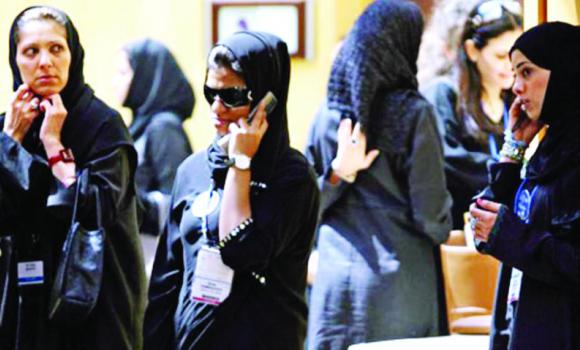
Daughters of expat workers see no future in Kingdom

September 1, 2013

Daughters_of_expat

Jeddah, Sep 1: The recent ministerial decision that prohibits daughters of expatriate workers to transfer their sponsorship from their guardian to their employer and the decision that disallows them to work at all has sparked disagreement among expat families and working daughters in the Kingdom.

Shabal Amri, a Jordanian national working at Al-Rajhi Bank in Jeddah, says that there is no way the Kingdom can put away working female expats and get Saudis to take over. “For example, Saudi staff at female branches of banks are for the most part unable to help expat English-speaking customers simply because they are not bilingual. At this point, they expect us expats to provide help.”

Amri suggests that the Ministry of Labor needs to consider this decision because it will inevitably result in expat working daughters living in the Kingdom going back to their home countries to seek employment.

Many institutions, especially international schools that used to hire youth as substitute teachers, will suffer from this recent ministerial decision.

“I think the ministry should revisit this decision,” says Naila Haq, vice-principal at a girls’ school in Dammam and mother of a female MBA graduate who is currently seeking employment in the Kingdom. “Otherwise there won’t have been any use educating our daughters. If the government is seeking to tackle unemployment problems among Saudi youth, I can safely predict that this decision is not going to make things right or fill the gaps they hope to fill.”

Haq says that expat daughters are not studying so that they can stay at home after completing their studies. “They need to be given opportunities in this country too. After being born and bred in Saudi Arabia, it is completely unfair to send them back to their countries to seek employment.”

“Several international schools will also face a big loss because of this decision to disallow expatriate daughters to work,” says Haq. “Many applications we receive for interviews are mostly expat wives or daughters that are living in the kingdom. This decision may upset a lot of expatriates in the Kingdom.”

“I applauded the decision by King Abdullah to grant all expats more time to correct their status once the initial deadline was up in July,” says Qurratulain Ashfaq, account manager at a digital ad agency in Jeddah. “However, the recent news has come as a shock and has left me extremely disappointed. This country and its ever-changing laws just keep affirming the belief that I have held for quite some time now, which is that I have been raised in an extremely sexist country.”

Ashfaq says that it makes absolutely no sense to that she should stay at home while her brother goes out for work, calling it “sexism.”

“Am I supposed to sit at home now? Is the ministry going to give me my monthly allowance?” asks Ashfaq. “At the age of 24, I am no longer a child who has to be financially dependent on her parents. I have a right to earn my own living.”

Ashfaq adds that since she heard about this decision, she has been under a lot of stress. “I can foresee a bleak future ahead of me. I am not the kind of girl who can sit at home and do nothing. I am young and educated and I like to work hard and earn a living to support my and my family. Yet it seems I will be losing my job soon, thanks to the Ministry of Labor.”

Comments

Add new comment

  • Coastaldigest.com reserves the right to delete or block any comments.
  • Coastaldigset.com is not responsible for its readers’ comments.
  • Comments that are abusive, incendiary or irrelevant are strictly prohibited.
  • Please use a genuine email ID and provide your name to avoid reject.
News Network
July 23,2020

Beirut, Jul 23: The pandemic will exact a heavy toll on Arab countries, causing an economic contraction of 5.7% this year, pushing millions into poverty and compounding the suffering of those affected by armed conflict, a U.N. report said Thursday.

The U.N.'s Economic and Social Commission for Western Asia expects some Arab economies to shrink by up to 13%, amounting to an overall loss for the region of $152 billion.

Another 14.3 million people are expected to be pushed into poverty, raising the total number to 115 million — a quarter of the total Arab population, it said. More than 55 million people in the region relied on humanitarian aid before the COVID-19 crisis, including 26 million who were forcibly displaced.

Arab countries moved quickly to contain the virus in March by imposing stay-at-home orders, restricting travel and banning large gatherings, including religious pilgrimages.

Arab countries as a whole have reported more than 830,000 cases and at least 14,717 deaths. That equates to an infection rate of 1.9 per 1,000 people and 17.6 deaths per 1,000 cases, less than half the global average of 42.6 deaths, according to the U.N.

But the restrictions exacted a heavy economic toll, and authorities have been forced to ease them in recent weeks. That has led to a surge in cases in some countries, including Lebanon, Iraq and the Palestinian territories.

Wealthy Gulf countries were hit by the pandemic at a time of low oil prices, putting added strain on already overstretched budgets. Middle-income countries like Jordan and Egypt have seen tourism vanish overnight and a drop in remittances from citizens working abroad.

War-torn Libya and Syria have thus far reported relatively small outbreaks. But in Yemen, where five years of civil war had already generated the world's worst humanitarian crisis, the virus is running rampant in the government-controlled south while rebels in the north conceal its toll.

Rola Dashti, the head of the U.N. commission, said Arab countries need to “turn this crisis into an opportunity” and address longstanding issues, including weak public institutions, economic inequality and over-reliance on fossil fuels.

“We need to invest in survival, survival of people and survival of businesses,” she said.

Comments

Add new comment

  • Coastaldigest.com reserves the right to delete or block any comments.
  • Coastaldigset.com is not responsible for its readers’ comments.
  • Comments that are abusive, incendiary or irrelevant are strictly prohibited.
  • Please use a genuine email ID and provide your name to avoid reject.
Agencies
May 26,2020

Riyadh, May 26: The authorities in Saudi Arabia have decided to ease some restrictions put in place over coronavirus fears, allowing movement and resumption of some economic and commercial activities, Saudi Press Agency reported early Tuesday citing an official source at the Interior Ministry.

The move also allows restarting of domestic flights, opening of mosques, restaurants and cafes and work attendance, however, the temporary suspension of Umrah pilgrimage remains in force.

The easing of restrictions will be carried out in a phased manner, with the first phase beginning on Thursday (May 28) and ending on May 30.

In the first phase, the movement within and between all regions of the Kingdom in private cars will be allowed from 6 a.m. to 3 p.m. except in Makkah. Economic and commercial activities will resume in retail and wholesale shops and malls but beauty salons, barber shops, sports clubs, health clubs, entertainment centers and cinemas will continue to remain shut due to social distancing concerns.

In the second phase, which begins on May 31 and ends on June 20, the movement is allowed from 6 a.m. and 8 p.m. in all areas of the Kingdom, except in Makkah. All congregational prayers, including Friday prayers, will resume in all mosques across the Kingdom except in Makkah.

The suspension of workplace attendance will end, allowing all employees in ministries, government entities and private sector companies to return to working from their offices provided that they follow strict precautionary guidelines.

The suspension on travel between regions in the Kingdom using various transport methods will no longer be in place. Airlines will be allowed to operate domestic flights if they adhere to precautionary measures set by the civil aviation authority and the Ministry of Health. The suspension of international flights, will, however, continue until further notice.

Restaurants and cafes serving food and beverages can reopen, however, beauty salons, barber shops, sports clubs, health clubs, entertainment centers and cinemas will be barred from reopening in the second phase. The ban on social gatherings of more than fifty people, such as weddings and funerals will also continue to remain in force.

In the third phase commencing on June 21, the Kingdom will return to "normal" conditions as it was before the coronavirus lockdown measures were implemented.

Meanwhile in Makkah, the first phase measures will be implemented between May 31 to June 20 and the second phase will begin on May 21. Friday prayers and all congregational prayers will continue to be held in the Grand Mosque, only to be attended by Imams and the employees.

Comments

Mohammed Sarfraz
 - 
Tuesday, 26 May 2020

I think second phase is May 31 to June 20. Must be a typo. 

Add new comment

  • Coastaldigest.com reserves the right to delete or block any comments.
  • Coastaldigset.com is not responsible for its readers’ comments.
  • Comments that are abusive, incendiary or irrelevant are strictly prohibited.
  • Please use a genuine email ID and provide your name to avoid reject.
News Network
March 31,2020

Mar 30: the UAE Cabinet approved a series of new initiatives, foremost among which was the automatic extension of residence permits expiring from March 1.

The residence visas would be extended for a renewable period of three months without any fees to ease the economic impact of the Covid-19 crisis on residents, official news agency WAM reported.

The Cabinet has also waived the administrative fines associated with infractions on the services provided by the Federal Authority of Identity and Citizenship, starting April 1 and lasting for a renewable period of three months.

The initiatives also entail granting a temporary license to use digital solutions for remotely notarising and completing judicial transactions.

Government services expiring from March 1 will also be extended from April 1 for a renewable period of three months. The decision applies to all federal government services, including documents, permits, licenses and commercial registers.

The UAE has introduced a slew of initiatives to control the spread of the Covid-19 virus, including the online renewal of driving licences and vehicle’s registration cards.

The country’s telecom regulator, Telecommunications Regulatory Authority (TRA), also issued a directive that no mobile service with expired ID documents will be disconnected or suspended in the UAE.

The UAE has reported a total of 611 Covid-19 infections and five related deaths in the country.

A national sterilisation programme is underway that will continue until Saturday April 4, concluding on the morning of Sunday, April 5.

Carried out daily from 8pm until 6am the following morning, the programme will include the disinfection of private and public facilities.

Comments

Add new comment

  • Coastaldigest.com reserves the right to delete or block any comments.
  • Coastaldigset.com is not responsible for its readers’ comments.
  • Comments that are abusive, incendiary or irrelevant are strictly prohibited.
  • Please use a genuine email ID and provide your name to avoid reject.