


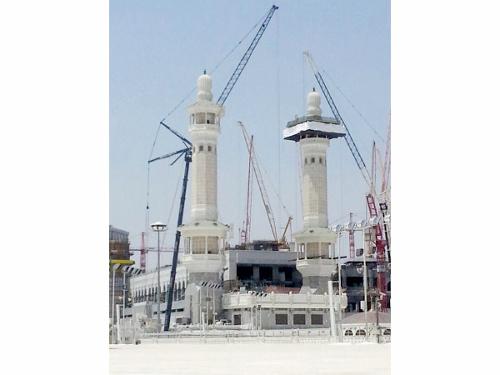
2 Grand Mosque minarets being pulled down for mataf expansion

September 9, 2013

Makkah, Sep 9: Work on the demolition of two minarets close to Al-Umrah Gate of the Grand Mosque started on Sunday so as to facilitate the ongoing expansion of the mataf (circumambulation area around the Holy Ka’aba).

minaret

Electricity to the minarets has been disconnected. Engineers and technicians from the company, which is implementing the expansion of the Grand Mosque and the mataf, have started removing loudspeakers, lamps and electrical appliances from the minarets.

Work is progressing under the supervision of officials and experts from a specialized committee under the contracting company, and that is in coordination with the Presidency for the Affairs of the Two Holy Mosques.

The minarets will be reconstructed after completion of the mataf expansion, according to well-informed sources.

Sheikh Abdul Rahman Al-Sudais, head of the Presidency, said that the demolition work of the minarets will be carried out without causing any disturbance to pilgrims and visitors to the Grand Mosque.

“As part of the tradition of the Presidency in preserving the remains of the Grand Mosque, the pillars of the old mosque and minarets and carvings on them will be packed and kept safely,” he said.

The Grand Mosque and the Prophet’s Mosque in Madinah are currently witnessing the largest-ever expansions in their history, and that will increase their capacity to more than two million worshipers each.

Tipped as the ‘Project of the Century,’ the King Abdullah Expansion of the Grand Mosque is estimated to cost more than SR100 billion. The total area of the existing mosque is 356,000 square meters with a capacity to accommodate 770,000 worshipers while the new expansion will accommodate an additional 1.2 million. The project includes expansion of mataf in order to increase its capacity from 48,000 to 130,000 per hour.

Comments

Add new comment

  • Coastaldigest.com reserves the right to delete or block any comments.
  • Coastaldigset.com is not responsible for its readers’ comments.
  • Comments that are abusive, incendiary or irrelevant are strictly prohibited.
  • Please use a genuine email ID and provide your name to avoid reject.
News Network
March 18,2020

Riyadh, Mar 18: Private-sector businesses in Saudi Arabia on Wednesday were ordered to introduce enforced remote working for all employees for 15 days in an attempt to prevent the spread of the coronavirus.

Businesses that require staff to be physically present to ensure they continue to operate — including those in vital or sensitive sectors such as electricity, water and communications — must reduce the number of workers in their offices to the bare minimum. This can be no more than 40 percent of the total number of staff.

In such cases precautionary measures set by the Ministry of Health must be followed. At offices, and staff accommodation, with more than 50 workers, an area at the entrance must be provided where temperatures can be taken and symptoms checked.

Employers must also set up a mechanism for workers to report any symptoms, such as high temperature, coughing or shortness of breath, or contact they have had with infected individuals or people who recently returned from other countries without following proper Ministry of Health quarantine procedures.

Inside offices, a safe amount of space between employees must be maintained at all times. In addition, all health clubs and nurseries provided by employers must close.

Pregnant women and new mothers, people suffering from respiratory diseases, those with immune-system problems or chronic conditions, cancer patients and employees above the age of 55 are to be given 14 days compulsory paid leave, which will not be deducted from their annual entitlement.

Businesses that are excluded from the new measures include pharmacies and supermarkets, and their suppliers. Private-sector organizations that provide services to government agencies must contact them before suspending workplace attendance. Any other business that considers it impossible to operate with only 40 percent of staff in the workplace must submit an exemption request to the authority that supervises it.

Comments

Add new comment

  • Coastaldigest.com reserves the right to delete or block any comments.
  • Coastaldigset.com is not responsible for its readers’ comments.
  • Comments that are abusive, incendiary or irrelevant are strictly prohibited.
  • Please use a genuine email ID and provide your name to avoid reject.
Agencies
June 5,2020

Expatriate workers who fail to abide by the coronavirus protocols in Kingdom of Saudi Arabia may face deportation, according to media reports.

“Individuals who fail to abide by preventive measures, including wearing medical or cloth face masks, failing to observe social distancing and refusing to have their temperatures taken, will be fined SR1,000. The fine will be doubled if the violation is repeated. Residents will be deported after paying the fines,” Okaz newspaper said.

Authorities called on people to report offenders by dialling the toll free number 999, except for the holy city of Makka, where the toll free number is 911.

As per the newly-revised Saudi protocols, social gatherings such as mourning or celebration events that take place inside homes, rest houses or farms, are allowed, but attendants should not exceed 50 persons.

The private sector is also required to adhere to precautionary measures: providing their staff with disinfectants and sanitisers, taking the temperatures of both staff and customers at the entrances of shopping malls.

Other measures include sterilising shopping trolleys and baskets after each use, sanitising facilities and surfaces, closing children’s play areas and fitting rooms in shopping malls and ready-wear outlets.

Authorities highlighted the need for all individuals and entities to abide by health safety rules, social-distancing protocol and the new guidelines set for social gatherings.

Comments

Add new comment

  • Coastaldigest.com reserves the right to delete or block any comments.
  • Coastaldigset.com is not responsible for its readers’ comments.
  • Comments that are abusive, incendiary or irrelevant are strictly prohibited.
  • Please use a genuine email ID and provide your name to avoid reject.
News Network
May 20,2020

Cairo, May 20: A senior Kuwaiti lawmaker has called for imposing a tax on expatriates’ remittances to shore up the country’s finances.

MP Khalil Al Saleh, the head of the parliament’s Human Resources Committee, has presented a draft law on the proposed tax to the legislature.

“Imposing fees on expatriates’ transfers will have a role in improving the state's revenues and diversify sources of income,” he told Al Rai newspaper.

Migrant workers transfer about 4.2 billion dinars annually from Kuwait, he added, citing figures from Kuwait’s Central Bank.

“This system is in effect in most countries of the world and in more than one Gulf country. Expats there have not objected to it. Allowing this money to exit the country is very dangerous and has a direct effect on economy,” MP Al Saleh said.

“We do not target brotherly expats because imposing symbolic fees on financial transfers will not affect their money, but will have a positive effect on the state’s sources,” he said. “This has become a necessity after the money transferred outside Kuwait has reached 4.2 billion dinars annually without the state [Kuwait] making any benefit from this.”

Foreign workers make up 3.3 million of Kuwait’s 4.6 million population.

Several Kuwaiti public figures have recently pushed for redrawing the demographic imbalance in the country, accusing expatriates of straining health facilities and increasing the Covid-19 threat.

Comments

Add new comment

  • Coastaldigest.com reserves the right to delete or block any comments.
  • Coastaldigset.com is not responsible for its readers’ comments.
  • Comments that are abusive, incendiary or irrelevant are strictly prohibited.
  • Please use a genuine email ID and provide your name to avoid reject.