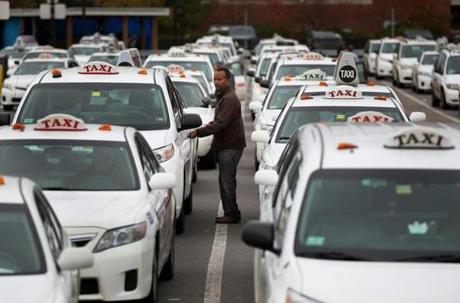
Taxi firms fear losing revenue if women drive

October 26, 2013

Taxi_firmsJeddah, Oct 26: Taxi operators here say they would lose 60 percent of their revenue and may even have to close shop if women are allowed to drive in the city.

Saudi women have been pushing for the right to drive and many plan to get behind the wheel today to highlight their cause.

Ali Sayed, an Egyptian taxi supervisor in Jeddah, told Arab News that his firm would likely lose 60 percent of its customers.

“It is well known that many more women than men use our taxis. We depend on the revenue from women customers. Many taxi firms will close down if women are allowed to drive their own cars,” said Sayed.

Many taxi drivers have contracts with women to pick them up at home and drop them off at work or university. They make more than SR1,000 at the end of the month from these contracts.

Mukhtar Salem, a Yemeni taxi driver, told Arab News: “I have a contract to drop off two Saudi women every day at King Abdul Aziz University for SR1,500 a month. If they drive their own cars, I will lose this money.”

Mahmoud Abdul Shafi, an Egyptian taxi driver, told Arab News that taxi drivers would face a “real crisis” if women are allowed to drive. “We cannot depend on men customers who have no cars. It's easy for them to find friends to drop them off or to take a bus.”

“Other men use taxis on a temporary basis until they can buy their own cars. We have long term contracts with women because they have no other option and are dependent on us,” said Shafi.

Activists behind the “Oct. 26 Driving Campaign” have called on fellow Saudis to put the campaign's logo on their cars and urged women to learn to drive.

However, a spokesman from the Ministry of Interior said in a statement on Wednesday that “regulations in Saudi Arabia prohibit any action that disturbs social peace and opens the door for sedition and responds to the illusions of prejudiced intruders with sick dreams.”

Comments

Add new comment

  • Coastaldigest.com reserves the right to delete or block any comments.
  • Coastaldigset.com is not responsible for its readers’ comments.
  • Comments that are abusive, incendiary or irrelevant are strictly prohibited.
  • Please use a genuine email ID and provide your name to avoid reject.
Arab News
March 21,2020

Jeddah, Mar 21: Saudi government ministers on Friday announced a war chest of more than SR120 billion ($32 billion) to fight the “unprecedented” health and economic challenges facing the country as a result of the killer coronavirus pandemic.

During a press conference in Riyadh, finance minister and acting minister of economy and planning, Mohammed Al-Jadaan, unveiled a SR70 billion stimulus package to support the private sector, especially small- and medium-sized enterprises (SMEs) and businesses worst-hit by the virus outbreak.

And the Saudi Arabian Monetary Authority (SAMA) has also sidelined SR50 billion to help the Kingdom’s banking sector, financial institutions and SMEs.

Al-Jadaan said the government had introduced tough measures to protect the country’s citizens while immediately putting in place a financial safety net. He added that the Kingdom was moving decisively to address the global COVID-19 disease crisis and cushion the financial and economic impact of the outbreak on the country.

The SR70 billion package of initiatives revealed by the minister will include exemptions and postponement of some government dues to help provide liquidity for private-sector companies.

Minister of Health Dr. Tawfig Al-Rabiah noted the raft of precautionary measures that had been introduced by the Kingdom in cooperation with the private sector and government agencies to combat the spread of the coronavirus, highlighting the important contribution of the data communication services sector.

He reassured the Saudi public that the Kingdom would continue to do whatever was required to tackle the crisis.

“This pandemic has a lot of challenges. It’s difficult to make presumptions at this moment as we’ve seen; many developed countries did not expect the rate of transmission of this virus.

“We see that the reality of the situation is different from what many expected. The virus is still being studied and though we know the means of transmission, it is transmitted at a very fast rate, having spread to many countries faster than expected.

“We see that many countries have not taken the strong precautionary measures from the beginning of the crisis which led to the vast spread of the virus in these countries,” Al-Rabiah said.

He pointed out that social distancing would help slow the spread.

Al-Jadaan said the Saudi government had the financial and economic capacity to deal with the situation. “We have large reserves and large investments, but we do not want to withdraw from the reserves more than what was already announced in the budget. We do not want to liquidate any of the government’s investments so we will borrow.

“We have approval from the government after the finance committee raised its recommendations to increase the proportion of the domestic product borrowing from 30 percent to 50 percent. We do not expect to exceed 50 percent from now until the end of 2022,” he added.

The government would use all the tools available to it to finance the private sector, especially SMEs, and ensure its ongoing stability.

The finance minister said that at this stage it was difficult to predict the economic impact of the pandemic on the private sector, but he emphasized that international coordination, most notably through G20 countries and health organizations, was ongoing.

On recorded cases of the COVID-19 disease in the Kingdom, Al-Rabiah said: “Many of the confirmed cases are without symptoms, this is due to the precautionary measures being considered.

“As soon as a case is confirmed, we contact and examine anyone who was in direct contact with the patient. This epidemiological investigation, is conducted on a large scale to investigate any case that was in contact with the patient.”

Al-Jadaan also announced the formation of a committee made up of the ministers of finance, economy and planning, commerce, and industry and mineral resources, along with the vice chairman of the board of the Saudi National Development Fund, and its governor.

The committee will be responsible for identifying and reviewing incentives, facilities, and other initiatives led by the fund.

Committees had also been established, said Al-Jadaan, to study the impact and repercussions of the coronavirus crisis on all sectors and regions, and look at ways of overcoming them through subsidies or stimulus packages.


Comments

Add new comment

  • Coastaldigest.com reserves the right to delete or block any comments.
  • Coastaldigset.com is not responsible for its readers’ comments.
  • Comments that are abusive, incendiary or irrelevant are strictly prohibited.
  • Please use a genuine email ID and provide your name to avoid reject.
Agencies
May 7,2020

Dubai, May 7: Indians in the UAE have voiced scepticism about a "massive" operation announced by New Delhi to bring home some of the hundreds of thousands of nationals stranded by coronavirus restrictions.

"It is just propaganda," said Ishan, an Indian expatriate in Dubai, one of seven emirates in the UAE and long a magnet for foreign workers.

He was reacting to his government's announcement this week that it would deploy passenger jets and naval ships to bring home citizens stuck in a host of countries.

India's consulate in Dubai said it received about 200,000 requests from nationals seeking repatriation -- mostly workers who have lost their jobs in the pandemic.

One vessel was heading to the UAE, India's government said, while two flights were scheduled to depart the UAE for India on Thursday.

But the plans drew scorn from Ishan, who was a manager at a luxury services company before he was made redundant last month.

"It's like throwing a dog a bone," the 35-year-old complained on Wednesday, dismissing the Indian government's efforts as a drop in the ocean.

"Let's say they repatriate 400 people on the first day, and about 5,000 people in 10 days, what difference has it made?"

India banned all incoming commercial flights in late March as it imposed one of the world's strictest lockdowns to tackle the spread of coronavirus.

The UAE is home to a 3.3-million-strong Indian community, who make up around 30 per cent of the Gulf state's population.

To the anger of some Indian expatriates, the evacuees will have to pay for their passage home and spend two weeks in quarantine on arrival.

"We are upset over the failure of our government," Ishan said. "What about the people with no money? How are you helping them?"

The Indian consulate could not be reached for comment.

Ibrahim Khalil, head of the Kerala Muslim Cultural Center in Dubai, said the consulate had asked him to select 100 Indian nationals for repatriation.

"We are planning to pay for the tickets of those who cannot afford it," he said, adding that the elderly, pregnant and those suffering from illnesses were a priority.

But one Indian woman, eight months pregnant in the neighbouring emirate of Sharjah, was not one of the lucky ones chosen to go back home in one of Thursday's planned departures.

"We called them but nobody would pick up," the 26-year-old, who requested anonymity, told AFP.

She arrived in the UAE a few months ago to visit her husband, who lives in a shared apartment with another family to save money.

"We have no insurance here and the medical expenses are too costly," said the woman, who was anxious to leave to give birth at home.

"I just hope that I am chosen to go back to India. I don't know why I haven't been considered."

Comments

Add new comment

  • Coastaldigest.com reserves the right to delete or block any comments.
  • Coastaldigset.com is not responsible for its readers’ comments.
  • Comments that are abusive, incendiary or irrelevant are strictly prohibited.
  • Please use a genuine email ID and provide your name to avoid reject.
News Network
January 16,2020

Dubai, Jan 16: The UAE Ministry of Climate Change and Environment on Wednesday announced that it has banned the import of birds, some eggs and meat products from Hungary and Slovakia.

The ministry said the decision was taken following a notification from the World Organization for Animal Health (OIE) on the outbreak of a highly pathogenic strain of bird flu, H5N2, in the two countries.

Accordingly, the ministry has banned "the import of all species of domestic and wild live birds, ornamental birds, chicks, hatching eggs, meats and meat products and non-heat-treated wastes from Hungary and Slovakia".

It has also regulated the import of poultry meat and non-heat-treated products, requiring a health certificate for the export of meat and meat products from the two countries to release consignments into the UAE.

A health certificate will be needed for the import of eggs, the ministry added.

However, thermally-treated poultry products (meat and eggs) have been cleared for import from all parts of Hungary and Slovakia.

Kaltham Ali Kayaf, Acting Director, Animal Development & Health Department at the ministry, said: "These measures reiterate the ministry's keenness in achieving its strategic objectives including enhancing bio-security levels and eliminating pathogens before they enter the country. In doing so, the ministry prevents the bird flu virus and related risks and impacts on the country's poultry health and safety, in addition to protecting public health and well-being."

Comments

Add new comment

  • Coastaldigest.com reserves the right to delete or block any comments.
  • Coastaldigset.com is not responsible for its readers’ comments.
  • Comments that are abusive, incendiary or irrelevant are strictly prohibited.
  • Please use a genuine email ID and provide your name to avoid reject.