



Life hit hard by labor raids

November 5, 2013

Life_hit

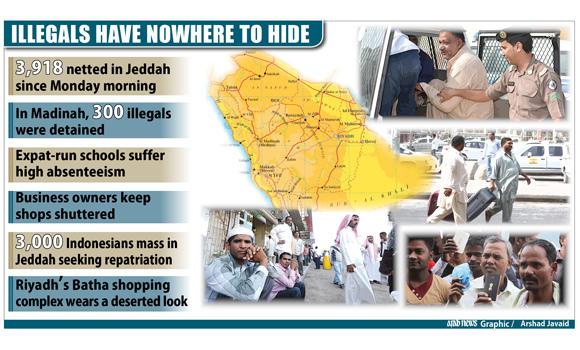
Jeddah, Nov 5: Labor inspectors on Monday swept up thousands of illegal workers in a series of raids across the Kingdom as the amnesty period for expatriates to legalize work status expired on Sunday.

According to Jeddah police spokesman, Nawaf Al-Bouq, 3,918 undocumented expats were arrested in and around Jeddah on Monday.

In Madinah, police raids netted 300 illegals.

Anticipating the sweeps, hundreds of business owners shuttered their shops. In addition, commercial activity at the Jeddah Islamic Port dropped and food prices spiked.

The rush-hour commutes in Jeddah and Riyadh were less congested, as undocumented expats stayed home. Some school administrators closed their campuses because their teachers’ legal status remains unresolved.

On Palestine Street at Prince Majed Road in Jeddah, at least 3,000 Indonesians gathered to protest their inability to obtain legal status.

“We had tried for weeks to regularize our status, but officials are insisting we bring our original passports and other documents which we are unable to do,” one illegal worker told Arab News.

Abdulmeneem Al-Shehri, head of the Jeddah Labor Office, told Arab News Monday that labor inspectors began targeting commercial business.

“The Ministry of Labor has a strategic plan for its inspection mission,” Al-Shehri said. “The mission has started and will continue to be conducted by highly qualified staff displaying their official badges.”

He said he expects business owners to cooperate and “uphold the new law” for the public interest and growth of the local economy.

“Business owners and workers who are found to be in violation will be immediately referred to the Ministry of Interior,” he said.

The Labor Ministry’s campaign to rid the country of illegal workers followed a seven-month grace period, which allowed foreigners working illegally in Saudi Arabia to obtain the proper iqamas. The Saudi government gave workers a three-month amnesty period that was scheduled to end July 3, but extended it to Nov. 3. The government did not provide a third grace period.

Workers in unskilled positions, part-time office workers under the sponsorship of their parents and international schoolteachers have been particularly hard hit. However, undocumented teachers have been given reprieve by the Ministry of Education, which issued a statement that no raids would be conducted during the first semester of school.

Many small shops and restaurants, which commonly hired undocumented workers, were closed throughout Jeddah.

In Riyadh, the usually bustling Al-Batha shopping complex in the city center appeared deserted, with many shops either empty or closed altogether.

The Ministry of Labor offices will continue to help workers who had already applied for sponsorship transfer to complete the process this week, according to Al-Shehri. Legalizing workers’ residency status shall also continue.

In addition, the ministry has launched an employment service to allow legal expats to hold part-time positions while employed in full-time jobs.

Workers must hold valid iqamas and have permission from the original sponsors to work. In addition, they must register their labor information at www.ajeer-sa.com and have a sound attendance record.

Comments

Add new comment

  • Coastaldigest.com reserves the right to delete or block any comments.
  • Coastaldigset.com is not responsible for its readers’ comments.
  • Comments that are abusive, incendiary or irrelevant are strictly prohibited.
  • Please use a genuine email ID and provide your name to avoid reject.
News Network
May 5,2020

Dubai, May 5: Saudi Arabian prosecutors have ordered the arrest of a Saudi citizen for insulting an Asian expatriate and abusing him for not embracing Islam.

A video went viral online showing the expat, apparently with little knowledge of the Arabic language, being insulated by an Arabic-speaking man who does not appear in the clip, for having not embraced Islam and for not fasting.

A monitoring centre affiliated with the public prosecution examined the video the content of which “shows the citizen’s use of abusive words against the Asian resident on the pretext of inviting him to Islam,” the prosecution source said.

“The public prosecution closely follows up whatever infringes rights of citizens and residents including harm to their dignity and legal rights regardless of pretexts of such infringement,” the source added.

Comments

Add new comment

  • Coastaldigest.com reserves the right to delete or block any comments.
  • Coastaldigset.com is not responsible for its readers’ comments.
  • Comments that are abusive, incendiary or irrelevant are strictly prohibited.
  • Please use a genuine email ID and provide your name to avoid reject.
News Network
May 11,2020

May 11: Saudi Arabia will triple its value-added tax rate and suspend a cost of living allowance for state workers, it said on Monday, seeking to shield finances hit by low oil prices and a slump in demand for its lifeline export worsened by the new coronavirus.

Historic oil output cuts agreed by Riyadh and other major producers have given only limited support to prices after they sank on oversupply caused by a war for petroleum market share between the kingdom and its fellow oil titan Russia.

Saudi Arabia, the world's largest oil exporter, is also being hit hard by measures to fight the new coronavirus, which are likely to curb the pace and scale of economic reforms launched by Crown Prince Mohammed bin Salman.

"The cost of living allowance will be suspended as of June 1, and the value added tax will be increased to 15% from 5% as of July 1," Finance Minister Mohammed al-Jadaan said in a statement reported by the state news agency. "These measures are painful but necessary to maintain financial and economic stability over the medium to long term...and to overcome the unprecedented coronavirus crisis with the least damage possible."

The austerity measures come after the kingdom posted a $9 billion budget deficit in the first quarter.

The minister said non-oil revenues were affected by the suspension and decline in economic activity, while spending had risen due to unplanned strains on the healthcare sector and the initiatives taken to support the economy.

"All these challenges have cut state revenues, pressured public finances to a level that is hard to deal with going forward without affecting the overall economy in the medium to long term, which requires more spending cuts and measures to support non-oil revenues stability," he added.

The government has cancelled and put on hold some operating and capital expenditures for some government agencies, and cut allocations for some reform initiatives and projects worth a total 100 billion riyals ($26.6 billion), the statement said.

Central bank foreign reserves fell in March at their fastest rate in at least 20 years and to their lowest since 2011, while oil revenues in the first three months of the year fell 24% from a year earlier to $34 billion, pulling total revenues down 22%.

"The reforms are positive from a fiscal side as greater adjustment is essential. However, the tripling of VAT is unlikely to help that much in 2020 revenue wise with the expected fall in consumption," said Monica Malik, chief economist at Abu Dhabi Commercial Bank.

She said she kept unchanged her deficit forecast of 16.3% of GDP for this year, which already factors in a greater than previously announced spending cut.

About 1.5 million Saudis are employed in the government sector, according to official figures released in December.

In 2018, Saudi Arabia's King Salman ordered a monthly payment of 1,000 riyals ($267) to every state employee to compensate them for the rising living costs after the government hiked domestic gas prices and introduced value-added tax.

DIFFICULT TIMES

A committee has been formed to study all financial benefits paid to public sector employees and contractors, and will submit recommendations within 30 days, the statement said.

In late 2015, when oil prices fell from record highs, the kingdom slashed lavish bonuses, overtime payments and other benefits once considered routine perks in the public sector.

In a country without elections and with political legitimacy resting partly on distribution of oil revenue, the ability of citizens to adapt to such reforms is crucial for stability.

"Tripling the VAT will test the limits of the balance between revenues and consumption as the economy dives into a deep recession. The move will impact consumption and could also lower the expected revenues," said John Sfakianakis, a Gulf expert at the University of Cambridge.

"These are pro-austerity and pro-revenue moves rather than pro-growth ones," he said.

Hasnain Malik, head of equity strategy at Tellimer, said the VAT rise could bring about $24-$26.5 billion in additional non-oil fiscal revenue. The rise would hit consumer spending further but was a needed step towards fiscal sustainability, he said.

Comments

Add new comment

  • Coastaldigest.com reserves the right to delete or block any comments.
  • Coastaldigset.com is not responsible for its readers’ comments.
  • Comments that are abusive, incendiary or irrelevant are strictly prohibited.
  • Please use a genuine email ID and provide your name to avoid reject.
News Network
April 26,2020

Abu Dhabi, Apr 26: Indian Ambassador to the UAE Pavan Kapoor says he is appalled after the bodies of three Indians flown back to India were returned to Abu Dhabi on Friday.

The three deceased Indian nationals had died of non-coronavirus causes and were flown to Delhi on Thursday but were promptly returned by authorities there.

“We are appalled at what has happened,” Kapoor told Gulf News. “We do not know if the bodies were returned because of coronavirus-related restrictions, but we are obviously not sending the remains of people [who have passed away from COVID-19],” he added.

“[As we understand], it happened because of new protocols at the airport and we are trying to sort it out,” he said.

Sent back a few hours later

“The remains were not offloaded from the plane, and were sent back a few hours later,” Kapoor explained.

The deceased were Kamlesh Bhatt, who passed away on April 17, and Sanjeev Kumar and Jagsir Singh who both died on April 13.

According to reports in Indian media, Kamlesh Bhat was 23 years old, and hailed from Tehri Garhwal district. He allegedly died of cardiac arrest. Along with the remains Kumar and Singh, Bhatt’s body was initially repatriated on an Etihad Airways flight, then sent back, even though his relatives had been on their way to collect them.

Kapoor explained the procedure through which remains are normally returned to family members back home, saying that the worker’s employer typically makes arrangements with cargo companies to repatriate bodies on cargo aircraft.

The employer applies for a No Objection Certificate from the Indian Embassy, which is granted once the Embassy ensures that all local formalities have been completed. The cargo company then applies for airport clearance, and the airline obtains approvals from the receiving airport.

“If airport protocols have changed, it means cargo companies have to be more careful about the clearance they’re getting,” Kapoor advised.

Additional costs
The ambassador added there may eventually be additional costs to repatriate the bodies but that it is first necessary to sort out the concerns.

The global coronavirus outbreak has spawned difficulties in repatriating mortal remains as a result of the travel restrictions imposed by countries. Remains of people dying from COVID-19 are not being sent back, but the caution surrounding the handling of bodies often affects the repatriation of those who succumb to other causes.

As Gulf News reported, Kerala chief minister Pinarayi Vijayan reached out to Indian Prime Minister Narendra Modi on Friday for intervention in bringing back the bodies of Keralites who have died in the Gulf from non-COVID-19 causes.

“I would like to draw your attention to the grievances received from Non-resident Keralites Associations (NRKs) in the Gulf Cooperation Council (GCC) countries on the delay caused in bringing home the mortal remains of NRKs who had expired due to reasons other than the COVID-19 infection,” read the letter by the CM.

“It is learnt that a ‘clearance certificate’ from the Indian Embassies is required to process the application of bringing home the mortal remains of the dead. The Embassies are [further] insisting on the production of a no-objection certificate from the Ministry of Home Affairs (MHA), New Delhi. To enable to bring back the bodies of the NRIs whose deaths occurred due to reasons other than COVID-19 infection, without necessary procedural hassles, I request your kind intervention,” Vijayan has requested.

Comments

Add new comment

  • Coastaldigest.com reserves the right to delete or block any comments.
  • Coastaldigset.com is not responsible for its readers’ comments.
  • Comments that are abusive, incendiary or irrelevant are strictly prohibited.
  • Please use a genuine email ID and provide your name to avoid reject.