



Life hit hard by labor raids

November 5, 2013

Life_hit

Jeddah, Nov 5: Labor inspectors on Monday swept up thousands of illegal workers in a series of raids across the Kingdom as the amnesty period for expatriates to legalize work status expired on Sunday.

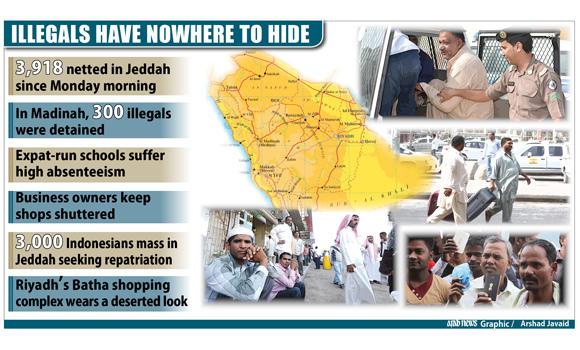
According to Jeddah police spokesman, Nawaf Al-Bouq, 3,918 undocumented expats were arrested in and around Jeddah on Monday.

In Madinah, police raids netted 300 illegals.

Anticipating the sweeps, hundreds of business owners shuttered their shops. In addition, commercial activity at the Jeddah Islamic Port dropped and food prices spiked.

The rush-hour commutes in Jeddah and Riyadh were less congested, as undocumented expats stayed home. Some school administrators closed their campuses because their teachers’ legal status remains unresolved.

On Palestine Street at Prince Majed Road in Jeddah, at least 3,000 Indonesians gathered to protest their inability to obtain legal status.

“We had tried for weeks to regularize our status, but officials are insisting we bring our original passports and other documents which we are unable to do,” one illegal worker told Arab News.

Abdulmeneem Al-Shehri, head of the Jeddah Labor Office, told Arab News Monday that labor inspectors began targeting commercial business.

“The Ministry of Labor has a strategic plan for its inspection mission,” Al-Shehri said. “The mission has started and will continue to be conducted by highly qualified staff displaying their official badges.”

He said he expects business owners to cooperate and “uphold the new law” for the public interest and growth of the local economy.

“Business owners and workers who are found to be in violation will be immediately referred to the Ministry of Interior,” he said.

The Labor Ministry’s campaign to rid the country of illegal workers followed a seven-month grace period, which allowed foreigners working illegally in Saudi Arabia to obtain the proper iqamas. The Saudi government gave workers a three-month amnesty period that was scheduled to end July 3, but extended it to Nov. 3. The government did not provide a third grace period.

Workers in unskilled positions, part-time office workers under the sponsorship of their parents and international schoolteachers have been particularly hard hit. However, undocumented teachers have been given reprieve by the Ministry of Education, which issued a statement that no raids would be conducted during the first semester of school.

Many small shops and restaurants, which commonly hired undocumented workers, were closed throughout Jeddah.

In Riyadh, the usually bustling Al-Batha shopping complex in the city center appeared deserted, with many shops either empty or closed altogether.

The Ministry of Labor offices will continue to help workers who had already applied for sponsorship transfer to complete the process this week, according to Al-Shehri. Legalizing workers’ residency status shall also continue.

In addition, the ministry has launched an employment service to allow legal expats to hold part-time positions while employed in full-time jobs.

Workers must hold valid iqamas and have permission from the original sponsors to work. In addition, they must register their labor information at www.ajeer-sa.com and have a sound attendance record.

Comments

Add new comment

  • Coastaldigest.com reserves the right to delete or block any comments.
  • Coastaldigset.com is not responsible for its readers’ comments.
  • Comments that are abusive, incendiary or irrelevant are strictly prohibited.
  • Please use a genuine email ID and provide your name to avoid reject.
News Network
January 6,2020

Dubai/Washington, Jan 6: Tens of thousands of Iranians thronged the streets of Tehran on Monday for the funeral of Quds Force commander Qassim Suleimani who was killed in a US air strike last week and his daughter said his death would bring a "dark day" for the United States.

"Crazy Trump, don't think that everything is over with my father's martyrdom," Zeinab Suleimani said in her address broadcast on state television after US President Donald Trump ordered Friday's strike that killed the top Iranian general.

Iran has promised to avenge the killing of Qassim Suleimani, the architect of Iran's drive to extend its influence across the region and a national hero among many Iranians, even many of those who did not consider themselves devoted supporters of the Islamic Republic's clerical rulers.

The scale of the crowds in Tehran shown on television mirrored the masses that gathered in 1989 for the funeral of the founder of the Islamic Republic, Ayatollah Ruhollah Khomeini.

In response to Iran's warnings, Trump has threatened to hit 52 Iranian sites, including cultural targets, if Tehran attacks Americans or US assets, deepening a crisis that has heightened fears of a major Middle East conflagration.

The coffins of the Iranian general and Iraqi militia leader Abu Mahdi al-Muhandis, who was also killed in Friday's attack on Baghdad airport, were passed across the heads of mourners massed in central Tehran, many of them chanting "Death to America".

One of the Islamic Republic's major regional goals, namely to drive US forces out of neighbouring Iraq, came a step closer on Sunday when the Iraqi parliament backed a recommendation by the prime minister for all foreign troops to be ordered out.

"Despite the internal and external difficulties that we might face, it remains best for Iraq on principle and practically," said Iraqi caretaker Prime Minister Adel Abdul Mahdi, who resigned in November amid anti-government protests.

Iraq's rival Shi'ite leaders, including ones opposed to Iranian influence, have united since Friday's attack in calling for the expulsion of US troops.

Esmail Qaani, the new head of the Quds Force, the Revolutionary Guards' unit in charge of activities abroad, said Iran would continue Suleimani's path and said "the only compensation for us would be to remove America from the region."

ALLIES AT FUNERAL

Prayers at Suleimani's funeral in Tehran, which will later move to his southern home city of Kerman, were led by Iran's Supreme Leader Ayatollah Ali Khamenei. Suleimani was widely seen as the second most powerful figure in Iran behind Khamenei.

The funeral was attended by some of Iran's allies in the region, including Ismail Haniyeh, the leader of Palestinian group Hamas who said: "I declare that the martyred commander Suleimani is a martyr of Jerusalem."

Adding to tensions, Iran said it was taking another step back from commitments under a 2015 nuclear deal with six major powers, a pact from which the United States withdrew in 2018.

Washington has since imposed tough sanctions on Iran, describing its policy as "maximum pressure" and saying it wanted to drive down Iranian oil exports - the main source of government revenues - to zero.

Talking to reporters aboard Air Force One on the way to Washington from Florida on Sunday, Trump stood by his remarks to include cultural sites on his list of potential targets, despite drawing criticism from US politicians.

"They're allowed to kill our people. They're allowed to torture and maim our people. They're allowed to use roadside bombs and blow up our people. And we're not allowed to touch their cultural sites? It doesn't work that way," Trump said.

Democratic critics of the Republican president have said Trump was reckless in authorizing the strike, and some said his comments about targeting cultural sites amounted to threats to commit war crimes. Many asked why Soleimani, long seen as a threat by US authorities, had to be killed now.

Republicans in the US Congress have generally backed Trump's move.

Trump also threatened sanctions against Iraq and said that if US troops were required to leave the country, Iraq's government would have to pay Washington for the cost of a "very extraordinarily expensive" air base there.

He said if Iraq asked US forces to leave on an unfriendly basis, "we will charge them sanctions like they've never seen before ever. It'll make Iranian sanctions look somewhat tame."

Comments

Add new comment

  • Coastaldigest.com reserves the right to delete or block any comments.
  • Coastaldigset.com is not responsible for its readers’ comments.
  • Comments that are abusive, incendiary or irrelevant are strictly prohibited.
  • Please use a genuine email ID and provide your name to avoid reject.
News Network
March 5,2020

Dubai, Mar 5: A 16-year-old Indian girl here has tested positive for the deadly coronavirus, bringing the total number of confirmed infection cases in the UAE to 28, according to media reports.

Health officials here confirmed on Wednesday that a new coronavirus case was detected in the girl who attended an Indian school in Dubai, Al-Arabiya website reported.

The girl tested positive for the COVID-19 after she contracted the infection from her father who travelled overseas, Dubai Health Authority (DHA) was quoted as saying by the report.

The Indian High School in Dubai will be closed from Thursday as a precautionary measure, the Gulf News reported.

"As a precautionary measure, Indian High School Group of schools is closed from Thursday, March 5. Detailed circular about exams will be mailed. Your well-being is important. Take care," the report said.

The father developed symptoms of the virus five days after returning to Dubai. Both the student and family members have been quarantined in hospital and are stable and recovering well. All other family members have also been quarantined, the Khaleej Times reported.

"Within the framework of comprehensive preventive measures against the spread of coronavirus, the DHA is conducting tests and monitoring the students, staff and workers of the school that may have interacted with the coronavirus patient," the DHA was quoted as saying by the Gulf News.

Comments

Add new comment

  • Coastaldigest.com reserves the right to delete or block any comments.
  • Coastaldigset.com is not responsible for its readers’ comments.
  • Comments that are abusive, incendiary or irrelevant are strictly prohibited.
  • Please use a genuine email ID and provide your name to avoid reject.
News Network
July 23,2020

Beirut, Jul 23: The pandemic will exact a heavy toll on Arab countries, causing an economic contraction of 5.7% this year, pushing millions into poverty and compounding the suffering of those affected by armed conflict, a U.N. report said Thursday.

The U.N.'s Economic and Social Commission for Western Asia expects some Arab economies to shrink by up to 13%, amounting to an overall loss for the region of $152 billion.

Another 14.3 million people are expected to be pushed into poverty, raising the total number to 115 million — a quarter of the total Arab population, it said. More than 55 million people in the region relied on humanitarian aid before the COVID-19 crisis, including 26 million who were forcibly displaced.

Arab countries moved quickly to contain the virus in March by imposing stay-at-home orders, restricting travel and banning large gatherings, including religious pilgrimages.

Arab countries as a whole have reported more than 830,000 cases and at least 14,717 deaths. That equates to an infection rate of 1.9 per 1,000 people and 17.6 deaths per 1,000 cases, less than half the global average of 42.6 deaths, according to the U.N.

But the restrictions exacted a heavy economic toll, and authorities have been forced to ease them in recent weeks. That has led to a surge in cases in some countries, including Lebanon, Iraq and the Palestinian territories.

Wealthy Gulf countries were hit by the pandemic at a time of low oil prices, putting added strain on already overstretched budgets. Middle-income countries like Jordan and Egypt have seen tourism vanish overnight and a drop in remittances from citizens working abroad.

War-torn Libya and Syria have thus far reported relatively small outbreaks. But in Yemen, where five years of civil war had already generated the world's worst humanitarian crisis, the virus is running rampant in the government-controlled south while rebels in the north conceal its toll.

Rola Dashti, the head of the U.N. commission, said Arab countries need to “turn this crisis into an opportunity” and address longstanding issues, including weak public institutions, economic inequality and over-reliance on fossil fuels.

“We need to invest in survival, survival of people and survival of businesses,” she said.

Comments

Add new comment

  • Coastaldigest.com reserves the right to delete or block any comments.
  • Coastaldigset.com is not responsible for its readers’ comments.
  • Comments that are abusive, incendiary or irrelevant are strictly prohibited.
  • Please use a genuine email ID and provide your name to avoid reject.