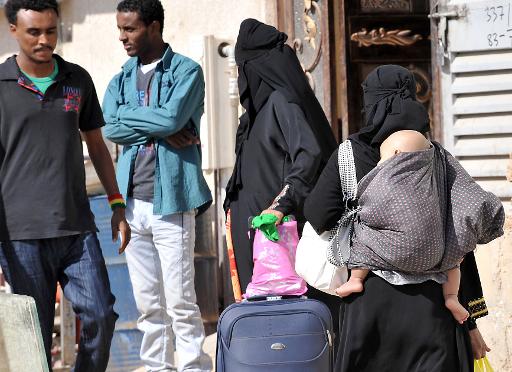
17,000 illegals surrender in Riyadh

November 12, 2013

Illegals_surrender

Riyadh, Nov 12: Nearly 17,000 illegal foreigners, including women and children, have surrendered to Riyadh police until Monday evening.

Riyadh police spokesman Brig. Gen. Nasser bin Saeed Al-Qahtani said: “Arrangements will be made to deport them immediately after going through their documents.”

On Saturday, the police asked violators to surrender to the authorities to facilitate their deportation to their respective countries.

Following clashes in Manfouha district on Saturday, Riyadh police asked illegal expatriates to report at a specified point for deportation to their home countries.

The police set up an asylum center for illegals at the intersection of the King Abdul Aziz Road with Riyadh Ring Road. Luxury coaches were provided by the police in Manfouha to ferry the asylum-seekers to the deportation center.

Violators, mostly Ethiopians, surrendered with their families at the center.

During the police raid in Riyadh on Saturday, a major scuffle erupted which resulted in the death of three people, including a Saudi national, and injuries to 68 people, including 28 Saudis. Around 50 people who were admitted to the Al-Iman and Prince Salman Hospitals were discharged on Sunday. During the encounter, the police arrested 561 residents.

During the clashes, the illegal residents pelted residents and citizens with stones and damaged 104 cars and ransacked shops in the neighborhood.

Before the end of the amnesty period, the government had specifically warned illegal expatriates of a SR100,000 fine and a jail term of two years. Illegal residents were given seven months to rectify their employment and residency status in the Kingdom.

Thousands of immigrants have been deported since Nov. 3, according to local media.

Comments

Add new comment

  • Coastaldigest.com reserves the right to delete or block any comments.
  • Coastaldigset.com is not responsible for its readers’ comments.
  • Comments that are abusive, incendiary or irrelevant are strictly prohibited.
  • Please use a genuine email ID and provide your name to avoid reject.
Gulf News
April 12,2020

Dubai, Apr 12: Saudi Arabia reported 429 new cases of coronavirus, bringing the total number of infections in the country to 4462, the Ministry of Health announced on Sunday.

The ministry also confirmed 7 deaths bringing the total number of deaths in the kingdom to 59.

According to the ministry of health the number of recoveries are 41 cases, making total of recoveries 761.

Ministry also said that 40,000 have been quarantined since the beginning of the epidemic, and only 7,000 remain in quarantine, including those who recently returned from abroad.

Extension of curfew

Early on Sunday, King Salman approved the extension of curfew until further notice due to current rates of coronavirus spread, the official news agency SPA announced.

Earlier last week, Saudi Arabia imposed a 24-hour curfew and lockdown on the cities of Riyadh, Tabuk, Dammam, Dhahran and Hofuf and throughout the governorates of Jeddah, Taif, Qatif and Khobar.

Authorities had already sealed off the holy cities of Makkah and Medina along with Riyadh and Jeddah, barring people from entering and exiting as well as prohibiting movement between all provinces.

Total lockdown on Medina neighbourhoods

The Ministry of Interior also announced a total lockdown on five neighbourhoods in Medina on thursday until further notice. The neighborhoods include Al Sherbat; Bani Dhafar; Qurban, Al Jumuah; and parts of Al Iskan district and Bani Khudrah. No one is allowed to enter or exit these areas.

An official source from the ministry highlighted that the Ministry of Labor and Social Development will provide residents of these neighbourhoods with food baskets and will follow up on their needs while the ministry of health will provide them with necessary medications.

Saudi Arabia, which has reported the highest number of infections in the Gulf, is making every possible effort to limit the spread of the disease at home.

Comments

Add new comment

  • Coastaldigest.com reserves the right to delete or block any comments.
  • Coastaldigset.com is not responsible for its readers’ comments.
  • Comments that are abusive, incendiary or irrelevant are strictly prohibited.
  • Please use a genuine email ID and provide your name to avoid reject.
News Network
May 11,2020

May 11: Saudi Arabia will triple its value-added tax rate and suspend a cost of living allowance for state workers, it said on Monday, seeking to shield finances hit by low oil prices and a slump in demand for its lifeline export worsened by the new coronavirus.

Historic oil output cuts agreed by Riyadh and other major producers have given only limited support to prices after they sank on oversupply caused by a war for petroleum market share between the kingdom and its fellow oil titan Russia.

Saudi Arabia, the world's largest oil exporter, is also being hit hard by measures to fight the new coronavirus, which are likely to curb the pace and scale of economic reforms launched by Crown Prince Mohammed bin Salman.

"The cost of living allowance will be suspended as of June 1, and the value added tax will be increased to 15% from 5% as of July 1," Finance Minister Mohammed al-Jadaan said in a statement reported by the state news agency. "These measures are painful but necessary to maintain financial and economic stability over the medium to long term...and to overcome the unprecedented coronavirus crisis with the least damage possible."

The austerity measures come after the kingdom posted a $9 billion budget deficit in the first quarter.

The minister said non-oil revenues were affected by the suspension and decline in economic activity, while spending had risen due to unplanned strains on the healthcare sector and the initiatives taken to support the economy.

"All these challenges have cut state revenues, pressured public finances to a level that is hard to deal with going forward without affecting the overall economy in the medium to long term, which requires more spending cuts and measures to support non-oil revenues stability," he added.

The government has cancelled and put on hold some operating and capital expenditures for some government agencies, and cut allocations for some reform initiatives and projects worth a total 100 billion riyals ($26.6 billion), the statement said.

Central bank foreign reserves fell in March at their fastest rate in at least 20 years and to their lowest since 2011, while oil revenues in the first three months of the year fell 24% from a year earlier to $34 billion, pulling total revenues down 22%.

"The reforms are positive from a fiscal side as greater adjustment is essential. However, the tripling of VAT is unlikely to help that much in 2020 revenue wise with the expected fall in consumption," said Monica Malik, chief economist at Abu Dhabi Commercial Bank.

She said she kept unchanged her deficit forecast of 16.3% of GDP for this year, which already factors in a greater than previously announced spending cut.

About 1.5 million Saudis are employed in the government sector, according to official figures released in December.

In 2018, Saudi Arabia's King Salman ordered a monthly payment of 1,000 riyals ($267) to every state employee to compensate them for the rising living costs after the government hiked domestic gas prices and introduced value-added tax.

DIFFICULT TIMES

A committee has been formed to study all financial benefits paid to public sector employees and contractors, and will submit recommendations within 30 days, the statement said.

In late 2015, when oil prices fell from record highs, the kingdom slashed lavish bonuses, overtime payments and other benefits once considered routine perks in the public sector.

In a country without elections and with political legitimacy resting partly on distribution of oil revenue, the ability of citizens to adapt to such reforms is crucial for stability.

"Tripling the VAT will test the limits of the balance between revenues and consumption as the economy dives into a deep recession. The move will impact consumption and could also lower the expected revenues," said John Sfakianakis, a Gulf expert at the University of Cambridge.

"These are pro-austerity and pro-revenue moves rather than pro-growth ones," he said.

Hasnain Malik, head of equity strategy at Tellimer, said the VAT rise could bring about $24-$26.5 billion in additional non-oil fiscal revenue. The rise would hit consumer spending further but was a needed step towards fiscal sustainability, he said.


Comments

Add new comment

  • Coastaldigest.com reserves the right to delete or block any comments.
  • Coastaldigset.com is not responsible for its readers’ comments.
  • Comments that are abusive, incendiary or irrelevant are strictly prohibited.
  • Please use a genuine email ID and provide your name to avoid reject.
Agencies
July 8,2020

Jeddah, Jul 8: The Organization of Islamic Cooperation (OIC) writes to the members of the United Nations Security Council (UNSC), urging the body to come in the way of a plan announced by Israel for annexation of significant portions of the occupied West Bank.

The letter was addressed by the 57-member organization’s Secretary-General Yousef al-Othaimeen to the UNSC’s members as well as the members of the Middle East Quartet — the European Union, Russia, United Nations, and United States— the Arabic-language Rai al-Youm news website reported on Tuesday.

The letter urged the Council to adopt “the necessary measures” that would prevent the annexation and compel Israel to stop all its illegal activities.

The OIC also urged the UNSC to hold an emergency meeting to “salvage the [remaining] opportunities for peace, and revive attempts at reinstatement of the political process under international supervision.” Such meeting, it added, had to enable realization of “the two-state solution, and [creation of] a Palestinian state with East Jerusalem [al-Quds] as its capital.”

Israel’s Prime Minister Benjamin Netanyahu announced the plan to annex 30 percent of the occupied Palestinian territory — namely the areas upon which the regime has built its illegal settlements as well as the Jordan Valley — after US President Donald Trump backed the annexation in January.

Trump pledged the support while unveiling details of his Middle East scheme called the “deal of the century.”

The highly controversial scheme allegedly seeks to resolve the Palestinian-Israeli conflict, but is heavily tilted in favor of the occupying regime. As well as backing the annexation, the scheme re-endorses Washington’s incendiary recognition in late 2017 of al-Quds as “Israel’s capital,” although Palestinians want the occupied holy city’s eastern part to serve as the capital of their future state.

Palestinians have roundly rejected either the American design or the Israeli plan that is rooted in it.

Tel Aviv had previously announced July 1 as the date it sought to start implementing the annexation plan. It, however, is yet to get it off the ground amid far-and-wide international condemnation and speculation that the plan was announced in the first place to deflect attention from a massive corruption scandal involving Netanyahu.

Countries warn Israel of consequences to bilateral ties

Also on Tuesday, Egypt, France, Germany, and Jordan warned Israel against going ahead with the plan, saying that doing so could have consequences for their bilateral relations with the Tel Aviv regime.

In a statement distributed by the German Foreign Ministry, the countries said their foreign ministers had discussed how to restart talks between Israel and the Palestinian Authority.

Most other European countries have likewise communicated their objection to the plan.

“We concur that any annexation of Palestinian territories occupied in 1967 would be a violation of international law and imperil the foundations of the peace process,” the European and Middle Eastern foreign ministers said, referring to the year, when Israel occupied the West Bank.

“We would not recognize any changes to the 1967 borders that are not agreed by both parties in the conflict,” they added. “It could also have consequences for the relationship with Israel.”

Israel had no immediate response. In a separate statement, however, Netanyahu’s office communicated Tel Aviv’s intransigence on the matter.

The statement said the Israeli premier had told his British counterpart Boris Johnson on Monday that he was committed to Trump’s “realistic” plan.

“Israel is prepared to conduct negotiations on the basis of President Trump’s peace plan, which is both creative and realistic, and will not return to the failed formulas of the past,” the statement alleged.

Comments

Add new comment

  • Coastaldigest.com reserves the right to delete or block any comments.
  • Coastaldigset.com is not responsible for its readers’ comments.
  • Comments that are abusive, incendiary or irrelevant are strictly prohibited.
  • Please use a genuine email ID and provide your name to avoid reject.