


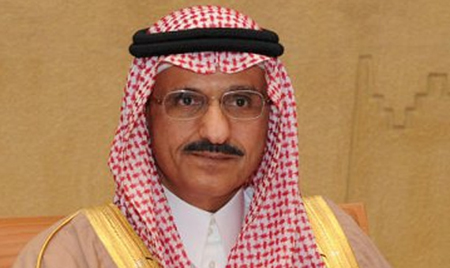
Riyadh Emir: Campaign not targeting any specific section

November 13, 2013

Prince_Khaled_Bin_BandarRiyadh, Nov 13: Riyadh Emir Prince Khaled Bin Bandar said on Tuesday that the ongoing security campaign is not targeting any specific section of expatriates but is directed against all violators of the labor and residency laws.

“We will vigorously continue the campaign up to the point of ensuring that all the foreigners in the Kingdom are legal residents,” he said during a reception at Al-Hakam Palace.

The reception, hosted by the Emir and Deputy Emir Prince Turki Bin Abdullah, was attended by Deputy Minister of Labor Muferrej Al-Haqbani, Public Security Assistant Director Maj. Gen. Jamaan Al-Ghamdi, several other officials, scholars and a number of citizens, the Saudi Press Agency (SPA) reported.

Prince Khaled drew attention of the audience to the incorrect reports being circulated by the foreign media about the situation of foreigners in the Kingdom.

He said that strict directives have been given to inspectors to behave decently with all those who failed to benefit from the amnesty period announced by Custodian of the Two Holy Mosques King Abdullah.

Talking about the incident in Riyadh’s Manfuhah area on Saturday, the Emir said that even though some illegal residents were involved in creating troubles in a limited area of Riyadh which claimed the lives of one Saudi and two illegals, the situation was swiftly brought under control.

“In consequence, a large number of violators turned themselves in and the authorities have extended all the facilities for their deportation in cooperation with their embassies,” he said.

The Emir noted that Saudi Arabia is not the only country which is regulating its labor market. All other countries are doing the same. The government, however, is keen to create job opportunities for Saudis. Prince Khaled also warned against exploiting the situation to hike prices of essential goods.

Speaking on the occasion, Al-Haqbani said the grace period was definitive evidence of the Kingdom’s determination not to have a roll back on the measures to correct the labor market.

The Kingdom announced this year that migrants can only work for their sponsors, even those of them who have residency permits.

On Monday, the authorities began rounding up thousands of illegals following the expiry of a final amnesty for them to formalize their status. Among them are foreigners who overstayed their visas, pilgrims who have sought jobs, and migrants under one sponsor trying to get jobs elsewhere. Having an official sponsor is a legal requirement in Saudi Arabia and most other Gulf states.

Buses have been transporting illegal immigrants to assembly centers near the capital Riyadh where authorities are finalizing procedures to deport them.

These centers have received some 17,000 foreign workers during the past few days.

Nearly a million migrants – Bangladeshis, Filipinos, Indians, Nepalis, Pakistanis and Yemenis among them – took advantage of the amnesty to leave. Another roughly four million were able to find employers to sponsor them. Expatriates account for a full nine million of the Kingdom’s population of 27 million.

Comments

Add new comment

  • Coastaldigest.com reserves the right to delete or block any comments.
  • Coastaldigset.com is not responsible for its readers’ comments.
  • Comments that are abusive, incendiary or irrelevant are strictly prohibited.
  • Please use a genuine email ID and provide your name to avoid reject.
News Network
July 23,2020

Beirut, Jul 23: The pandemic will exact a heavy toll on Arab countries, causing an economic contraction of 5.7% this year, pushing millions into poverty and compounding the suffering of those affected by armed conflict, a U.N. report said Thursday.

The U.N.'s Economic and Social Commission for Western Asia expects some Arab economies to shrink by up to 13%, amounting to an overall loss for the region of $152 billion.

Another 14.3 million people are expected to be pushed into poverty, raising the total number to 115 million — a quarter of the total Arab population, it said. More than 55 million people in the region relied on humanitarian aid before the COVID-19 crisis, including 26 million who were forcibly displaced.

Arab countries moved quickly to contain the virus in March by imposing stay-at-home orders, restricting travel and banning large gatherings, including religious pilgrimages.

Arab countries as a whole have reported more than 830,000 cases and at least 14,717 deaths. That equates to an infection rate of 1.9 per 1,000 people and 17.6 deaths per 1,000 cases, less than half the global average of 42.6 deaths, according to the U.N.

But the restrictions exacted a heavy economic toll, and authorities have been forced to ease them in recent weeks. That has led to a surge in cases in some countries, including Lebanon, Iraq and the Palestinian territories.

Wealthy Gulf countries were hit by the pandemic at a time of low oil prices, putting added strain on already overstretched budgets. Middle-income countries like Jordan and Egypt have seen tourism vanish overnight and a drop in remittances from citizens working abroad.

War-torn Libya and Syria have thus far reported relatively small outbreaks. But in Yemen, where five years of civil war had already generated the world's worst humanitarian crisis, the virus is running rampant in the government-controlled south while rebels in the north conceal its toll.

Rola Dashti, the head of the U.N. commission, said Arab countries need to “turn this crisis into an opportunity” and address longstanding issues, including weak public institutions, economic inequality and over-reliance on fossil fuels.

“We need to invest in survival, survival of people and survival of businesses,” she said.

Comments

Add new comment

  • Coastaldigest.com reserves the right to delete or block any comments.
  • Coastaldigset.com is not responsible for its readers’ comments.
  • Comments that are abusive, incendiary or irrelevant are strictly prohibited.
  • Please use a genuine email ID and provide your name to avoid reject.
News Network
April 13,2020

Dubai, Apr 13: The UAE plans to impose "strict restrictions" on countries reluctant to take back their nationals working in the Gulf country in the wake of the coronavirus outbreak and restructure its cooperation and labour relations with them, a state-run media report said on Sunday.

Indian expatriate community of nearly 33 lakh is the largest ethnic community in UAE constituting roughly about 30 per cent of the country’s population. Among the Indian states, Kerala is the most represented followed by Tamil Nadu and Andhra Pradesh.

The options being considered by the Ministry of Human Resources and Emiratisation include "imposing strict future restrictions on the recruitment" of workers from these countries and activating the "quota" system in recruitment operations, state-run WAM news agency reported, citing an official.

It said the options also include suspending memoranda of understanding signed between the ministry and concerned authorities in these countries.

Citing the unnamed official, it said these options are being considered after many countries did not respond to requests by their nationals to return home following the coronavirus outbreak.

The official made it clear that all countries of foreign workers in the UAE should be responsible for their nationals wishing to return to their countries as part of the humanitarian initiative launched recently by the ministry.

Earlier this month, the ministry launched the initiative to enable residents who work in the UAE and wish to return to their countries to do so during the period of precautionary measures undertaken in the UAE to contain the spread of the coronavirus.

Employees will be asked to submit their annual leave dates or agree with their employers on unpaid leave.

UAE's Ambassador to India Ahmed Abdul Rahman Al Banna has said that the Ministry of Foreign Affairs and International Cooperation (MOFAIC) had sent out a “note verbale” to all the embassies in the UAE, including the Indian mission, during the past couple of weeks on the issue.

“We have sent the note verbale and all the embassies have been informed including the Indian embassy in the UAE and even the Ministry of External Affairs in India,” Al Banna told Gulf News over phone on Saturday.

He said the UAE has offered to test those who want to be evacuated.

“We are assuring everybody that we have the best of the facilities, the best of the testing centres and we have tested more than 500,000 people,” he said.

“We are assuring them also of our cooperation to fly those who got stranded in the UAE for some reasons. Some got stuck because of the lockdown and closure of airports in India. Some were visiting the UAE.”

“We are offering our system and making sure that they are good (to fly) by doing all the tests and transport them according to the request of their own government,” he said.

The envoy said those who test positive for COVID-19 will remain in the UAE. “They will be treated in our home facilities,” he added.

The Kerala High Court on Saturday sought the central government's response to a petition seeking a direction to bring back Indians stranded in the UAE in view of the coronavirus outbreak in the gulf nation.

Considering the plea by Kerala Muslim Cultural Centre (KMCC) in Dubai, the court directed the Centre to file an affidavit on the steps taken by it to ensure the safety of Indians living there and bring back those stuck in the Gulf countries.

In its plea, KMCC, the organisation for non-resident Indians from Kerala, sought directions to the Ministries of External Affairs and Civil Aviation to provide exemptions in the international air travel ban to bring back those Indians stranded in the UAE.

Comments

Add new comment

  • Coastaldigest.com reserves the right to delete or block any comments.
  • Coastaldigset.com is not responsible for its readers’ comments.
  • Comments that are abusive, incendiary or irrelevant are strictly prohibited.
  • Please use a genuine email ID and provide your name to avoid reject.
Agencies
July 19,2020

Kuwait City, Jul 19: Kuwaiti ruler Sheikh Sabah al-Ahmad al-Jaber al-Sabah has successfully undergone surgery early on Sunday, the emir's office said.

"His Highness the Amir Sheikh Sabah Al-Ahmad Al-Jaber Al-Sabah ... has undergone surgery this morning, with thanks to God for its success," the head of the emir's office Sheikh Ali Jarrah al-Sabah said, as quoted by state news agency KUNA.

The 91-year-old was admitted to hospital for a medical checkup.

Yesterday, a royal order was issued assigning Crown Prince Sheikh Nawaf al-Ahmed al-Sabah, the emir's designated successor, "to take over some constitutional jurisdictions of His Highness the Emir temporarily"

In August 2019, Kuwait acknowledged the emir suffered an unspecified medical "setback" that required him to be hospitalised.

Comments

Add new comment

  • Coastaldigest.com reserves the right to delete or block any comments.
  • Coastaldigset.com is not responsible for its readers’ comments.
  • Comments that are abusive, incendiary or irrelevant are strictly prohibited.
  • Please use a genuine email ID and provide your name to avoid reject.