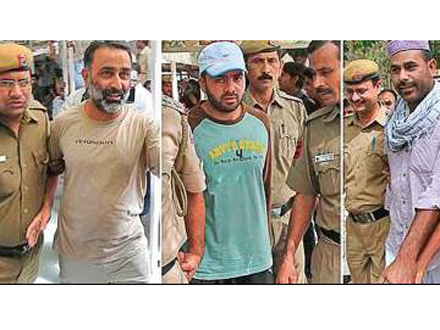
Acquitted man's mother narrates ordeal

[email protected] (Greaterkashmir.com)
November 23, 2012

kash

In a corner of a dimly-lit room, Padsha Begum, 65—whose son was Thursday acquitted after 17 years by Delhi High Court in the 1996 Lajpat Nagar blast case—is on a prayer mat with both joy and sorrow reflecting on her face. Her daughter Nighat is reciting some verses from the holy Qur'an loudly.

The acquittal of Begum's son Mirza Nissar Hussian has infused a new lease of life to this Srinagar family that has been living in deep distress for the past 17 years.

Begum says she offered special thanksgiving prayer after hearing about Hussain's acquittal. And so did Nighat.

On Thursday Delhi High Court acquitted two convicts who were given death penalty in the 1996 Lajpat Nagar Market bomb blasts. Mirza Nissar Hussain is one among them.

“Thanks to Almighty Allah. My son will be home after 17 years. Truth has ultimately prevailed,” Begum says. “His acquittal has proven that he was not guilty of what he was framed for. How can an 8th standard student carry out a blast and kill people? We will see our innocent son after 17 years for no fault of his.”

Hussain's sister says, “My another brother Iftikhar, who was also arrested in 1996 in connection with the blasts, was released after 14 years in 2010. By then our family had literally collapsed. While our father had already passed away, two of my brothers were put in jail for no fault. We will see the face of another brother after 17 years. It has been a very tough time.”

Nighat says the family has nothing to celebrate as of now as “Nissar is being implicated in some other case relating to Jaipur blasts.” “What kind of justice is this?” she asks. “If my brother was proven innocent in a case for which he spent 17 years in jail, it is paranoia that they are implicating him in some other case.”

Comments

Add new comment

  • Coastaldigest.com reserves the right to delete or block any comments.
  • Coastaldigset.com is not responsible for its readers’ comments.
  • Comments that are abusive, incendiary or irrelevant are strictly prohibited.
  • Please use a genuine email ID and provide your name to avoid reject.
Agencies
May 17,2020

As millions of people get hooked to online dating platforms, their proliferation has led to online romance scams becoming a modern form of fraud that have spread in several societies along with the development of social media like Facebook Dating, warn researchers.

For example, extra-marital dating app Gleeden has crossed 10 lakh users in India in COVID-19 times while dating apps like Tinder and Bumble have gained immense popularity.

According to researchers from University of Siena and Scotte University Hospital led by Dr Andrea Pozza, via a fictitious Internet profile, the scammer develops a romantic relationship with the victim for 6-8 months, building a deep emotional bond to extort economic resources in a manipulative dynamic.

"There are two notable features: on the one hand, the double trauma of losing money and a relationship, on the other, the victim's shame upon discovery of the scam, an aspect that might lead to underestimation of the number of cases," the authors wrote in a paper published in the journal Clinical Practice & Epidemiology in Mental Health.

Around 1,400 dating sites/chats have been created over the last decade in North America alone. In the UK, 23 per cent of Internet users have met someone online with whom they had a romantic relationship for a certain period and even 6 per cent of married couples met through the web.

"The online dating industry has given rise to new forms of pathologies and crime, said the authors.

The results showed that 63 per cent of social media users and 3 per cent of the general population reported having been a victim at least once.

Women, middle-aged people, and individuals with higher tendencies to anxiety, romantic idealization of affective relations, impulsiveness and susceptibility to relational addiction are at higher risk of being victims of the scam.

Online romance scams are, in other words, relationships constructed through websites for the purpose of deceiving unsuspecting victims in order to extort money from them.

The scammer always acts empathetically and attempts to create the impression in the victim that the two are perfectly synced in their shared view of life.

"The declarations of the scammer become increasingly affectionate and according to some authors, a declaration of love is made within two weeks from initial contact," the study elaborated.

After this hookup phase, the scammer starts talking about the possibility of actually meeting up, which will be postponed several times due to apparently urgent problems or desperate situations such as accidents, deaths, surgeries or sudden hospitalizations for which the unwitting victim will be manipulated into sending money to cover the momentary emergency.

Using the strategy of "testing-the-water", the scammer asks the victim for small gifts, usually to ensure the continuance of the relationship, such as a webcam, which, if successful, leads to increasingly expensive gifts up to large sums of money.

When the money arrives from the victim, the scammer proposes a new encounter.

The request for money can also be made to cover the travel costs involved in the illusory meeting. In this phase, the victim may start having second thoughts or showing doubt about the intentions of the partner and gradually decide to break off the relationship.

"In other cases, the fraudulent relationship continues or even reinforces itself as the victim, under the influence of ambivalent emotions of ardor and fear of abandonment and deception, denies or rationalizes doubts to manage their feelings," said the study.

In some cases, the scammer may ask the victim to send intimate body photos that will be used as a sort of implicit blackmail to further bind the victim to the scammer.

Once the scam is discovered, the emotional reaction of the victim may go through various phases: feelings of shock, anger or shame, the perception of having been emotionally violated (a kind of emotional rape), loss of trust in people, a sensation of disgust towards oneself or the perpetrator of the crime and a feeling of mourning.

"Understanding the psychological characteristics of victims and scammers will allow at-risk personality profiles to be identified and prevention strategies to be developed," the authors suggested.


Comments

Add new comment

  • Coastaldigest.com reserves the right to delete or block any comments.
  • Coastaldigset.com is not responsible for its readers’ comments.
  • Comments that are abusive, incendiary or irrelevant are strictly prohibited.
  • Please use a genuine email ID and provide your name to avoid reject.
Agencies
May 27,2020

Due to impacts of COVID-19, shipments of total mobile phones are forecast to decline 14.6% in 2020, while smartphone shipments will achieve a slightly slower decline of 13.7 % year over year to total 1.3 billion units this year, according to a Gartner forecast on Tuesday.

"While users have increased the use of their mobile phones to communicate with colleagues, work partners, friends and families during lockdowns, reduced disposable income will result in fewer consumers upgrading their phones," Ranjit Atwal, Senior Research Director at Gartner, said in a statement.

"As a result, phone lifetimes will extend from 2.5 years in 2018 to 2.7 years in 2020," said Atwal.

In 2020, affordable 5G phones were expected to be the catalyst to increase phone replacements, but now it is unlikely to be the case.

5G phones are now forecast to represent only 11% of total mobile phone shipments in 2020.

"The delayed delivery of some 5G flagship phones is an ongoing issue," said Annette Zimmermann, Research Vice President at Gartner.

"Moreover, the lack of 5G geographical coverage along with the increasing cost of the 5G phone contract will impact the choice of a 5G phone."

Overall, spending on 5G phones will be impacted in most regions apart from China, where continued investment in 5G infrastructure is expected, allowing providers in China to effectively market 5G phones.

The combined global shipments PCs, tablets and mobile phones are on pace to decline 13.6% in 2020, according to the forecast.

PC shipments are expected to decline 10.5% this year. Shipments of notebooks, tablets and Chromebooks are forecast to decline slower than the PC market overall in 2020.

"The forecasted decline in the PC market in particular could have been much worse," said Atwal.

"However, government lockdowns due to COVID-19 forced businesses and schools to enable millions of people to work from home and increase spending on new notebooks, Chromebooks and tablets for those workers. Education and government establishments also increased spending on those devices to facilitate e-learning."

Gartner said that 48 per cent of employees will likely work remotely at least part of the time after the COVID-19 pandemic, compared to 30 % pre-pandemic.

Overall, the work from home trend will make IT departments shift to more notebooks, tablets and Chrome devices for work.

"This trend combined with businesses required to create flexible business continuity plans will make business notebooks displace desk based PCs through 2021 and 2022," said Atwal.

Comments

Add new comment

  • Coastaldigest.com reserves the right to delete or block any comments.
  • Coastaldigset.com is not responsible for its readers’ comments.
  • Comments that are abusive, incendiary or irrelevant are strictly prohibited.
  • Please use a genuine email ID and provide your name to avoid reject.
Agencies
March 3,2020

Facebook on Monday launched a new consumer marketing campaign in India titled 'More Together'. India is the first country in the Asia Pacific region where such a campaign is being rolled out.

It is also the first time that Facebook is rolling out a 'high decibel campaign of this stature in India', the company said in a statement.

It is also the first time that Facebook is rolling out a 'high decibel campaign of this stature in India', the company said in a statement.

"India is at the heart of Facebook and one of our focus areas this year is to tell the exciting story of a service that is deeply embedded in the fabric of India," said Ajit Mohan, Vice President and Managing Director, Facebook India.

The campaign would have multiple campaigns over the next few weeks in eight languages and the one will be set in the context of Holi.

Facebook in 2019 introduced a new company logo to further distinguish the company from the Facebook app.

The company recently announced the appointment of Avinash Pant as the Marketing Director for India operations, to drive the consumer marketing efforts across the family of apps.

Comments

Add new comment

  • Coastaldigest.com reserves the right to delete or block any comments.
  • Coastaldigset.com is not responsible for its readers’ comments.
  • Comments that are abusive, incendiary or irrelevant are strictly prohibited.
  • Please use a genuine email ID and provide your name to avoid reject.