



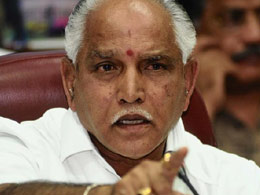
Karnataka witnesses a politically turbulent 2012

December 23, 2012
yeddy


BS Yeddyurappa breaking ranks with BJP and floating his own party, another change of guard, the Cauvery issue, busting of a terror module and an ugly incident of three ministers watching porn clippings in the assembly marked the year 2012 for Karnataka.

The year also saw attacks on girls and boys at a home stay in Mangalore, clash between lawyers and police in the wake of men of legal fraternity attacking journalists and exodus of people from northeastern states following rumours of attack.

The Cauvery water sharing row returned to haunt Karnataka, with Tamil Nadu managing to get court orders for release of water on two occasions and Cauvery basin districts plunged into agitation opposing water release.

The first-ever saffron party government in south India continued to be hit by political turmoil following a banner of revolt launched by its strong man Yeddyurappa, who later launched Karnataka Janata Party with the sole aim of decimating BJP in next year's election.

The other notable events that marked the year was a problem of mounting garbage in the city, which also tarnished the brand name of Bangalore at the international level, resignation drama by ministers and legislators to seek the sacking of D V Sadananda Gowda as chief minister.

There were private complaints pouring against Chief Minister Jagadish Shettar, which the Lokayukta court quashed, Law Minister S Suresh Kumar, former chief minister Sadananda Gowda , BBMP Mayor Venkatesh Murthy and former chief ministers H D Devegowda, S M Krishna and Yeddyurappa accusing them of abusing their power.

The year also witnessed an unprecedented scene of ministers and ruling party legislators boycotting the budget session to press for their demand to sack Gowda and make Shettar as chief minister.


In a continued collision-course between Governor HR Bhardwaj with the government, the former rejected in February the recommendation to appoint retired judge S R Bannurmath as Lokayukta in the wake of him facing a land allotment row.

The image of the BJP government took a beating when two of its ministers, Laxman Savadi and C C Patil, were caught on camera watching porn clippings in the state assembly when the house was debating the hardships faced by drought-hit people.

The footage aired by a regional channel and later by others led to the resignation of three ministers-- J Krishna Palemar, who was accused of providing the clippings, besides Savadi and Patil.

Yeddyurappa got a major relief from the high court in March when it quashed the FIR registered against him in illegal mining case on Lokayukta report and also a chapter in the report that indicted him. This prompted the 70-year-old Lingayat leader to stake claim for re-instating himself as chief minister, a post he was forced to quit in July 2011, but the BJP high command rejected the demand, which ultimately led him to bid adieu to the saffron party and launch KJP.

However, Yeddyurappa suffered a major setback when the Supreme Court ordered a CBI probe in May into illegal mining and mysterious disappearance of iron ore from Belekeri Port in Uttara Kannada district.

The year saw the tragic death of two officials -- Karnataka Administrative Service (KAS) officer Mahantesh, who was murdered by some individuals in Bangalore City and an Assistant Conservator of Forest Madan Naik in Dandeli, who was assaulted by a group of tourists to death for warning them to be beware of crocodiles in the lake, triggering off protests from government servants.


The internal feud that has been simmering in the ruling BJP ever since it came to power in 2008 continued unabated in 2012 and led to sacking of Sadananda Gowda as chief minister by the rebels led by Yeddyurappa.

Yeddyurappa ensured that nine ministers loyal to him quit seeking Gowda's replacement with Shettar on June 29 and they withdrew the resignation on July 2 after BJP high command accepted the demand for change of guard.

Gowda quit as chief minister on July 8 and Shettar, another Lingayat leader, assumed office on July 12. But the rumblings in the government and also the party continued.

People of the state were for a rude shock when the city police announced that they have uncovered a terror module with the arrest of 11 terror suspects who had planned to eliminate prominent politicians and journalists on August 30.


The reputation of the state suffered a major dent when the activists of Hindu Jagaran Vedike stormed a home stay in Mangalore, beat up girls and boys partying there in July. The attack evoked nationwide outrage.



Comments

Add new comment

  • Coastaldigest.com reserves the right to delete or block any comments.
  • Coastaldigset.com is not responsible for its readers’ comments.
  • Comments that are abusive, incendiary or irrelevant are strictly prohibited.
  • Please use a genuine email ID and provide your name to avoid reject.
Agencies
March 13,2020

Amid the rapid spread of the novel coronavirus (COVID-19), which has infected 73 people in India and killed more than 4,500 individuals globally, doctors have advised that in addition to regularly washing hands, one should also disinfect their smartphone every 90 minutes with alcohol-based hand sanitizer.

Ravi Shekhar Jha, Head of Department at Fortis Escorts Hospital in Faridabad said the best method to disinfect your smartphone is to use regular doctor spirit or the alcohol-based hand sanitizer at least every 90 minutes.

"Avoid touching your eyes, mouth, or nose. The best option is to use a phone cover or a Bluetooth device and try to touch your phone as less as possible. We would also recommend cleaning your phone at least twice a day," Jha told IANS.

According to research, published in 2018 by Insurance2Go, a gadget insurance provider, revealed that smartphone screens have three times more germs than a toilet seat.

One in 20 smartphone users was found to clean their phones less than every six months, said the study.

"In the time of fear of coronavirus, smartphones should also be disinfected with alcohol-based sanitizer rub. Pour few drops of sanitizer on a tiny clean cotton pad and rub it safely on your entire phone," said Jyoti Mutta, Senior Consultant, Microbiology, Sri Balaji Action Medical Institute in New Delhi.

"You can repeat this process every evening coming back home after an entire day out at work and once in the morning before going out," Mutta added.

"Maintain basic cleanliness, and try to avoid using other's phones especially if suffering from respiratory illness or flu-like symptoms as there is no other way to disinfect these regular gadgets," she stressed.

Another study from the University of Surrey in the UK, also found that the home button on your smartphone may be harbouring millions of bacteria - some even harmful.

The World Health Organisation (WHO) declared the novel coronavirus as a global pandemic on Wednesday. The death toll of COVID-19 has crossed the 4,500 marks and confirmed cases globally have touched one lakh as per the reports.

According to Suranjeet Chatterjee, Senior Consultant in Internal Medicine Department of Indraprastha Apollo Hospitals in New Delhi, "We should frequently wash our hands, cover our coughs and it is important to adapt to other good hygiene habits that are most important in such a situation."

"Coronavirus and other germs can live on surfaces like glass, metal or plastics and phones are bacteria-ridden. It is necessary that we sanitize our hands frequently and make sure that our hands are clean all the time," Chatterjee told IANS.

"The emphasis should be laid on sanitising our hands rather than sanitizing the phone - once in a while the phone can be sanitized under the guidance of the makers of the phone," Chatterjee stressed.

According to the global health agency, the most effective way to protect yourself against coronavirus is by frequently cleaning of your hands with alcohol-based hand rub or washing them with soap and water.

The WHO's report showed the virus infects people of all ages, among which older people and those with underlying medical conditions are at a higher risk of getting infected.

People should eat only well-cooked food, avoid spitting in public, and avoid close contact, the WHO said, adding that it is important for people to seek medical care at the earliest if they become sick.

Comments

Add new comment

  • Coastaldigest.com reserves the right to delete or block any comments.
  • Coastaldigset.com is not responsible for its readers’ comments.
  • Comments that are abusive, incendiary or irrelevant are strictly prohibited.
  • Please use a genuine email ID and provide your name to avoid reject.
Agencies
March 10,2020

New Delhi, Mar 10: Crisis-hit Yes Bank on Tuesday said that it has enabled inward IMPS and NEFT services.

The move allows people to send money from other bank accounts to their Yes Bank account through IMPS (Immediate Payment Service) and NEFT (National Electronic Funds Transfer) mode.

In a tweet, the bank also said that Yes Bank customers can pay their credit card dues and loan obligations from other bank accounts.

"Inward IMPS/NEFT services have now been enabled. You can make payments towards YES BANK Credit Card dues and loan obligations from other bank accounts. Thank you for your co-operation. @RBIA @FinMinIndia," said tweet.

Last week Yes Bank was placed under moratorium and a withdrawal cap of Rs 50,000 was imposed till April 3.

The administrator of Yes Bank, Prashant Kumar and Rajnish Kumar, the Chairman of the State Bank of India are hopeful that moratorium would be lifted within a week.

As per the Reserve Bank of India (RBI) draft reconstruction scheme for the crisis-hit private lender, the SBI will take up 49 per cent in the bank by investing Rs 2,450 crore.

The new board of directors will stand constituted from the appointed date. It will comprise a CEO and MD, non-executive chairman and non-executive directors. The SBI will have nominee directors appointed on the board of the reconstructed bank.

The RBI may appoint additional directors to the board, who shall continue in office for one year, or until an alternate board is constituted by Yes Bank.

The SBI will not reduce its holding below 26 per cent before completion of three years from the date of infusion of the capital.

Comments

Add new comment

  • Coastaldigest.com reserves the right to delete or block any comments.
  • Coastaldigset.com is not responsible for its readers’ comments.
  • Comments that are abusive, incendiary or irrelevant are strictly prohibited.
  • Please use a genuine email ID and provide your name to avoid reject.
News Network
June 18,2020

Beijing, Jun 18:  Besides washing hands and wearing masks, it is also important to close the toilet lid before flushing to contain the spread of COVID-19, as per a new study.

According to a new study cited by The Washington Post, scientists who simulated toilet water and airflows, have found that flushing a toilet can generate a plume of virus-containing aerosol particles that is widespread and can linger in the air long enough to be inhaled by others. The novel coronavirus has been found in the faeces of COVID-19 patients, but it remains unknown whether such clouds could contain enough virus to infect a person.

"Flushing will lift the virus up from the toilet bowl," co-author Ji-Xiang Wang, who researches fluids at Yangzhou University in Yangzhou, China, said in an email. Wang stressed that bathroom users "need to close the lid first and then trigger the flushing process" and wash hands properly if the closure is not possible. As one flushes the toilet with the lids open, bits of faecal matter swish around so violently that they can be propelled into the air, become aerosolised and then settle on the surroundings.

Experts call it the "toilet plume".Age-old studies have been made to understand the potential for airborne transmission of infectious disease via sewage, and the toilet plume's role. Scientists who have seeded toilet bowls with bacteria and viruses have found contamination of seats, flush handles, bathroom floors and nearby surfaces. This is one reason we are told to wash our hands after visiting the toilet. Public bathrooms are well known to contribute to the spread of viruses that transmit via ingestion, such as the noroviruses that haunt cruise ships. However, their role in the transmission of respiratory viruses has not been established, said Charles P Gerba, a microbiologist at the University of Arizona."The risk is not zero, but how great a risk it is, we do not know. The big unknown is how much virus is infectious in the toilet when you flush it ... and how much virus does it take to cause an infection," said Gerba, who has studied the intersection of toilets and infectious disease for 45 years.

A study published in March in the journal Gastroenterology found significant amounts of coronavirus in the stool of patients and determined that viral RNA lasted in faeces even after the virus cleared from the patients` respiratory tracts. While another study in the journal Lancet found coronavirus in faeces up to a month after the illness had passed.

Scientists around the world are now studying sewage to track the spread of the virus. According to the researchers, the presence of the virus in excrement and the gastrointestinal tract raises the prospect of transmission via toilets, because many COVID-19 patients experience diarrhoea or vomiting.

A study of air samples in two hospitals in Wuhan, China found that although coronavirus aerosols in isolation wards and ventilated patient rooms were very low, "it was higher in the toilet areas used by the patients".The Centers for Disease Control and Prevention (CDC) says it remains "unclear whether the virus found in faeces may be capable of causing COVID-19," and "there has not been any confirmed report of the virus spreading from faeces to a person".For now, the CDC characterises the risk as low based on observations from previous outbreaks of other coronaviruses such as severe acute respiratory syndrome (SARS) and the Middle East respiratory syndrome (MERS). Wang decided to use computer models to simulate toilet plumes while isolating at home, as per Chinese government orders and thinking about how a fluids researcher "could contribute to the global fight against the virus".

Published in the journal Physics of Fluids, the study found that flushing of both single-inlet toilets, which push water into the bowl from one port, and annular-inlet toilets, which pour water into the bowl from the rim's surrounding edge with even greater energy, results in "massive upward transport of virus".

Particles can reach heights of more than three feet and float in the air for more than a minute, it found. The paper recommends not just lid-closing and hand-washing, it urges manufacturers to produce toilets that close and self-clean automatically. It also suggests that toilet-users should wipe down the seat. Gerba, however, said seats should not be a major concern.

Research has found that public and household toilet seats are typically the cleanest surfaces in restrooms, he said, probably because so many people already wipe them off before using them. Also, he said of SARS-CoV-2, the virus that causes COVID-19, "I don't think it's butt-borne, so I don`t think you have to worry."Gerba, who has been studying coronavirus transmission for two decades to investigate the role of a toilet flushing in a SARS outbreak stresses "flush and run" when using a public toilet without a lid. Gerba also said that people should wash hands well post-flushing and use hand sanitiser after leaving the restroom. "Choose well-ventilated bathrooms if possible and do not hang around the restroom in any case," added Gerba.

Comments

Add new comment

  • Coastaldigest.com reserves the right to delete or block any comments.
  • Coastaldigset.com is not responsible for its readers’ comments.
  • Comments that are abusive, incendiary or irrelevant are strictly prohibited.
  • Please use a genuine email ID and provide your name to avoid reject.