



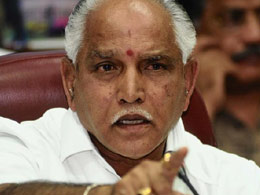
Karnataka witnesses a politically turbulent 2012

December 23, 2012
yeddy


BS Yeddyurappa breaking ranks with BJP and floating his own party, another change of guard, the Cauvery issue, busting of a terror module and an ugly incident of three ministers watching porn clippings in the assembly marked the year 2012 for Karnataka.

The year also saw attacks on girls and boys at a home stay in Mangalore, clash between lawyers and police in the wake of men of legal fraternity attacking journalists and exodus of people from northeastern states following rumours of attack.

The Cauvery water sharing row returned to haunt Karnataka, with Tamil Nadu managing to get court orders for release of water on two occasions and Cauvery basin districts plunged into agitation opposing water release.

The first-ever saffron party government in south India continued to be hit by political turmoil following a banner of revolt launched by its strong man Yeddyurappa, who later launched Karnataka Janata Party with the sole aim of decimating BJP in next year's election.

The other notable events that marked the year was a problem of mounting garbage in the city, which also tarnished the brand name of Bangalore at the international level, resignation drama by ministers and legislators to seek the sacking of D V Sadananda Gowda as chief minister.

There were private complaints pouring against Chief Minister Jagadish Shettar, which the Lokayukta court quashed, Law Minister S Suresh Kumar, former chief minister Sadananda Gowda , BBMP Mayor Venkatesh Murthy and former chief ministers H D Devegowda, S M Krishna and Yeddyurappa accusing them of abusing their power.

The year also witnessed an unprecedented scene of ministers and ruling party legislators boycotting the budget session to press for their demand to sack Gowda and make Shettar as chief minister.


In a continued collision-course between Governor HR Bhardwaj with the government, the former rejected in February the recommendation to appoint retired judge S R Bannurmath as Lokayukta in the wake of him facing a land allotment row.

The image of the BJP government took a beating when two of its ministers, Laxman Savadi and C C Patil, were caught on camera watching porn clippings in the state assembly when the house was debating the hardships faced by drought-hit people.

The footage aired by a regional channel and later by others led to the resignation of three ministers-- J Krishna Palemar, who was accused of providing the clippings, besides Savadi and Patil.

Yeddyurappa got a major relief from the high court in March when it quashed the FIR registered against him in illegal mining case on Lokayukta report and also a chapter in the report that indicted him. This prompted the 70-year-old Lingayat leader to stake claim for re-instating himself as chief minister, a post he was forced to quit in July 2011, but the BJP high command rejected the demand, which ultimately led him to bid adieu to the saffron party and launch KJP.

However, Yeddyurappa suffered a major setback when the Supreme Court ordered a CBI probe in May into illegal mining and mysterious disappearance of iron ore from Belekeri Port in Uttara Kannada district.

The year saw the tragic death of two officials -- Karnataka Administrative Service (KAS) officer Mahantesh, who was murdered by some individuals in Bangalore City and an Assistant Conservator of Forest Madan Naik in Dandeli, who was assaulted by a group of tourists to death for warning them to be beware of crocodiles in the lake, triggering off protests from government servants.


The internal feud that has been simmering in the ruling BJP ever since it came to power in 2008 continued unabated in 2012 and led to sacking of Sadananda Gowda as chief minister by the rebels led by Yeddyurappa.

Yeddyurappa ensured that nine ministers loyal to him quit seeking Gowda's replacement with Shettar on June 29 and they withdrew the resignation on July 2 after BJP high command accepted the demand for change of guard.

Gowda quit as chief minister on July 8 and Shettar, another Lingayat leader, assumed office on July 12. But the rumblings in the government and also the party continued.

People of the state were for a rude shock when the city police announced that they have uncovered a terror module with the arrest of 11 terror suspects who had planned to eliminate prominent politicians and journalists on August 30.


The reputation of the state suffered a major dent when the activists of Hindu Jagaran Vedike stormed a home stay in Mangalore, beat up girls and boys partying there in July. The attack evoked nationwide outrage.



Comments

Add new comment

  • Coastaldigest.com reserves the right to delete or block any comments.
  • Coastaldigset.com is not responsible for its readers’ comments.
  • Comments that are abusive, incendiary or irrelevant are strictly prohibited.
  • Please use a genuine email ID and provide your name to avoid reject.
Agencies
January 10,2020

Indian enterprises were flooded with a whopping 14.6 crore malware threats in 2019 - a growth of 48 per cent (year-on-year) compared to 2018, a new report said on Friday.

Manufacturing, BFSI (banking, financial services and insurance), education, healthcare, IT/ITES, and the government were the most at-risk industries in the country, said the report from Seqrite, the enterprise arm of Pune-based IT security firm Quick Heal Technologies.

Interestingly, almost a quarter (23 per cent) of the threats were identified through 'Signatureless behaviour-based' detection by Seqrite, indicating how a growing number of cybercriminals were deploying new or previously unknown threat vectors to compromise enterprise security.

"With the latest Seqrite annual threat report, we want to empower CIOs, CISOs, business leaders and all key public stakeholders with the insights they need to combat the growing complexity of the threat landscape," said Sanjay Katkar, Joint Managing Director and CTO, Quick Heal Technologies.

The most prominent trend was the drastic increase in the volume, intensity, and sophistication of cyber-attack campaigns targeting Indian enterprises in 2019.

The rapid integration of IoT devices, BYOD (bring your own device), and third-party APIs into enterprise networks has created newer security vulnerabilities that might go unnoticed until a major breach occurs.

Threat researchers at Seqrite observed several large-scale advanced persistent threats (APT) attacks deployed against organisations in the government sector.

"The entry of nation-states and organised cybercrime cells into the fray is expected to add more complication to this situation and will require Indian government bodies and corporate enterprises to shore up their cyber defence strategies in 2020 and beyond," the report noted.

More alarming, however, was the continued lack of security awareness amongst enterprises and government organisations.

"Unsecured Remote Desktop Protocol (RDP) and Server Message Block (SMB) protocols continued to be targeted through brute-force attacks," said the report.

Spear phishing attack campaigns leveraging Office exploits and infected macros were also used extensively by cybercriminals to gain access to enterprise networks and steal critical data.

"India's digital journey depends on ensuring robust cybersecurity for all stakeholders within the enterprise ecosystem," said Katkar.

The sharp spike should be a cause of concern for CIOs and CISOs in the country, especially given the growing digital penetration within their enterprise networks.

"With network vulnerabilities and potential entry points increasing at a rapid pace, threat actors are expected to leverage artificial intelligence (AI) capabilities to power their malware campaigns in the future to capitalise on newer attack vectors," the report added.

Comments

Add new comment

  • Coastaldigest.com reserves the right to delete or block any comments.
  • Coastaldigset.com is not responsible for its readers’ comments.
  • Comments that are abusive, incendiary or irrelevant are strictly prohibited.
  • Please use a genuine email ID and provide your name to avoid reject.
News Network
May 30,2020

May 30: Patients undergoing surgery after contracting the novel coronavirus are at an increased risk of postoperative death, according to a new study published in The Lancet journal which may lead to better treatment guidelines for COVID-19.

In the study, the scientists, including those from the University of Birmingham in the UK, examined data from 1,128 patients from 235 hospitals from a total of 24 countries.

Among COVID-19 patients who underwent surgery, they said the death rates approach those of the sickest patients admitted to intensive care after contracting the virus.

The scientists noted that SARS-CoV-2 infected patients who undergo surgery, experience substantially worse postoperative outcomes than would be expected for similar patients who do not have the infection.

According to the study, the 30-day mortality among these patients was nearly 24 per cent.

The researchers noted that mortality was disproportionately high across all subgroups, including those who underwent elective surgery (18.9 per cent), and emergency surgery (25.6 per cent).

Those who underwent minor surgery, such as appendicectomy or hernia repair (16.3 per cent), and major surgery such as hip surgery or for colon cancer also had higher mortality rates (26.9 per cent), the study said.

According to the study, the mortality rates were higher in men versus women, and in patients aged 70 years or over versus those aged under 70 years.

The scientists said in addition to age and sex, risk factors for postoperative death also included having severe pre-existing medical problems, undergoing cancer surgery, undergoing major procedures, and undergoing emergency surgery.

"We would normally expect mortality for patients having minor or elective surgery to be under 1 per cent, but our study suggests that in SARS-CoV-2 patients these mortality rates are much higher in both minor surgery (16.3%) and elective surgery (18.9%)," said study co-author Aneel Bhangu from the University of Birmingham.

Bhangu said these mortality rates are greater than those reported for even the highest-risk patients before the pandemic.

Citing an example from the 2019 UK National Emergency Laparotomy Audit report, he said the 30-day mortality was 16.9 per cent in the highest-risk patients.

Based on an earlier study across 58 countries, Bhangu said the 30-day mortality was 14.9 per cent in patients undergoing high-risk emergency surgery.

"We recommend that thresholds for surgery during the SARS-CoV-2 pandemic should be raised compared to normal practice," he said.

"For example, men aged 70 years and over undergoing emergency surgery are at particularly high risk of mortality, so these patients may benefit from their procedures being postponed," Bhangu added.

The study also noted that patients undergoing surgery are a vulnerable group at risk of SARS-CoV-2 exposure in hospital.

It noted that the patients may also be particularly susceptible to subsequent pulmonary complications, due to inflammatory and immunosuppressive responses to surgery and mechanical ventilation.

The scientists found that overall in the 30 days following surgery 51 per cent of patients developed a pneumonia, acute respiratory distress syndrome, or required unexpected ventilation.

Nearly 82 per cent of the patients who died had experienced pulmonary complications, the researchers said.

"Worldwide an estimated 28.4 million elective operations were cancelled due to disruption caused by COVID-19," said co-author Dmitri Nepogodiev from the University of Birmingham.

"Our data suggests that it was the right decision to postpone operations at a time when patients were at risk of being infected with SARS-CoV-2 in hospital," Nepogodiev said.

According to the researchers, there's now an urgent need for investment by governments and health providers in to measures which ensure that as surgery restarts patient safety is prioritised.

They said this includes the provision of adequate personal protective equipment (PPE), establishment of pathways for rapid preoperative SARS-CoV-2 testing, and consideration of the role of dedicated 'cold' surgical centres.

Comments

Add new comment

  • Coastaldigest.com reserves the right to delete or block any comments.
  • Coastaldigset.com is not responsible for its readers’ comments.
  • Comments that are abusive, incendiary or irrelevant are strictly prohibited.
  • Please use a genuine email ID and provide your name to avoid reject.
Agencies
June 8,2020

Washington DC, Jun 8: Astronomers acting on a hunch have likely resolved a mystery about young, still-forming stars and regions rich in organic molecules closely surrounding some of them.

They used the National Science Foundation's Karl G Jansky Very Large Array (VLA) to reveal one such region that previously had eluded detection and that revelation answered a longstanding question.

The regions around the young protostars contain complex organic molecules which can further combine into prebiotic molecules that are the first steps on the road to life.

The regions, dubbed "hot corinos" by astronomers, are typically about the size of our solar system and are much warmer than their surroundings, though still quite cold by terrestrial standards.

The first hot corino was discovered in 2003 and only about a dozen have been found so far. Most of these are in binary systems, with two protostars forming simultaneously.

Astronomers have been puzzled by the fact that, in some of these binary systems, they found evidence for a hot corino around one of the protostars but not the other.

"Since the two stars are forming from the same molecular cloud and at the same time, it seemed strange that one would be surrounded by a dense region of complex organic molecules and the other wouldn't," said Cecilia Ceccarelli, of the Institute for Planetary Sciences and Astrophysics at the University of Grenoble (IPAG) in France.

The complex organic molecules were found by detecting specific radio frequencies, called spectral lines, emitted by the molecules. Those characteristic radio frequencies serve as "fingerprints" to identify the chemicals.

The astronomers noted that all the chemicals found in hot corinos had been found by detecting these "fingerprints" at radio frequencies corresponding to wavelengths of only a few millimetres.

"We know that dust blocks those wavelengths, so we decided to look for evidence of these chemicals at longer wavelengths that can easily pass through dust," said Claire Chandler of the National Radio Astronomy Observatory, and principal investigator on the project.

"It struck us that dust might be what was preventing us from detecting the molecules in one of the twin protostars," added Chandler.

The astronomers used the VLA to observe a pair of protostars called IRAS 4A, in a star-forming region about 1,000 light-years from Earth. They observed the pair at wavelengths of centimetres.

At those wavelengths, they sought radio emissions from methanol, CH3OH (wood alcohol, not for drinking). This was a pair in which one protostar clearly had a hot corino and the other did not, as seen using the much shorter wavelengths.

The result confirmed their hunch. "With the VLA, both protostars showed strong evidence of methanol surrounding them. This means that both protostars have hot corinos. The reason we did not see the one at shorter wavelengths was because of dust," said Marta de Simone, a graduate student at IPAG who led the data analysis for this object.

The astronomers cautioned that while both hot corinos now are known to contain methanol, there still may be some chemical differences between them. That, they said, can be settled by looking for other molecules at wavelengths not obscured by dust.

"This result tells us that using centimetre radio wavelengths is necessary to properly study hot corinos," Claudio Codella of Arcetri Astrophysical Observatory in Florence, Italy, said.

"In the future, planned new telescopes such as the next-generation VLA and SKA, will be very important to understanding these objects," added Codella.

Comments

Add new comment

  • Coastaldigest.com reserves the right to delete or block any comments.
  • Coastaldigset.com is not responsible for its readers’ comments.
  • Comments that are abusive, incendiary or irrelevant are strictly prohibited.
  • Please use a genuine email ID and provide your name to avoid reject.