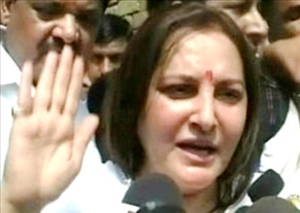
Jaya Prada threatens to slap journalist

March 13, 2013

Jaya_Prada_slaps_journalist

Lucknow, Mar 12: Expelled Samajwadi Party (SP) Lok Sabha member Jaya Prada, it appears, has learnt from West Bengal Chief Minister Mamata Banerjee on how to deal with prying journalists.

Following in Mamata's footsteps, Jaya Prada also threatened to slap a journalist.

Jaya Prada, a Lok Sabha member from Uttar Pradesh's Rampur constituency, was speaking to reporters at Deoria, about 325 km from here, on Tuesday when she suddenly lost her cool and threatened a local scribe.

“Ek lafa doongi abhi” (I will give you a slap), the MP threatened the scribe, apparently irked over persistent queries about her return to the SP. “Tumko buddhi hai ya nahin...galat baat mat karo...mujhe party se nikal diya hai” (Do you have any sense?...Don't talk rubbish..I have been expelled from the party), she shouted at the top of her voice when asked if she would consider returning to the SP.

The actor-turned-politician threatened to slap the scribe when he persisted with the question. She, however, earlier termed SP supremo Mulayam Singh Yadav her father and UP Chief Minister Akhilesh Yadav her brother.

Jaya Prada had been expelled from the SP along with former party general secretary Amar Singh. After their expulsion, the duo had floated Lok Manch, which had put up candidates in the last year's Assembly polls in the state.

It, however, could not win any seat. There were unconfirmed reports that Jaya Prada was looking to join the BJP .

The MP had come to Deoria to meet the wife of the slain Uttar Pradesh Deputy Superintendent of Police Zia-ul-Haq and offer her condolences to her.

Comments

Add new comment

  • Coastaldigest.com reserves the right to delete or block any comments.
  • Coastaldigset.com is not responsible for its readers’ comments.
  • Comments that are abusive, incendiary or irrelevant are strictly prohibited.
  • Please use a genuine email ID and provide your name to avoid reject.
Agencies
March 16,2020

While Google is still working on a coronavirus screening and tracking website, Microsoft Bing team has already launched a web portal for tracking COVID-19 infections worldwide.

The website, accessible at bing.com/covid, provides up-to-date infection statistics for each country.

The COVID-19 Tracker currently lists 168,835 as total confirmed cases, 84,558 active cases, 77,761 recovered cases and 6,516 deaths.

There are at least 3,244 confirmed cases of novel coronavirus in the US and at least 61 deaths.

"Lots of Bing folks worked (from home) this past week to create a mapping and authoritative news resource for COVID19 info," Michael Schechter, General Manager for Bing Growth and Distribution at Microsoft, was quoted as saying in a ZDNet report on Sunday.

An interactive map allows site visitors to click on the country to see the specific number of cases and related articles from a variety of publishers.

Data is being aggregated from sources like the World Health Organization (WHO), the US Centers for Disease Control and Prevention (CDC), and the European Centre for Disease Prevention and Control (ECDC).

Microsoft announced the website two days after US President Donald Trump said Google has begun working on COVID-19-related portal for US citizens.

Google's website is being built by Verily, a subsidiary of Alphabet focused on healthcare services.

"More than 1,700 engineers are currently working on the site", Trump said during a press briefing last week.

The tool will triage people who are concerned about their COVID-19 risk into testing sites based on guidance from public health officials and test availability.

Initially, there was some confusion on Google's coronavirus portal but the company later announced that it is "partnering with the US Government in developing a nationwide website that includes information about COVID-19 symptoms, risk, and testing information."

Comments

Add new comment

  • Coastaldigest.com reserves the right to delete or block any comments.
  • Coastaldigset.com is not responsible for its readers’ comments.
  • Comments that are abusive, incendiary or irrelevant are strictly prohibited.
  • Please use a genuine email ID and provide your name to avoid reject.
News Network
April 17,2020

Paris, Apr 17: Even as virologists zero in on the virus that causes COVID-19, a very basic question remains unanswered: do those who recover from the disease have immunity?

There is no clear answer to this question, experts say, even if many have assumed that contracting the potentially deadly disease confers immunity, at least for a while.

"Being immunised means that you have developed an immune response against a virus such that you can repulse it," explained Eric Vivier, a professor of immunology in the public hospital system in Marseilles.

"Our immune systems remember, which normally prevents you from being infected by the same virus later on."

For some viral diseases such a measles, overcoming the sickness confers immunity for life.

But for RNA-based viruses such as Sars-Cov-2 -- the scientific name for the bug that causes the COVID-19 disease -- it takes about three weeks to build up a sufficient quantity of antibodies, and even then they may provide protection for only a few months, Vivier told AFP.

At least that is the theory. In reality, the new coronavirus has thrown up one surprise after another, to the point where virologists and epidemiologists are sure of very little.

"We do not have the answers to that -- it's an unknown," Michael Ryan, executive director of the World Health Organization's Emergencies Programme said in a press conference this week when asked how long a recovered COVID-19 patient would have immunity.

"We would expect that to be a reasonable period of protection, but it is very difficult to say with a new virus -- we can only extrapolate from other coronaviruses, and even that data is quite limited."

For SARS, which killed about 800 people across the world in 2002 and 2003, recovered patients remained protected "for about three years, on average," Francois Balloux director of the Genetics Institute at University College London, said.

"One can certainly get reinfected, but after how much time? We'll only know retroactively."

A recent study from China that has not gone through peer review reported on rhesus monkeys that recovered from Sars-Cov-2 and did not get reinfected when exposed once again to the virus.

"But that doesn't really reveal anything," said Pasteur Institute researcher Frederic Tangy, noting that the experiment unfolded over only a month.

Indeed,several cases from South Korea -- one of the first countries hit by the new coronavirus -- found that patients who recovered from COVID-19 later tested positive for the virus.

But there are several ways to explain that outcome, scientists cautioned.

While it is not impossible that these individuals became infected a second time, there is little evidence this is what happened.

More likely, said Balloux, is that the virus never completely disappeared in the first place and remains -- dormant and asymptomatic -- as a "chronic infection", like herpes.

As tests for live virus and antibodies have not yet been perfected, it is also possible that these patients at some point tested "false negative" when in fact they had not rid themselves of the pathogen.

"That suggests that people remain infected for a long time -- several weeks," Balloux added. "That is not ideal."

Another pre-publication study that looked at 175 recovered patients in Shanghai showed different concentrations of protective antibodies 10 to 15 days after the onset of symptoms.

"But whether that antibody response actually means immunity is a separate question," commented Maria Van Kerhove, Technical Lead of the WHO Emergencies Programme.

"That's something we really need to better understand -- what does that antibody response look like in terms of immunity."

Indeed, a host of questions remain.

"We are at the stage of asking whether someone who has overcome COVID-19 is really that protected," said Jean-Francois Delfraissy, president of France's official science advisory board.

For Tangy, an even grimmer reality cannot be excluded.

"It is possible that the antibodies that someone develops against the virus could actually increase the risk of the disease becoming worse," he said, noting that the most serious symptoms come later, after the patient had formed antibodies.

For the moment, it is also unclear whose antibodies are more potent in beating back the disease: someone who nearly died, or someone with only light symptoms or even no symptoms at all. And does age make a difference?

Faced with all these uncertainties, some experts have doubts about the wisdom of persuing a "herd immunity" strategy such that the virus -- unable to find new victims -- peters out by itself when a majority of the population is immune.

"The only real solution for now is a vaccine," Archie Clements, a professor at Curtin University in Perth Australia, told AFP.

At the same time, laboratories are developing a slew of antibody tests to see what proportion of the population in different countries and regions have been contaminated.

Such an approach has been favoured in Britain and Finland, while in Germany some experts have floated the idea of an "immunity passport" that would allow people to go back to work.

"It's too premature at this point," said Saad Omer, a professor of infectious diseases at the Yale School of Medicine.

"We should be able to get clearer data very quickly -- in a couple of months -- when there will be reliable antibody tests with sensitivity and specificity."

One concern is "false positives" caused by the tests detecting antibodies unrelated to COVID-19.

The idea of immunity passports or certificates also raises ethical questions, researchers say.

"People who absolutely need to work -- to feed their families, for example -- could try to get infected," Balloux.


Comments

Add new comment

  • Coastaldigest.com reserves the right to delete or block any comments.
  • Coastaldigset.com is not responsible for its readers’ comments.
  • Comments that are abusive, incendiary or irrelevant are strictly prohibited.
  • Please use a genuine email ID and provide your name to avoid reject.
Agencies
July 2,2020

Leiden, Jul 2: Astronomers have discovered a luminous galaxy caught in the act of reionizing its surrounding gas only 800 million years after the Big Bang.

The research, led by Romain Meyer, PhD student at UCL in London, UK, has been presented at the virtual annual meeting of the European Astronomical Society (EAS).

Studying the first galaxies that formed 13 billion years ago is essential to understanding our cosmic origins. One of the current hot topics in extragalactic astronomy is 'cosmic reionization,' the process in which the intergalactic gas was ionized (atoms stripped of their electrons).

Cosmic reionization is similar to an unsolved murder: We have clear evidence for it, but who did it, how and when? We now have strong evidence that hydrogen reionization was completed about 13 billion years ago, in the first billion years of the universe, with bubbles of ionized gas slowly growing and overlapping.

The objects capable of creating such ionized hydrogen bubbles have however remained mysterious until now: the discovery of a luminous galaxy in which 60-100 percent of ionizing photons escape, is likely responsible for ionizing its local bubble. This suggests the case is closer to being solved.

The two main suspects for cosmic reionization are usually 1) a population of numerous faint galaxies leaking ~10 percent of their energetic photons, and 2) an 'oligarchy' of luminous galaxies with a much larger percentage (>50 percent) of photons escaping each galaxy.

In either case, these first galaxies were very different from those today: galaxies in the local universe are very inefficient leakers, with only <2-3 percent of ionizing photons escaping their host. To understand which galaxies governed cosmic reionization, astronomers must measure the so-called escape fractions of galaxies in the reionization era.

The detection of light from excited hydrogen atoms (the so-called Lyman-alpha line) can be used to infer the fraction of escaping photons. On the one hand, such detections are rare because reionization-era galaxies are surrounded by neutral gas which absorbs that signature hydrogen emission.

On the other hand, if this hydrogen signal is detected it represents a 'smoking gun' for a large ionized bubble, meaning we have caught a galaxy reionizing its surroundings. The size of the bubble and the galaxy's luminosity determines whether it is solely responsible for creating this ionized bubble or if unseen accomplices are necessary.

The discovery of a luminous galaxy 800 million years after the Big Bang supports the scenario where an 'oligarchy' of bright leakers emits most of the ionizing photons.

"It is the first time we can point to an object responsible for creating an ionized bubble, without the need for a contribution from unseen galaxies.

Additional observations with the upcoming James Webb Space Telescope will enable us to study further what is likely one of the best suspects for the unsolved case of cosmic reionization," said Meyer.

Comments

Add new comment

  • Coastaldigest.com reserves the right to delete or block any comments.
  • Coastaldigset.com is not responsible for its readers’ comments.
  • Comments that are abusive, incendiary or irrelevant are strictly prohibited.
  • Please use a genuine email ID and provide your name to avoid reject.