



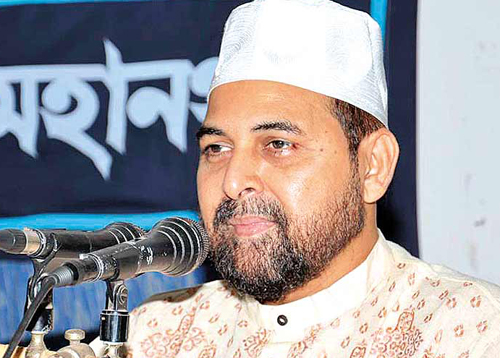
People Respect Sayedee, So They're Protesting The Verdict'- interview with Bangla Jamaat-e-Islami leader

[email protected] (Pranay Sharma, Outlook)
March 14, 2013
The Jamaat-e-Islami is said to be the cause of the present instability in Bangladesh. Many of its leaders are now being tried for alleged crimes committed during the liberation struggle of 1971. There is also a growing mood in the country to isolate and ban the Jamaat. The acting secretary-general of Bangladesh Jam­aat-e-Islami (BJI), Rafiqul Islam Khan, spoke to Pranay Sharma about the current situation, the organisation and what lies in the coming days.
rafiqul_islam_khan

Much of this violence is being attributed to the Jamaat-e-Islami. Is that correct?

The violence is being attributed to Jamaat-e-Islami without any justification. BJI is a lawful political party with representation in Parliament. For the last three years, BJI has not being given permission to organize peaceful meetings and protests. All its party offices are controlled by the security forces. Nobody is allowed to go into the party office without the consent of police. Party leaders and activists are being indiscriminately arrested. Every time the BJI has organized a peaceful protest, the police have fired upon the unarmed and peaceful protestors. It is the police that are causing the violence.

Do you respect the verdict of the International Crimes Tribunal (ICT) against the accused BJI leaders?

The ICT proceedings are totally flawed. This is not only my opinion but that of the international community as well. Human Rights Watch, Amnesty International, International Bar Association and a number of others have expressed such views. Even the former attorney general of India has opined that the Act under which the ICT operates is 'ultra virus” to the Constitution of Bangladesh. Many of them have asked for a retrial following the resignation of some of the judges of the Tribunal and appointment of new members in it. Therefore, the ICT has lost all credibility. Even though our attempt for a retrial was rejected we will still go for an appeal to the Supreme Court against the verdict.

Jamaat-e-Islami had opposed the break-up of Pakistan and was against the creation of Bangladesh. When you look back do you regret having taken that stand?

Jamaat-e-Islami had politically opposed the breakup of Pakistan in the same way the Indian National Congress had opposed the division of India in 1947. It was a political act by BJI. The leadership of BJI was in no way involved with the war crimes or “crimes against humanity” as alleged or otherwise.

Many people see the Jamaat-e-Islami as a subversive and religious fundamentalist force and feel that it has no place in a democracy like Bangladesh. How do you react to that?

Jamaat-e-Islami is a democratic political party with Islamic values as its ideals. It wants to establish social, economic and political justice. It is the only political party in Bangladesh which practices intra-party democracy. Its Ameer (head) is elected every four years and its district committee members are elected every two years. BJI believes in constitutionalism and rule of law. It has participated in all the elections in Bangladesh since 1979 and has representations in all parliaments since then.

What are the chances of the Jamaat-e-Islami being banned as an organization? How will you react if that does happen?

In the event BJI is banned as a political party, we will challenge the ban before the High Court and thereafter in the Supreme Court of Bangladesh. We will act in a dignified and in a Constitutional manner.

What has been the impact of BJI in Bangladesh so far and what fundamental changes have you brought in the country?

Corruption is endemic in Bangladesh and it hinders Bangladesh's growth and prosperity. Even the arch enemy of BJI praises its leadership for being honest. The two ministers of the BJI in the last BNP-BJI coalition government had earned the reputation of being competent and un-corrupt.

Why are your relations with the Awami League so hostile? You did work with each other in past, why has it become so hostile now?

During the democratic movement in the '80s, and the movement for incorporating the care taker Government in the Constitution, in the mid 90s, BJI and Awami League had fought hand in hand. Awami League has turned against BJI only because of its partnership with Bangladesh Nationalist Party. This Partnership is perceived by Awami League as a threat that can stop it from coming to power.

How are your relations with the US which has been waging a global war on terror against many Islamic organizations and other European countries?

Our relationship with the countries of the European Union and United States is a cordial one. Our representatives are regular visitors to the UK & USA. We are also in contact with the civil society of these two countries. Occasionally we also send our representatives to visit other European Countries as well.

You did enjoy close relations with Pakistan at one time, how are your relations now?

BJI believes in friendly relationship with all the countries.

The Jamaat-e-Islami is seen in India as an anti-Indian force which is committed to spreading hatred and anti-Indian feelings among the people of Bangladesh. Shouldn't India be worried about the Jamaat in Bangladesh?

India is a big country and a neighbour. You cannot change your neighbour and you should not ignore your neighbour. BJI always wants friendly relationship with India on the basis of mutual respect and trust. This trust can only be built if the outstanding problems between the two countries namely: exchange of territories, water sharing, border trade, International trade etc are solved fairly and justly. BJI would be very happy to engage with Indian establishment and Indian civil society.

Could you explain why among others, Hindus are being targeted by the Jamaat cadres?

It is a travesty of truth to say that Hindus are being targeted by BJI members. It is quite the contrary. In time of need, BJI has always stood by its Hindu brothers and sisters who are respectable citizens of Bangladesh. BJI in its recent statement has condemned the attack on Hindus and in their temples. It has asked its work force to protect the life and property of Hindus and all other religious and ethnic minorities.

What kind of relations do you see with India in future?

Good, friendly, working and neighbourly relationship.

Comments

Add new comment

  • Coastaldigest.com reserves the right to delete or block any comments.
  • Coastaldigset.com is not responsible for its readers’ comments.
  • Comments that are abusive, incendiary or irrelevant are strictly prohibited.
  • Please use a genuine email ID and provide your name to avoid reject.
Agencies
February 27,2020

Feb 27: With the window to submit comments on India's proposed personal data protection law closing on Tuesday, a period of anxious wait for final version of the Bill started for social media firms.

This comes even as global Internet companies have called on the government for improved transparency related to intermediary Guidelines (Amendment) Rules and allay fears about the prospect of increased surveillance and prompting a fragmentation of the Internet in India that would harm users.

As per the proposed amendments, an intermediary having over 50 lakh users in the country will have to be incorporated in India with a permanent registered office and address.

When required by lawful order, the intermediary shall, within 72 hours of communication, provide such information or assistance as asked for by any government agency or assistance concerning security of the state or cybersecurity.

This means that the government could pull down information provided by platforms such as Wikipedia, potentially hampering its functioning in India.

In the open letter to IT Minister Ravi Shankar Prasad, leading browser and software development platform like Mozilla, Microsoft-owned GitHub and Cloudflare earlier called for improved transparency by allowing the public an opportunity to see a final version of these amendments prior to their enactment.

According to a Business Insider report, Indian users may lose access to Wikipedia if the new intermediary rules for internet and social media companies are approved.

Since the rules would require the website to take down content deemed illegal by the government, it would require Wikipedia to show different content for different countries.

Anusha Alikhan, senior communications director for Wikimedia told Business Insider that the platform is built though languages and not geographies. Therefore, removing content from one country, while it is still visible to other country users may not work for the company’s model.

India is one of Wikipedia’s largest markets. Over 771 million Indian users accessed the site in just November 2019.

Also read: Explained: What is the Personal Data Protection Bill and why you should care

The Personal Data Protection Bill, 2019, which was introduced in Lok Sabha in the winter session last year, was referred to a Joint Parliamentary Committee (JPC) of both the Houses.

The government last month decided to seek views and suggestions on the Bill from individuals and associations and bodies concerned and the last date for submitting the comments was on Tuesday.

Prasad, while introducing the Personal Data Protection Bill, 2019, in the Lok Sabha on December 11, announced that the draft Bill empowers the government to ask companies including Facebook, Google and others for anonymised personal data and non-personal data.

There was a buzz when the Bill's latest version was introduced in the Lok Sabha, especially the provision seeking to allow the use of personal and non-personal data of users in some cases, especially when national security is involved.

Several legal experts red-flagged the issue and said the provision will give the government unaccounted access to personal data of users in the country.

In their submission to the JPC, several organisations also flagged that the power to collect non-personal and anonymised data by the government without notice and consent should not form part of the Bill because of issues regarding effective anonymisation and potential abuse.

"Clauses 35 and 36 of the Bill provide unbridled access to personal data to the Central Government by giving it powers to exempt its agencies from the application of the Bill on the basis of various broad worded grounds," SFLC.in, a New Delhi-based not-for-profit legal services organisation, commented.

The Software Alliance, also known as BSA, a trade group which includes tech giants such as Microsoft, IBM and Adobe, among others said that the current version of the privacy bill pose substantial challenges, including the sweeping new powers for the government to acquire non-personal data, restrictions on data transfers, and local storage requirements.

"We urge the Joint Parliamentary Committee, as it considers revisions to the Bill, to eliminate provisions concerning non-personal data from the Personal Data Protection Bill and to remove the data localisation requirements and restrictions on international data flows," said Venkatesh Krishnamoorthy, Country Manager-India, BSA.

The Personal Data Protection (PDP) Bill, 2019 draws its origins from the Justice B.N. Srikrishna Committee on data privacy, which produced a draft of legislation that was made public in 2018 ("the Srikrishna Bill").

The mandatory requirement for storing a mirror copy of all personal data in India as per Section 40 of the Srikrishna Bill has been done away with in the PDP Bill, 2019, meaning that companies like Facebook and Twitter would be able to store data of Indian users abroad if they so wish.

But the bill prohibits processing of sensitive personal data and critical personal data outside India.

What is more, what constitutes critical data has not been clearly defined.

As per the proposals, social media companies will have to modify their application as they are required to have a system in place by which a user can verify themselves.

So legal experts believe that some system to upload identification documents should be there and something like the Twitter blue tick mark should be there to identify verified accounts.

"The 2019 Bill introduces a new category of data fiduciaries called social media intermediaries ('SMIs'). SMIs are a subcategory of significant data fiduciaries ('SDFs') and will be notified by the Central government after due consultation with the DPA, or the Data Protection Authority. Clause 26(4) of the Bill defines SMIs as intermediaries who primarily or solely enable online interaction between two or more users," SFLC.in said.

"On a plain reading of the definition, online platforms like Facebook, Twitter, YouTube, TikTok, ShareChat and WhatsApp are likely to be notified as SMIs under the Bill," it added.

Comments

Add new comment

  • Coastaldigest.com reserves the right to delete or block any comments.
  • Coastaldigset.com is not responsible for its readers’ comments.
  • Comments that are abusive, incendiary or irrelevant are strictly prohibited.
  • Please use a genuine email ID and provide your name to avoid reject.
Agencies
May 30,2020

The GST Council is unlikely to make major changes in the indirect tax structure at its next meeting slated mid June.

A top government source said that the Centre is not in favour of increasing tax rates on any goods or service as it could further impact consumption and demand that is already suppressed due the COVID-19 pandemic and lockdown.

It was widely expected that the GST Council could consider raising tax rates and cess on certain non-essential items to boost revenue for states and the Centre. Several states have reportedly taken an over 80-90 per cent hit in GST collections in April, the official data for which has not yet been released by the Centre.

"The need of the hour is to boost consumption and improve demand. By categorising items into essential and non-essential and then raising taxes on non-essential is not what Centre favours. But, the issue on rates and relief will be decided by the GST Council that is meeting next month," the finance ministry official source quoted above said.

The GST Council is chaired by the Union finance minister and thus the views of the Centre play out strongly in the council meetings.

However, the Council will also have to balance the expectations of the states whose revenues have nosedived after the coronavirus outbreak and wide scale disruption to businesses while they have still not been paid GST compensation since the December-January period.

To the question of wider scale job losses in the period of lockdown as businesses get widely impacted, the official said that the Finance Ministry has asked the labour ministry to collect data on job losses during Covid-19 and is constantly engaging with the ministry to oversee job losses and salary cuts.

On restrictions put on Chinese investment in India, the official clarified that no decision had yet been taken to restrict China through the Foreign Portfolio Investment (FPI) route.

Asked about monetising government debt, the official said that the issue would be looked at when we reach a stage. It has not come to that stage yet.

In the government's over Rs 20 lakh crore economic package, the official defended its structure while suggesting that comparisons with the economic packages of other countries should not be drawn as India's needs were different from others.

"We have gone in more reforms that is needed to give strength to the economy. This is required more in our country," the official source said.

Comments

Add new comment

  • Coastaldigest.com reserves the right to delete or block any comments.
  • Coastaldigset.com is not responsible for its readers’ comments.
  • Comments that are abusive, incendiary or irrelevant are strictly prohibited.
  • Please use a genuine email ID and provide your name to avoid reject.
Agencies
February 23,2020

Google has indexed invite links to private WhatsApp group chats, meaning anyone can join various private chat groups (including several porn-sharing groups) with a simple search.

According to a report in Motherboard, invitations to WhatsApp group chats were being indexed by Google.

The team found private groups using specific Google searches and even joined a group intended for NGOs accredited by the UN and had access to all the participants and their phone numbers.

Journalist Jordan Wildon said on Twitter that he discovered that WhatsApp's "Invite to Group Link" feature lets Google index groups, making them available across the internet since the links are being shared outside of WhatsApp's secure private messaging service.

"Your WhatsApp groups may not be as secure as you think they are," Wildon tweeted on Friday, adding that using particular Google searches, people can discover links to the chats.

According to app reverse-engineer Jane Wong, Google has around 470,000 results for a simple search of "chat.whatsapp.com", part of the URL that makes up invites to WhatsApp groups.

WhatsApp spokesperson Alison Bonny said: "Like all content that is shared in searchable public channels, invite links that are posted publicly on the internet can be found by other WhatsApp users."

"The links that users wish to share privately with people they know and trust should not be posted on a publicly accessible website," Bonny told The Verge.

Danny Sullivan, Google's public search liaison, tweeted: "Search engines like Google & others list pages from the open web. That's what's happening here. It's no different than any case where a site allows URLs to be publicly listed. We do offer tools allowing sites to block content being listed in our results."

Comments

Add new comment

  • Coastaldigest.com reserves the right to delete or block any comments.
  • Coastaldigset.com is not responsible for its readers’ comments.
  • Comments that are abusive, incendiary or irrelevant are strictly prohibited.
  • Please use a genuine email ID and provide your name to avoid reject.