



A transplant that won a Pakistani heart

[email protected] (The Hindu)
May 24, 2013

Chennai, May 24: When Moulana Mohammed Zubair Ashmi's heart grew large, literally, and failed him, it was another large heart that replaced it. If hearts have nationalities, then the first was Pakistani, and the second, Indian.

The 51-year-old Pakistani religious teacher was diagnosed with a condition calleddilated cardiomyopathy' where the heart is enlarged, becomes weakened and is unable to function well. Doctors had told him that his only option was a heart transplant.

“There is no facility for a transplant back home,” he says over video, still not completely up to hobnobbing with media persons. His folks did a search and contacted K.R.Balakrishnan, director, Cardiac Sciences, Fortis Malar Hospital, here.
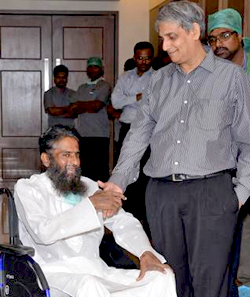
Pakistani_heartHe was critically ill even as he was flown to Chennai via Dubai from Lahore.To make matters worse, he was Hepatitis C positive.

Though he spent about two months in the ICU at the hospital, Ashmi's condition continued to deteriorate. Doctors had to find a donor heart for him or put him on an artificial implant device. It turns out a donor became available in March. The family of a 37-year-old man who had met with a road accident and been declared brain dead, came forward to donate the organs.

“Even if there had been a delay of two days, we would have lost him,” says Suresh Rao, chief, Cardiac Anaesthesia and Critical Care, Fortis Malar. He goes on to explain that though the donor and recipient were of two different blood groups, the tissue mapping showed a good and viable match.

Pre- and post-transplant, Ashmi's Hepatitis C viral load had to be brought down, the kidney damage managed, and immuno suppressant therapy had to be modified to suit the patient, Dr. Rao explains.

Traditional immuno suppressants affect the liver, and with an existing hepatitis C infection, extra care had to be paid to that, Dr. Balakrishnan adds.

“It is good government policy in Tamil Nadu that has facilitated a man from Pakistan to get a heart from Chennai. Goes to show that good policies have a major impact on promoting good health, not only locally, but globally too,” he says, further.

Maulana Ashmi is weak, but has gone back to talking at length. He would like to go home, to his family (his wife could not accompany him as she was denied a visa) and back to teaching in his mosque.

Comments

Add new comment

  • Coastaldigest.com reserves the right to delete or block any comments.
  • Coastaldigset.com is not responsible for its readers’ comments.
  • Comments that are abusive, incendiary or irrelevant are strictly prohibited.
  • Please use a genuine email ID and provide your name to avoid reject.
Agencies
June 7,2020

New Delhi, Jun 7: The Government of India (GoI) must strengthen the laws to protect animals, said People for the Ethical Treatment of Animals (PETA) India CEO Dr Manilal Valliyate on Sunday, following an elephant's death in Kerala and cow injured due to ingestion of explosives in Himachal Pradesh.

"Such incidents are not just restricted to certain regions but are happening all across the country. PETA receives more than 100 similar cases every day. People send in their complaints to us, not just for cows and elephants but for so many other animals as well," he said.

The PETA chief urged the GoI to strengthen the laws established to protect animals.

"As per the current laws set out against animal cruelty, the perpetrator would only be charged Rs 50,000 as a fine. That is equivalent to no punishment at all," added PETA India CEO.

He expressed his anguish against municipal agencies as well, saying that they are not doing "serious" work. He also highlighted how cows are left on the roads to wander, after milking them, to feed on garbage, in several parts of the country.

"These injustices against animals through explosives has been going on for quite a while. But for the first time, it has received such public attention," he said.

After a pregnant elephant was fed cracker-filled pineapple and her eventual death on May 27 in Kerala's Palakkad district, a pregnant cow sustained fatal injuries on May 25 due to accidental ingestion of explosives in Dadh village of Bilaspur district of Himachal Pradesh.

One person has been arrested in the Dadh village for allegedly hurting the cow.

Comments

Add new comment

  • Coastaldigest.com reserves the right to delete or block any comments.
  • Coastaldigset.com is not responsible for its readers’ comments.
  • Comments that are abusive, incendiary or irrelevant are strictly prohibited.
  • Please use a genuine email ID and provide your name to avoid reject.
Agencies
May 10,2020

In the wake of the gas leak at a factory in Visakhapatnam, the National Disaster Management Authority (NDMA) has issued detailed guidelines for restarting industries after the lockdown and the precautions to be taken for the safety of the plants as well as the workers.

In a communication to all states and union territories, the NDMA said due to several weeks of lockdown and the closure of industrial units, it is possible that some of the operators might not have followed the established standard operating procedures.

As a result, some of the manufacturing facilities, pipelines, valves may have residual chemicals, which may pose risk. The same is true for the storage facilities with hazardous chemicals and flammable materials, it said.

The NDMA guidelines said while restarting a unit, the first week should be considered as the trial or test run period after ensuring all safety protocols.

Companies should not try to achieve high production targets. There should be 24-hour sanitisation of the factory premises, it said.

The factories need to maintain a sanitisation routine every two-three hours especially in the common areas that include lunch rooms and common tables which will have to be wiped clean with disinfectants after every single use, it added.

For accommodation, the NDMA said, sanitisation needs to be performed regularly to ensure worker safety and reduce the spread of contamination.

To minimise the risk, it is important that employees who work on specific equipment are sensitised and made aware of the need to identify abnormalities like strange sounds or smell, exposed wires, vibrations, leaks, smoke, abnormal wobbling, irregular grinding or other potentially hazardous signs which indicate the need for immediate maintenance or if required shutdown, it said.

At least 11 people lost their lives and about 1,000 others were exposed to a gas leak at a factory in Andhra Pradesh''s Visakhapatnam on May 7.

The incident took place after it restarted operations when the government allowed industrial activities in certain sectors following several weeks of lockdown.

The lockdown was first announced by Prime Minister Narendra Modi on March 24 for 21 days in a bid to combat the coronavirus threat. The lockdown was then extended till May 3 and again till May 17.

Comments

Add new comment

  • Coastaldigest.com reserves the right to delete or block any comments.
  • Coastaldigset.com is not responsible for its readers’ comments.
  • Comments that are abusive, incendiary or irrelevant are strictly prohibited.
  • Please use a genuine email ID and provide your name to avoid reject.
Agencies
June 24,2020

New Delhi, Jun 24: The Centre has made it mandatory for sellers to enter the 'Country of Origin' while registering all new products on government e-marketplace (GeM).

The e-marketplace is a special purpose vehicle (SPV) under the Ministry of Commerce and Industry which facilitates the entry of small local sellers in public procurement, while implementing 'Make in India' and MSE Purchase Preference Policies of the Centre.

Accordingly, the ministry said the move has been made to promote 'Make in India' and 'Atma Nirbhar Bharat'.

The provision has been enabled via the introduction of new features on GeM.

Besides the registration process, the new feature also reminds sellers who have already uploaded their products, to disclose their products' 'Country of Origin' details.

The ministry further said that failing to disclose the detail will lead to removal of the products from the e-marketplace.

"GeM has taken this significant step to promote 'Make in India' and 'Aatmanirbhar Bharat'," the ministry said in a statement.

"GeM has also enabled a provision for indication of the percentage of local content in products. With this new feature, now, the 'Country of Origin' as well as the local content percentage are visible in the marketplace for all items. More importantly, the 'Make in India' filter has now been enabled on the portal. Buyers can choose to buy only those products that meet the minimum 50 per cent local content criteria."

In case of bids, the ministry said that buyers can now reserve any bid for a "Class I Local suppliers. For those bids below Rs 200 crore, only Class I and Class II Local Suppliers are eligible to bid, with Class I supplier getting purchase preference".

In addition to this, the Department for Promotion of Industry and Internal Trade (DPIIT) has reportedly called for a meeting with all e-commerce companies such as Amazon and Flipkart to display the country of origin on the products sold on their platform, as well as the extent of value added in India.

Comments

Add new comment

  • Coastaldigest.com reserves the right to delete or block any comments.
  • Coastaldigset.com is not responsible for its readers’ comments.
  • Comments that are abusive, incendiary or irrelevant are strictly prohibited.
  • Please use a genuine email ID and provide your name to avoid reject.