



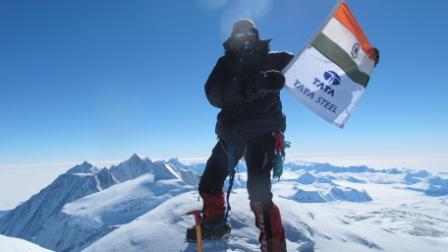
Premlata first Indian woman to climb 7 peaks

June 1, 2013

Premlata

New Delhi, Jun 1: Ace woman mountaineer Premlata Agrawal has become the first Indian woman mountaineer to scale the seven continental peaks after climbing Alaska's McKinley Peak.

With this, she became the first Indian woman mountaineer to step on the highest peak of North America. She was felicitated for this momentous achievement on her return to India, here in the capital today.

On each of the seven continents, there is one peak that stands above the rest.

The Seven Summits present different challenges that have to be overcome with extreme and testing fortitude. Summiting all of them is regarded as one of the world's biggest mountaineering challenge.

Seven Summits has become the dream of many climbers, but only a select few have succeeded. Premlata now proudly belongs to this group.

"I am extremely proud to have accomplished this achievement on behalf of my country and all the women who live here with courage and determination. This experience has again taught me that if you have the will and focus, no matter where you come from, you can conquer the world," Premlata said.

The unassuming housewife worked towards her passion for heights starting at the age of 35 when she undertook the Dalma (hill) trek 13 years ago.

That was the starting point that led to the now famous Thar Camel Expedition, the ascent of Mt Kilimanjaro before setting foot on the world's highest peak, Mt Everest, on May 20.

Just before Premlata embarked on the ascent of McKinley Peak to cap off her seven continental peaks' successful climbs, the Government of India awarded her The Padmashree Honor for her trail-blazing achievements.

"Even when foul weather thwarted my initial attempt of planting my National Flag atop Mt Denali, my determination to climb this peak did not fizzle out; instead, it re-bolstered my will to start anew and ascend Denali," she said.

"What egged me on in overcoming the toughest of obstacles during my ascents was the fire covering my spirit to achieve in the form of our Tricolour wrapped around me, which, I have planted atop each of the seven Continental Peaks with the pride of being an Indian woman," she added.

Comments

Add new comment

  • Coastaldigest.com reserves the right to delete or block any comments.
  • Coastaldigset.com is not responsible for its readers’ comments.
  • Comments that are abusive, incendiary or irrelevant are strictly prohibited.
  • Please use a genuine email ID and provide your name to avoid reject.
Agencies
June 8,2020

Washington DC, Jun 8: Astronomers acting on a hunch have likely resolved a mystery about young, still-forming stars and regions rich in organic molecules closely surrounding some of them.

They used the National Science Foundation's Karl G Jansky Very Large Array (VLA) to reveal one such region that previously had eluded detection and that revelation answered a longstanding question.

The regions around the young protostars contain complex organic molecules which can further combine into prebiotic molecules that are the first steps on the road to life.

The regions, dubbed "hot corinos" by astronomers, are typically about the size of our solar system and are much warmer than their surroundings, though still quite cold by terrestrial standards.

The first hot corino was discovered in 2003 and only about a dozen have been found so far. Most of these are in binary systems, with two protostars forming simultaneously.

Astronomers have been puzzled by the fact that, in some of these binary systems, they found evidence for a hot corino around one of the protostars but not the other.

"Since the two stars are forming from the same molecular cloud and at the same time, it seemed strange that one would be surrounded by a dense region of complex organic molecules and the other wouldn't," said Cecilia Ceccarelli, of the Institute for Planetary Sciences and Astrophysics at the University of Grenoble (IPAG) in France.

The complex organic molecules were found by detecting specific radio frequencies, called spectral lines, emitted by the molecules. Those characteristic radio frequencies serve as "fingerprints" to identify the chemicals.

The astronomers noted that all the chemicals found in hot corinos had been found by detecting these "fingerprints" at radio frequencies corresponding to wavelengths of only a few millimetres.

"We know that dust blocks those wavelengths, so we decided to look for evidence of these chemicals at longer wavelengths that can easily pass through dust," said Claire Chandler of the National Radio Astronomy Observatory, and principal investigator on the project.

"It struck us that dust might be what was preventing us from detecting the molecules in one of the twin protostars," added Chandler.

The astronomers used the VLA to observe a pair of protostars called IRAS 4A, in a star-forming region about 1,000 light-years from Earth. They observed the pair at wavelengths of centimetres.

At those wavelengths, they sought radio emissions from methanol, CH3OH (wood alcohol, not for drinking). This was a pair in which one protostar clearly had a hot corino and the other did not, as seen using the much shorter wavelengths.

The result confirmed their hunch. "With the VLA, both protostars showed strong evidence of methanol surrounding them. This means that both protostars have hot corinos. The reason we did not see the one at shorter wavelengths was because of dust," said Marta de Simone, a graduate student at IPAG who led the data analysis for this object.

The astronomers cautioned that while both hot corinos now are known to contain methanol, there still may be some chemical differences between them. That, they said, can be settled by looking for other molecules at wavelengths not obscured by dust.

"This result tells us that using centimetre radio wavelengths is necessary to properly study hot corinos," Claudio Codella of Arcetri Astrophysical Observatory in Florence, Italy, said.

"In the future, planned new telescopes such as the next-generation VLA and SKA, will be very important to understanding these objects," added Codella.

Comments

Add new comment

  • Coastaldigest.com reserves the right to delete or block any comments.
  • Coastaldigset.com is not responsible for its readers’ comments.
  • Comments that are abusive, incendiary or irrelevant are strictly prohibited.
  • Please use a genuine email ID and provide your name to avoid reject.
Agencies
January 19,2020

New Delhi, Jan 19: Messaging service WhatsApp which on Sunday faced issues in transmitting multimedia content including pictures and images, prompting social media users to share hilarious memes and messages, resumed regular services after over two hours.

#WhatsAppDown was the trending hashtag on Twitter for most part of Sunday afternoon in India along with several other countries such as Brazil, Europe and also parts of Middle-East including UAE, reported downdetector.in, a realtime problem and outage monitoring website.

Users of the popular messaging app were unable to send media files, stickers and GIFs.

Most users immediately went to Twitter to find out about the problem and check if others were facing the same issue.

Numerous tweets and memes took over the internet as soon as the news broke about the WhatsApp tech issue. After around two hours of technical glitch, the app resumed full service.

Even after full recovery of media transfer, people globally still continued checking the status of the messaging app.

WhatsApp has been one of the prime messaging apps since May 2009 and has recently collaborated with Facebook.

Comments

Add new comment

  • Coastaldigest.com reserves the right to delete or block any comments.
  • Coastaldigset.com is not responsible for its readers’ comments.
  • Comments that are abusive, incendiary or irrelevant are strictly prohibited.
  • Please use a genuine email ID and provide your name to avoid reject.
Agencies
March 18,2020

Thiruvananthapuram, Mar 18: To raise awareness about protective measures against coronavirus, Kerala Police released a dance video on the State Police Media Centre's Facebook page promoting the washing of hands, here on Tuesday.

In the video, the police officers were seen dancing to the tunes of Kalakkatha from the Malayalam action-drama thriller Ayyappanum Koshiyum while demonstrating the right technique for washing hands.

The video gained over 27,000 likes and over 2,400 comments and more than 33,000 netizens shared the video.

The video has received a positive response with users congratulating Kerala Police for the initiative.

"Congrats Kerala police media for this kind of initiative," one user commented on Facebook. Another user thanked the police in the comments section saying, "Super super thanks to KL (Kerala) police."

The number of people who have tested positive for the coronavirus in Kerala is 25.

The total number of confirmed COVID-19 cases in India has reached 147, including 122 Indians and 25 foreign nationals, said the Ministry of Health and Family Welfare earlier today.

Globally, the virus has infected more than 184,000 people and killed more than 7500, as per the data available on the World Health Organisation website.

Comments

Add new comment

  • Coastaldigest.com reserves the right to delete or block any comments.
  • Coastaldigset.com is not responsible for its readers’ comments.
  • Comments that are abusive, incendiary or irrelevant are strictly prohibited.
  • Please use a genuine email ID and provide your name to avoid reject.