



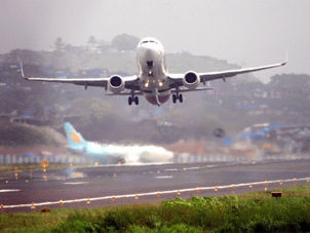
Jet Airways enters into code share agreements with Air France, KLM

June 18, 2013

Jet_AirwaysNew Delhi, Jun 18: Jet Airways and European carriers Air France and Royal Dutch Airlines (KLM) have entered into a code share agreement to provide seamless connectivity to passengers for destinations in India and Europe.

As per the agreement, Air France (AF) and KLM can place their own codes (AF) and (KL) on Jet Airways domestic flights for providing connectivity to three major Indian cities beyond South Indian city of Bengaluru, Delhi and Mumbai.

Code share is a commercial agreement between two or more airlines that share the same flight, with all the partnering airlines able to sell seats on that particular flight.

"Customers travelling from Europe to India on Air France flights will now be able to connect seamlessly with one ticket to Chennai via Bengaluru, Delhi and Mumbai, and to Kolkata, Hyderabad via Mumbai and Bengaluru.

"Likewise, KLM would place its marketing code (KL) on Jet's domestic flights to four major cities in India beyond Delhi, allowing passengers travelling from Europe to India to connect seamlessly to South Indian cities of Bengaluru, Chennai, Hyderabad and Western Coastal Indian city of Mumbai via Delhi," a joint statement issued by Jet and AF-KLM said.

The tickets are open for sale from Monday for passengers wanting to travel from June 19.

"We are delighted with this enhancement in our relationship with both Air France and KLM...The code share arrangements will allow our guests the convenience of enhanced connectivity from across Air France and KLM's networks via their European gateways in Paris and Amsterdam to key destinations throughout India," Chief Commercial Officer of Jet Airways, Sudheer Raghavan said.

Referring to the agreement, Dominique Patry, Air France's Vice-President, International Affairs and Alliances, said, "we are strengthening our presence in a key market following the code sharing agreement with Jet Airways."

Pieter Elbers, MD and Chief Operating Officer of KLM, said KLM is pleased with this important step in expanding the cooperation between Jet Airways and KLM.

"Being able to serve our customers an expanded network in India with four important domestic code share destinations is considered as key strategic value to our company," he said.

Air France-KLM have 27 weekly long-haul flights between Europe and India, while Jet Airways operates to 72 places in India and abroad including Abu Dhabi, Bahrain, Bangkok, Brussels, Dubai, Hong Kong, Jeddah, London, New York (Newark), Singapore and Toronto.

Comments

Add new comment

  • Coastaldigest.com reserves the right to delete or block any comments.
  • Coastaldigset.com is not responsible for its readers’ comments.
  • Comments that are abusive, incendiary or irrelevant are strictly prohibited.
  • Please use a genuine email ID and provide your name to avoid reject.
Agencies
May 22,2020

Kochi, May 22: During the nationwide COVID-19 lockdown, Kerala recorded the highest number of cyber attacks followed by Punjab and Tamil Nadu, a study by anti-virus software firm K7 Computing said on Thursday.

In a statement issued in Chennai, the company said its K7 Computing's Cyber Threat Report, a comprehensive analysis of cyber attacks during the lockdown has found that Kerala recorded the highest number of cyber attacks during this period. The report analyses various cyber attacks within India during the pandemic and reveals that threat actors targeted the state with COVID-themed attacks aimed at exploiting user trust.

In Kerala, regions like Kottayam, Kannur, Kollam, and Kochi saw the highest hits with 462, 374, 236, and 147 attacks respectively, while the state as a whole saw around 2,000 attacks during the period - the highest thus far in the country.

This was followed by Punjab with 207 attacks and Tamil Nadu with 184 attacks, the company said.

The sudden surge in the frequency of attacks witnessed from February 2020 to mid-April 2020 indicates that scamsters across the world were exploiting the widespread panic around coronavirus at both the individual and corporate level.

These attacks aimed to compromise computers and mobile devices to gain access to users' confidential data, banking details, and cryptocurrency accounts.

The key threats seen during this period ranged from phishing attacks to rogue apps disguised as COVID-19 information apps that targeted users' sensitive data. Phishing attacks were noticed more in Tier-II and Tier-III cities while the metros fared better. Smaller cities saw over 250 attacks being blocked per 10,000 users.

Users from Ghaziabad and Lucknow seem to have faced almost 6 and 4 times the number of attacks as Bengaluru users.

According to the statement, a majority of the recorded attacks were phishing attacks with sophisticated campaigns that could easily snare even the most educated users. These attacks were aimed at heightening users' fears and creating a sense of urgency to take action.

K7 Labs noticed phishing attacks where scamsters posed as representatives of the United States Department of Treasury, the World Health Organization (WHO), and the Centres for Disease Control and Prevention (CDC), the company said.

Users were encouraged to visit links that would automatically download malware on the host computer such as the Agent Tesla keylogger or Lokibot information-stealing malware, infamous banking Trojans such as Trickbot or Zeus Sphinx, and even disastrous ransomware.

Other attacks included infected COVID-19 Android apps like CoronaSafetyMask that scam users with promises of masks for an upfront payment; the spyware app Project Spy; and seemingly genuine apps that are infected with dangerous malware like banking Trojans such as Ginp, Anubis and Cerberus.

"Covid-19 has created an ideal situation for various threat actors to target individuals and enterprises alike. The panic caused by the stringent lockdown measures and rapid spread of this virus has left many people looking for more information on the situation," J. Kesavardhanan, Founder and CEO of K7 Computing was quoted as saying in the statement.

"Threat actors exploit this fear to their advantage and scam users into downloading malicious software and divulging sensitive information like banking codes. The need to be cyber cautious has never been greater. This is more so in the case of corporates who have adopted a work from home policy hurriedly without adequate cyber hygiene. We have seen an increase in attacks on enterprises and SME employees as well," he added.

Such attacks are expected to continue till normalcy returns. Social engineering attacks targeted at winning users' trust will gain momentum.

Healthcare institutions, well-known government offices, and international organisations will continue to be a prime target throughout the pandemic, the statement said.

Comments

Add new comment

  • Coastaldigest.com reserves the right to delete or block any comments.
  • Coastaldigset.com is not responsible for its readers’ comments.
  • Comments that are abusive, incendiary or irrelevant are strictly prohibited.
  • Please use a genuine email ID and provide your name to avoid reject.
Agencies
July 2,2020

Leiden, Jul 2: Astronomers have discovered a luminous galaxy caught in the act of reionizing its surrounding gas only 800 million years after the Big Bang.

The research, led by Romain Meyer, PhD student at UCL in London, UK, has been presented at the virtual annual meeting of the European Astronomical Society (EAS).

Studying the first galaxies that formed 13 billion years ago is essential to understanding our cosmic origins. One of the current hot topics in extragalactic astronomy is 'cosmic reionization,' the process in which the intergalactic gas was ionized (atoms stripped of their electrons).

Cosmic reionization is similar to an unsolved murder: We have clear evidence for it, but who did it, how and when? We now have strong evidence that hydrogen reionization was completed about 13 billion years ago, in the first billion years of the universe, with bubbles of ionized gas slowly growing and overlapping.

The objects capable of creating such ionized hydrogen bubbles have however remained mysterious until now: the discovery of a luminous galaxy in which 60-100 percent of ionizing photons escape, is likely responsible for ionizing its local bubble. This suggests the case is closer to being solved.

The two main suspects for cosmic reionization are usually 1) a population of numerous faint galaxies leaking ~10 percent of their energetic photons, and 2) an 'oligarchy' of luminous galaxies with a much larger percentage (>50 percent) of photons escaping each galaxy.

In either case, these first galaxies were very different from those today: galaxies in the local universe are very inefficient leakers, with only <2-3 percent of ionizing photons escaping their host. To understand which galaxies governed cosmic reionization, astronomers must measure the so-called escape fractions of galaxies in the reionization era.

The detection of light from excited hydrogen atoms (the so-called Lyman-alpha line) can be used to infer the fraction of escaping photons. On the one hand, such detections are rare because reionization-era galaxies are surrounded by neutral gas which absorbs that signature hydrogen emission.

On the other hand, if this hydrogen signal is detected it represents a 'smoking gun' for a large ionized bubble, meaning we have caught a galaxy reionizing its surroundings. The size of the bubble and the galaxy's luminosity determines whether it is solely responsible for creating this ionized bubble or if unseen accomplices are necessary.

The discovery of a luminous galaxy 800 million years after the Big Bang supports the scenario where an 'oligarchy' of bright leakers emits most of the ionizing photons.

"It is the first time we can point to an object responsible for creating an ionized bubble, without the need for a contribution from unseen galaxies.

Additional observations with the upcoming James Webb Space Telescope will enable us to study further what is likely one of the best suspects for the unsolved case of cosmic reionization," said Meyer.

Comments

Add new comment

  • Coastaldigest.com reserves the right to delete or block any comments.
  • Coastaldigset.com is not responsible for its readers’ comments.
  • Comments that are abusive, incendiary or irrelevant are strictly prohibited.
  • Please use a genuine email ID and provide your name to avoid reject.
Agencies
June 18,2020

New Delhi, Jun 18: Vodafone Idea on Thursday told the Supreme Court that it has incurred Rs 1 lakh crore losses as it insisted it is not in a position to furnish bank guarantees.

A bench comprising Justices Arun Mishra, S. Abdul Nazeer, and M.R. Shah, taking up the adjusted gross revenue (AGR) matter through video conferencing, directed the telecom companies to submit their financial documents and books for the last 10 years.

Asking Vodafone if it was a foreign company, the bench said that how can the company say it would not furnish any bank guarantee.

"What if you fly away overnight in future without paying anything?" it asked.

Senior advocate Mukul Rohatgi, representing Vodafone Idea, denied his client is a completely foreign firm and cited before the bench its tie-ups and investments.

Vodafone owes over Rs 58,000 crore as AGR dues and so far, has paid close to Rs 7,000 crore.

Rohatgi contended before the court that the telecom company is in a tough situation, and cannot furnish any fresh bank guarantee, as profits have eluded the company in past many quarters. He submitted before the bench that Rs 15,000 crore bank guarantees are lying with the government, and his client's losses are over Rs 1 lakh crore.

"I cannot offer any more surety," he informed the bench.

Justice Mishra noted that this is public money and these dues should be recovered. "Do not tell us that you will pay if you were to make profits... the money must come," he noted.

Justice Shah observed that the telecom industry is the only industry which earned during the Covid-19 pandemic. "After all, this money will be used for public welfare", he said.

Rohatgi argued that his client would have to fold up if orders were issued to clear dues tomorrow. "11,000 employees will have to go without notice, as we cannot pay them," he added.

Senior advocate Abhishek Manu Singhvi, appearing for Bharti Airtel, contended before the court that out of Rs 21,000 crore AGR dues, the company has already deposited a sum of Rs 18,000 crore.

He argued that his client has given a bank guarantee, in excess of demand, to DoT, and supported the proposal for phased repayment of remaining AGR dues. He insisted that the company needs to sit down with the government and calculate the dues. Airtel owes Rs 25,976 crore after paying Rs 18,000 crore, as per the government.

Senior advocate Arvind Datar, representing Tata Telecom, informed the bench that his client has paid Rs 6,504 crore in AGR dues so far, and furnishing a bank guarantee may adversely impact investments in the sector.

The total AGR dues are close to Rs 1.5 lakh crore.

The top court will now take up the matter in the third week of July.

Comments

Add new comment

  • Coastaldigest.com reserves the right to delete or block any comments.
  • Coastaldigset.com is not responsible for its readers’ comments.
  • Comments that are abusive, incendiary or irrelevant are strictly prohibited.
  • Please use a genuine email ID and provide your name to avoid reject.